

New name, expanded mission: The Diaper Bank of Southern Arizona has joined forces with the Diaper Bank of Central Arizona to become the Arizona Diaper Bank.
Additionally, as of 2018, the Diaper Bank added distribution of menstrual hygiene products to its inventory of diapers and adult incontinence supplies.
“A lot of people don’t realize that we distribute period supplies. I can tell you that the statistics relating to period supplies are terrible: One in four women in Arizona report missing work or school because they can’t afford feminine hygiene products,” said aid Krista Hinman, Marketing and Business Outreach Coordinator for the Arizona Diaper Bank. “The rough estimate is that $27.5 million in wages are lost every month — or $330 million every year — in Arizona because of this problem,”
Hinman emphasized that the majority of women who struggle with the problem work in low-income positions and live at the poverty level, and ultimately, all taxpayers are impacted.
People are also reading…
To combat the issue, the nonprofit is promoting Period Poverty Awareness Week from May 21-28. Spearheaded by Supervisor Adelita Grijalva, the event offers education and outreach and seeks to collect feminine hygiene supplies through Period Product Drives at her office, 33 N. Stone Ave.
Local women-owned businesses, the YWCA of Southern Arizona, government agencies and libraries throughout the city will also serve as collection sites.
Additionally, many local volunteer groups and service organizations will support the event, according to Terri Tellez-Baker, President of the Junior League of Tucson.
The Junior League, which has a long history of volunteerism with the Diaper Bank, became champions of menstrual equity in 2022. In addition to staging product drives and raising funds to support the Diaper Bank initiative, the Junior League has advocated for removal of state sales tax on menstrual hygiene products.
“It was interesting that when we started talking to friends, family members and colleagues about menstrual equity, a lot of folks didn’t know it was even a problem,” said Tellez-Baker. “It has become really important to us because of the low-income teens and women it supports ... and after all, what woman hasn’t been caught off-guard without a menstrual product at some point? It made us think about how one little issue can spiral into other problems that non-menstruators don’t have to deal with.”
Garnering donations — and raising funds — for the Diaper Bank is extremely rewarding, according to Tellez-Baker.
For every $1 donated, the Diaper Bank can distribute $3 worth of period supplies, incontinence supplies and diapers in the community. Since babies use between 10-12 diapers daily and adults require a similar number of incontinence supplies, any savings has a big impact, according to Hinman.
“The adults we serve are on very fixed incomes, and, unlike with babies, the need for these supplies doesn’t stop in a few years,” Hinman said. “Many adults deal with this on an ongoing basis and they have to choose between buying incontinence supplies and other basic needs. Many become homebound because supplies are so expensive, and some are forced to go into adult care when their families can’t deal with it themselves.”
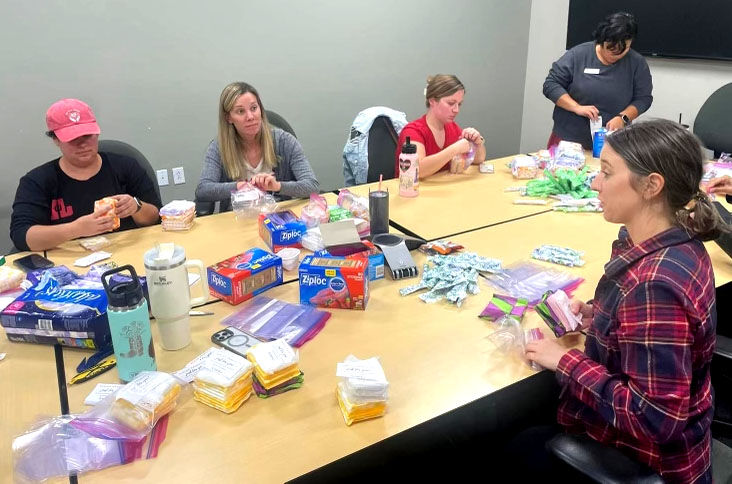
Tellez-Baker encourages team-building organizations and volunteer groups to consider providing hands-on support at the Diaper Bank warehouse located at 1050 S. Plumer Ave. Assistance is needed with organizing, bundling and distributing supplies, which are available for free from 9 a.m. to 3 p.m. every Monday, Wednesday and Friday. Those in need can visit once a month; identification, documentation regarding low-income status and proof of guardianship for children is needed. The Diaper Bank also distributes supplies through more than 40 partners, including social service agencies, faith-based organizations, senior centers, school programs and more.
Last year, more than 3.3 million diapers, 301,167 incontinence supplies and 220,949 period supplies were distributed.
“When you go in the warehouse and see the sheer volume of diapers and other products that are distributed to the community, it is just so impactful,” said Tellez-Baker, who finds it personally poignant as the mother of children ages 5, 3 and 1.
She said she can imagine what it would be like to be unable to afford diapers, incontinence supplies and female hygiene products, particularly since the cost of these supplies are not covered by safety nets and government programs such as Supplemental Nutrition Assistance Program (SNAP) and WIC.
“I don’t think the need is talked about enough. I love what the Diaper Bank is doing to be the bridge that helps families in need,” Tellez-Baker said.
Visit isit https://diaperbank.org/ to support Period Poverty Awareness week.


