

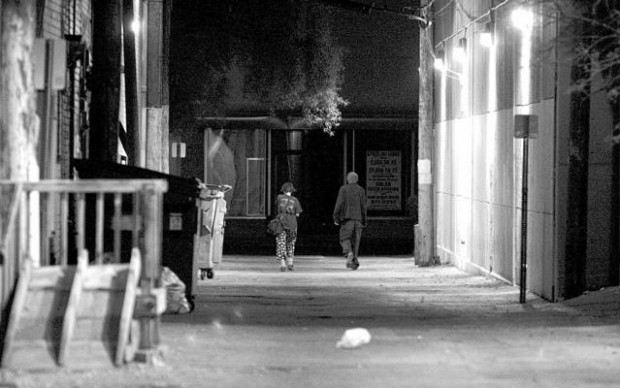
If you're seeing fewer homeless people Downtown these days, look up.
That's what Asylum nightclub owner Stephen Holder did a few months ago. As Holder emerged from his Congress Street cabaret he noticed a man camping out in a tent on his neighbor's rooftop.
Unfortunately for Elizabeth Mead, owner of the Silver Sea jewelry store, she didn't look up soon enough.
"Somebody was living on the roof and using the drain pipe as a trash can," Mead said. As a result, on the Friday before Christmas, 55 gallons of water crashed through her roof, shutting down her business for the day.
Holder and Mead are among a number of Downtown merchants discovering they're frequently, and unknowingly, sharing their buildings with some uninvited guests.
In recent months, dozens of homeless people — no one yet has a handle on how many — have taken to the rooftops, taking them off the street, out of sight and perhaps a little more out of harm's way. But in the process, they're subjecting the aging rooftops to damage, and the owners to concerns about such things as liability, theft, vandalism and repair costs.
People are also reading…
The water damage at the Silver Sea, near the corner of Sixth Avenue and Congress Street, was enough to inspire a cautionary note in the February newsletter for the Tucson Downtown Merchants.
"Be forewarned," the newsletter says. "This idea may be being copied by other homeless on other buildings."
Just how long homeless people have been sleeping on Downtown rooftops is unclear.
Officials with the city and the Tucson Police Department said they had never heard of such rooftop residents. But Margo Susco, who owns Hydra Leather and More, an alternative-clothing boutique on Congress Street, said that for the past few years it's been a regular occurrence.
"It very much exists," she said, adding that she checks her roof periodically.
The appeal for someone sleeping on a rooftop is hardly surprising. It's safe.
"Out of sight, out of mind," said Bob Stubblefield, who sleeps in a homeless camp near the Tucson Convention Center.
It's not uncommon, he said, to have rocks thrown at him or to be harassed by passers-by.
Stubblefield said he has been in the Tucson area for five years, and he's known others to sleep on rooftops.
He chooses not to because he's afraid he might fall.
"You have to go up, and find your way down," he said.
If one were looking for a rooftop to sleep on, the shops on the north side of Congress Street between Sixth and Scott avenues would be a natural choice.
They are only a few stories tall, and there is plenty of easy access from the alley. The rooftops rise and dip, making it hard to see people from the street.
For example, when Holder spotted the rooftop resident on his neighbor's property, he didn't at first see the person, he saw a tent.
"He had a tent and everything," Holder said. "But we got him out of here."
Mead, owner of the Silver Sea, said that to get on the roof most people shinny up a network of electrical boxes behind the Screening Room, an independent movie theater on Congress Street.
Wednesday and Thursday night, no one tried to climb to the rooftop, but there were certainly signs that people had in the past.
A small number of blankets, piles of garbage and empty beer bottles dotted the rooftops.
The phenomenon of people sleeping on rooftops comes at a time when Tucson's homeless population is growing. It's estimated at about 4,500.
For the city, the rise in population poses a particular challenge as officials try to buck the perception of Downtown as an unsafe place with a high concentration of homeless people — something having homeless people sleeping on rooftops does not help to change.
In fact, Downtown has the lowest crime rate of any part of the city, accounting for about 5 percent of total calls from July through January of last year, police say. There are 70 police officers who work the area, some of whom patrol by bike or by foot.
"Without a doubt, the visibility of homeless in the Downtown area adds to the perception of crime," said Capt. Michael Gillooly of the Tucson Police Department.
"It's one of the top complaints that we hear from people who come Downtown," said Rio Nuevo Director Greg Shelko, speaking of the homeless population. "Perception is reality, as the saying goes."
In many ways Mead is emblematic of this dynamic.
She moved her business from Tucson Mall to Downtown three years ago hoping to ride the Rio Nuevo wave to prosperity. She had about 800 customers who were willing to follow her to Downtown. These days, about 20 of those clients are now coming to her store.
She said many have stopped coming because of aggressive panhandling, and she now posts signs outside her shop telling people not to panhandle or loiter.
She also lost quite a bit of business when the water damage forced her to shut down at the height of the holiday season.
"I don't even want to think about how much I lost," she said.
As such, she'd like to see more enforcement of the panhandling laws, which she thinks will limit the number of surprise rooftop residents and possibly filter the homeless into social service agencies.
She, Holder and Susco all said it's not that they don't care about the well-being of the homeless Downtown. They just wish the presence wouldn't cut into their businesses.
"Initially I didn't do anything about people camping out," Mead said of people on rooftops and people who camped in her store's recessed entrance. "The thing is, you have to deal with people in a humane way."

 Former Sam Levitz building sells for $8.6 million


