For the second year in a row, the Trump administration wants to zero out the funding for a University of Arizona-led asteroid mission that’s already flying through space.
The White House’s budget request for fiscal year 2027 includes a $3.4 billion cut to NASA’s Science Mission Directorate that would eliminate nearly half of the space agency’s science fleet, according to an analysis by The Planetary Society.
The nonprofit advocacy group for space exploration identified 53 science missions facing termination, including the U of A’s OSIRIS-APEX space probe that is currently streaking through the inner solar system en route to a rendezvous with the asteroid Apophis in 2029.
People are also reading…

The Tucson-born OSIRIS-APEX spacecraft appears with its home planet in a "selfie" the robotic probe took as it swung past Earth on Sept. 23, 2025. Funding for the extended mission is now under threat from the Trump administration.
“The consequences of these cuts are immense, resulting in the loss of approximately 2,000 additional civil servant jobs at NASA, primarily in science, and billions of dollars of economic benefits evaporating from states like Arizona, which have competed and earned very competitive and significant funding for science projects,” said Casey Dreier, chief of space policy for The Planetary Society.
OSIRIS-APEX is a $200 million extended mission using the same spacecraft from NASA’s 7-year, almost $1.2 billion OSIRIS-REx project, which briefly touched down on the asteroid Bennu in 2020 and delivered samples back to Earth in 2023 before jetting off on its next asteroid encounter. The principal investigator in charge of OSIRIS-APEX is geophysicist Dani Mendoza DellaGiustina, a U of A graduate turned assistant professor who served as deputy principal investigator for OSIRIS-REx.
Other new and extended NASA missions with ties to the university are also on the chopping block, including the still-in-development VERITAS spacecraft destined for Venus, Juno currently in orbit around Jupiter, New Horizons in the Kuiper Belt near Pluto and Mars Odyssey and MAVEN at the Red Planet.
Historic cuts
The Trump administration tried to do the same thing to OSIRIS-APEX last year, but Congress eventually restored a portion of the mission’s funding, after some lobbying by DellaGiustina and other university officials and key help from Republican Rep. Juan Ciscomani and Democratic Sen. Mark Kelly.
DellaGiustina will be fighting for a similar outcome this time around.
“I hope that, as with the FY26 appropriations process, we will see both the House and Senate show strong bipartisan support for APEX, given the mission’s continued scientific value, the significant investment already made in the spacecraft and operations, and the unprecedented opportunity to encounter Apophis during its close approach to Earth,” she said.
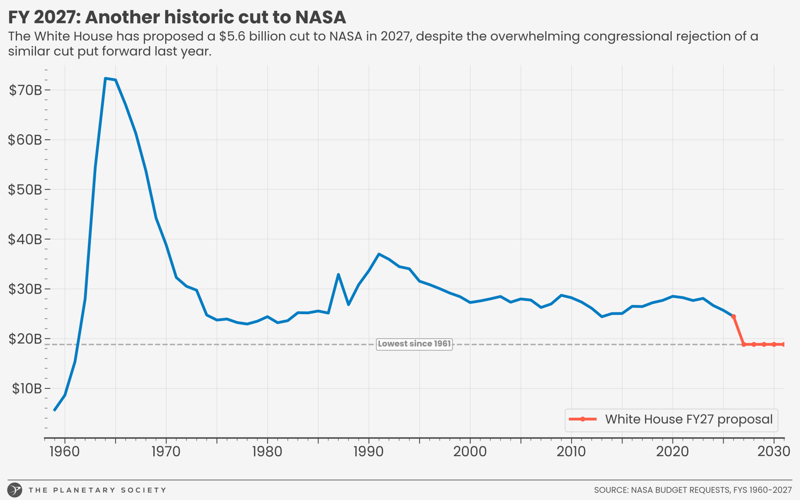
Dreier said the White House is proposing a historically large, $5.6 billion reduction to NASA’s overall budget that, when adjusted for inflation, would effectively return the agency to its 1961 funding level.

According to The Planetary Society, the Trump administration's proposed cuts to NASA for fiscal year 2027 would effectively return the space agency to its 1961 funding level.
The Planetary Society is calling it “an extinction-level event for space science.”
Trump’s Office of Management and Budget proposed comparable cuts last year that were mostly ignored by the lawmakers ultimately in control of the purse strings. This time around, Dreier said, the spending plan was drafted to make the elimination of entire projects difficult to track.
“This is the least transparent NASA budget request I've ever seen, and I've literally looked through every single one since 1960,” he said. “This budget hides nearly every science mission termination. The only way to find if a project is proposed as cancelled is to compare the list of projects in the FY 2026 budget request to the list in FY 2027 and look for the omissions.”
Dreier added that every NASA budget since 1961 has included prior-year spending levels for each program, but OMB excluded that information this year, “making it impossible to assess if a proposed funding level is a decrease from the baseline.”
Fortunately, he said, the House appears poised to once again reject most of the administration’s cuts, though NASA’s science directorate could still face a 17% reduction in funding.
“We have not yet seen details released on how that would impact specific missions,” Dreier said. “We should know more details of their budget next week, after the full appropriations committee markup scheduled on May 13.”
On defense
Already, Arizona’s senior senator is pushing back on at least some of the proposed cuts.
Last month, Kelly, a retired NASA astronaut, signed onto a letter with three other Democratic senators calling on leaders of the Senate Appropriations Committee to boost funding for Mars exploration, including at least $400 million for a planned mission to bring back samples from the planet’s surface.
“NASA’s Mars missions demand world-class, cutting-edge technologies developed through decades of experience, technical leadership, and relentless innovation,” the April 13 letter states. “The specialized workforce, infrastructure, and expertise required to achieve them cannot be quickly reconstituted and if lost, it would take many years to rebuild.”
After last year’s budget scare, DellaGiustina said what helped save her mission was its planetary defense applications.

University of Arizona geophysicist Dani Mendoza DellaGiustina is principal investigator for NASA's OSIRIS-APEX asteroid mission.
Apophis is roughly the size of the Empire State Building, and when it narrowly misses Earth on April 13, 2029, it will be close enough to be visible at night over parts of Europe and North Africa.
OSIRIS-APEX should reach the asteroid about two months later, so it can enter into orbit and study it in detail, including observing any possible changes caused by its close encounter with Earth’s gravity.
There are even plans to stir the surface of Apophis with the thrusters and prod it with the sampling arm on the space probe the size of a passenger van.

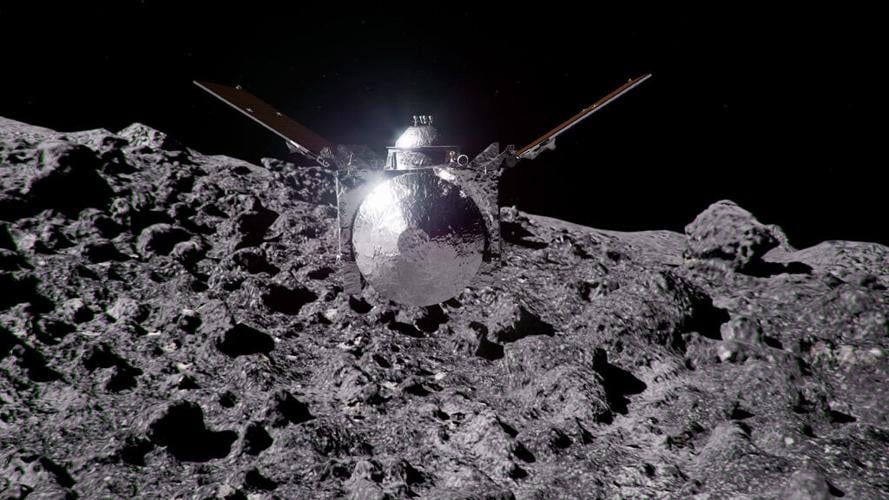
A NASA animation shows the spacecraft now known as OSIRIS-APEX as it prepares to use its thrusters to stir the surface of asteroid Apophis in a maneuver scheduled for September of 2030.
As DellaGiustina explained last year, you have to understand the composition and behavior of a potentially killer asteroid like this one if you’re going to have a chance of protecting the planet from it someday. “You just can't learn about how these things respond to impulsive forces without going and poking them, so to speak,” she said.
Before that can happen, though, OSIRIS-APEX must navigate two more slingshot maneuvers around Earth and three more potentially damaging dips toward the sun starting in 2027.
That is, if the spacecraft survives its latest brush with danger: the budget drama back home.



 BioBlitzers catalog wildlife in U.S., Mexico as walls go up along border