

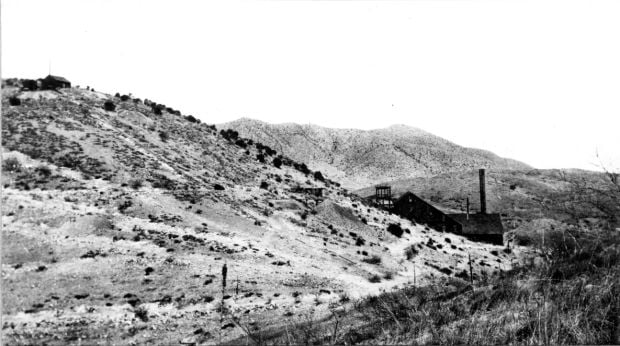
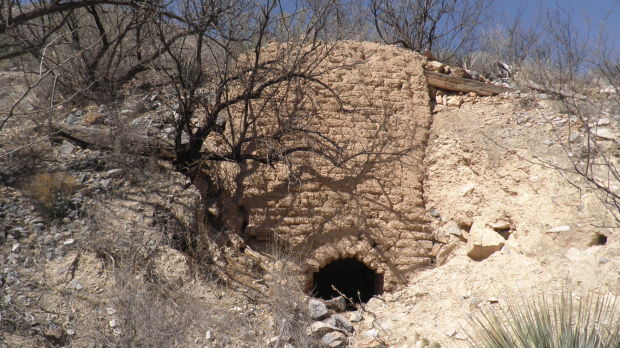
The Empire Mountains, 30 miles southeast of Tucson and stretching northeast from the Santa Rita Mountains, include several well-known mining properties, including the Total Wreck Mine, the Montana Mine and the Hilton Group Mines.
The mountains — 7 miles long and 4 miles wide — contain argentiferous lead and copper-bearing ores.
The mainline of the Southern Pacific Railroad was 7 miles north of the Empire Mountains at Pantano Station, and was accessible by wagon road during the 1880s.
The Montana Mine, also known as the Black Diamond, was discovered in 1890 by John Dement and Otto Schley, and was noted for its nearby gypsum deposits. Prior to 1940, 10 tons of sulfide ore averaging 9-percent copper were shipped from the property, located near the west end of State Highway 83.
The Hilton Group Mines, named after rancher H.P. Hilton and located 3 miles southwest of the Total Wreck Mine, were discovered in the late 1870s. More than 1.65 million pounds of high-grade oxidized lead and more than 300,000 pounds of zinc ore — valued at $161,000 — were mined there, mostly between 1928 and 1948.
People are also reading…
The Chief, Gopher, 49 and Prince mines were the highest-producing mines in the group.
The Total Wreck Mine was discovered in 1879 by John T. Dillion — an employee of Vail namesake Walter L. Vail — who pronounced the bolder-strewn landscape surrounding the future mining property a “total wreck.”
The mine, at an altitude of 4,600 feet, was acquired by the Empire Mining and Development Co. upon the arrival of the railroad and after several years of litigation.
A 70-ton milling plant ran at the site from 1881-82, supplied by water from nearby Cienega Creek.
The Boss continuous process was partly implemented there, reducing manual labor for the amalgamation of silver ores. The rich surface ore played out and silver prices dropped, causing mining to be suspended by the end of 1884.
The property was sold for taxes and acquired by E.L. Vail and Co. C.T. Roberts, and later E.P. Drew, worked the mine in the early 1900s for several thousand tons of low-grade ore from old workings.
The nearby Total Wreck camp included several general stores, hotels, saloons, Chinese laundries, a butcher shop, brewery and lumberyard. Reaching a maximum population of 200, the camp’s post office, established on Aug. 12, 1881, lasted until Nov. 1, 1890.
The area had its share of turmoil. An Apache raid on the west side of the nearby Whetstone Mountains in June 1883 resulted in the death of six Mexicans hired to cut wood to fuel the Total Wreck Mill. In a separate incident, E.B. Salsig was shot in the chest by an antagonist on the Total Wreck property, but his life was spared when the bullet lodged in a packet of love letters in his vest pocket from his future wife.
The Total Wreck Mine is credited with having produced $520,000 in high-grade silver between 1880 and 1930, and another half-million dollars in lead, copper and gold. It was the only gold ore deposit of significant size in the Empire Mountains.
By 1915, the Total Wreck Mine consisted of 5,000 feet of workings, including shafts, tunnels, drifts, inclines, stopes and winzes. Today, a visit to the mine requires driving a high-clearance vehicle over formidable terrain on the gasline road.
Email Tucson author and historian William Ascarza at mining@azstarnet.com
Sources: H. Alberding (1938), “The Geology of the Northern Empire Mountains, Arizona”; Gregory P. Dowell (1978), “The Total Wreck: Arizona’s Forgotten ‘Bonanza’ Mine”; George Patrick Sopp (1940), “Geology of the Montana Mine Area, Empire Mountains, Arizona”; David Leighton, “A total wreck of a hillside became a silver mine that became a road,” Arizona Daily Star, Oct. 1, 2013; Frank C. Schrader (1915), “Mineral Deposits of the Santa Rita and Patagonia Mountains, Arizona.”



 Tucson official: Air Force won't pay for D-M groundwater cleanup now


