“Legendary” is a word used often in articles about Tucson criminal defense lawyer Robert J. Hirsh.
Due to the many high-profile defendants who walked free because of him, the word “notorious” comes up, as well.
Hirsh won acquittals in numerous prominent murder cases by using the insanity defense, for example, becoming a nationally known expert. The backlash included the Arizona Legislature changing the law.
He died Wednesday in Flagstaff, where he was living after retiring about a decade ago. He was 89.
“Bob was probably the finest criminal defense lawyer in the history of Tucson,” said his former law partner, Michael Piccarreta. “He was larger than life, first of all, and one of the most recognizable people in town.”
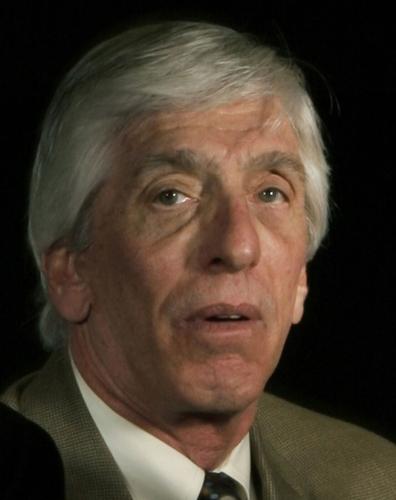
Lanky in his 6-foot-2 frame, fit from his passion for working out, with silver, Redfordesque hair and a big toothy smile, Hirsh cut a striking figure in courthouses, and in the downtown Tucson social scene after hours.
People are also reading…
“Tall, handsome and charismatic — he controlled the courtroom. You couldn’t take your eyes off Bob,” said local attorney Elliot Glicksman. “And no one was a better cross-examiner than Bob. Just with the inflection of his voice, witnesses would get flustered and angry. He’d exploit any inconsistency. And he’d come up with very creative theories.”
“He was the dean of the Tucson criminal defense bar for decades, and he was always the first choice,” Piccarreta said, joking about being the second choice for people needing a defense attorney.

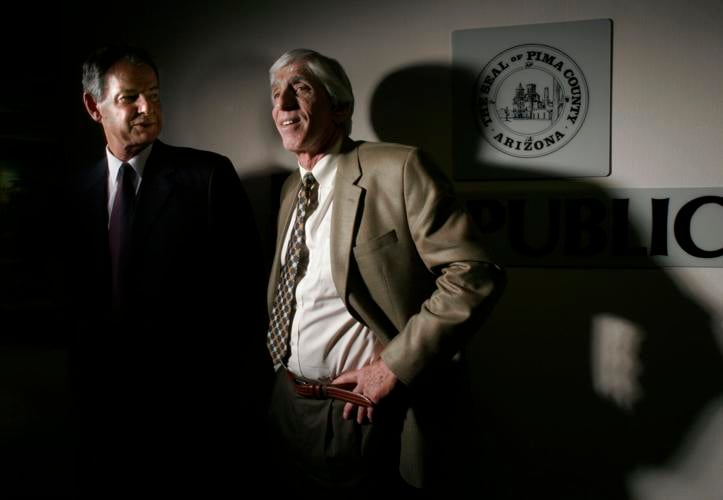
Then-Pima County Public Defender Bob Hooker, left, and Bob Hirsh, his chief deputy in that office, in 2005.
As the quickest wit and fastest thinker on his feet in most rooms, he could be arrogant. “He didn’t tolerate fools lightly,” Piccarreta said.
But Hirsh delighted in turning his full, magnetic charm on people, including jurors.
“He was a character with a compelling personality who attracted other people,” Piccarreta said, adding that he also used his good humor to connect with jurors. His longtime secretary, Catey Bartolucci, thinks his success with juries was also because “he was the kind of person who could talk to anybody.”
He also reveled in “winning the game,” his daughter Christine Hirsh-Putnam noted.
His biggest wins included:
— “Arizona’s most famous — or infamous — ‘sleepwalking’ case,” as Phoenix New Times called it. Stephen Steinberg of Scottsdale was accused of murdering his wife, Elana, in 1981. Hirsh called witnesses to testify Steinberg may have been sleepwalking or in a short-lived “dissociative” mental state when he stabbed Elana 26 times. Hirsh also shamelessly alleged Steinberg’s “Jewish American Princess” wife had driven him mad with nagging and spending too much money.
A jury found Steinberg not guilty on the grounds he was temporarily insane when he killed her. Because he was deemed “sane” at the time of his acquittal, Steinberg walked out of court a free man. The trial became a book, “Death of a Jewish American Princess” by Shirley Frondorf.
— A Tucson jury’s acquittal of Mark Alan Austin on murder and attempted murder charges, by reason of insanity. Austin slashed his estranged wife, Laura Griffin-Austin, to death and nearly killed her boyfriend in 1989.
The prosecution argued that Austin, angered by his wife’s revelation that she was involved in a sexual relationship, went to her house intent on the attack. She had moved out of the couple’s university-area house two months before. The prosecutor contended Austin was not insane, but was drunk; testimony showed he had up to nine beers and half a bottle of wine in the hours before the attack.
But Hirsh told the jury, “This whole thing is a Shakespearean tragedy.” He said Austin was driven to insanity when he peeked through a bedroom window and saw Griffin-Austin and her boyfriend having sex. What the prosecution said showed premeditation actually showed his client was in the throes of psychosis, he said.
“I know everybody believes I’m a terrible scoundrel, but I really believe he was crazy,” Hirsh told the Arizona Daily Star after the acquittal. He said the isolated pieces of the case pointed to a sinister act committed by Austin, but taken in its totality, “This guy was crazy.” And it is a fact, he said, that “people go crazy.”
One of Hirsh’s former clients, Larry Pace, dropped by the courtroom to hear his closing argument in the Austin case, the Star reported. Pace was an Air Force sergeant at Davis-Monthan in 1977 when he was accused of murdering his wife and two daughters and then setting a fire as a cover-up. Hirsh got him acquitted.
Austin was released after serving the required 120 days in Arizona State Hospital. That case was the one that led to the change in Arizona law on insanity defenses.
Laura Griffin-Austin’s grieving parents, Barbara and Robert Griffin, launched a political action committee to reform the legal system they said let Mark Austin escape punishment. After studying insanity-defense laws in every state, the Griffins proposed changes to the Arizona Legislature that Robert said would “assure that people who are sane do not use this as a backdoor to escape. ... (This) is anathema to the idea of justice.”
Since 1994, under “Laura’s Law,” judges have had to impose “guilty but insane” sentences in cases that formerly fell under the old “temporary insanity” model. Now, a person found guilty but insane must serve a sentence at a mental institution that may be as long as if they were sentenced to prison.
Hirsh said at the time, “I think it is very bad law and politics to respond to one case. We’re doing a disservice to a wide range of mentally ill people who may be accused of crimes in the future.”
— The successful defense of David L. Grandstaff, who was acquitted of the $3.3 million robbery of a Tucson bank in 1981. The verdict came despite the sworn testimony against Grandstaff of a man who was serving 20 years for his part in the robbery. Then-former Arizona Daily Star reporter Debra Weyermann wrote a book about the case, “The Gang That Couldn’t Shoot Straight.”
— His defense of the Rev. John Fife, co-founder of the Tucson-based sanctuary movement, which opened churches to people its advocates saw as refugees from political violence in Central America. Fife was tried along with 10 other church workers in Tucson.
Hirsh told the jury the sanctuary movement was a church ministry of “good people” working openly and not a criminal conspiracy, the Los Angeles Times reported. He accused the federal government of trying to “sinisterize” the sanctuary movement to make it appear criminal, and of paying a disreputable undercover informant to gather evidence.
Though Fife was found guilty of three counts of smuggling Central Americans into the U.S., he served no prison time. The trial was considered at least a public relations victory for the movement, in that “the government wanted to silence” Fife but in fact “gave him a megaphone,” Piccarreta said.
Piccarreta, who was on the defense team with Hirsh, says they offered to do it pro bono but the trial dragged on for six months, so a legal defense fund was created and they did receive compensation, “enormously reduced.” “We would never have taken a penny from those wonderful people,” he said. “They were honest, honorable, righteous people, and it was an honor to represent them. I know Bob felt that way.”
Two of Hirsh’s three children, Hirsh-Putnam and Jon Hirsh, joke affectionately that no matter how many killers, reputed Mafiosos (Joe Bonnano, “Bats” Battaglia and Peter Licavoli) and nude bars (First Amendment issues) their dad represented, they could always tell each other, “But he did the sanctuary case.”
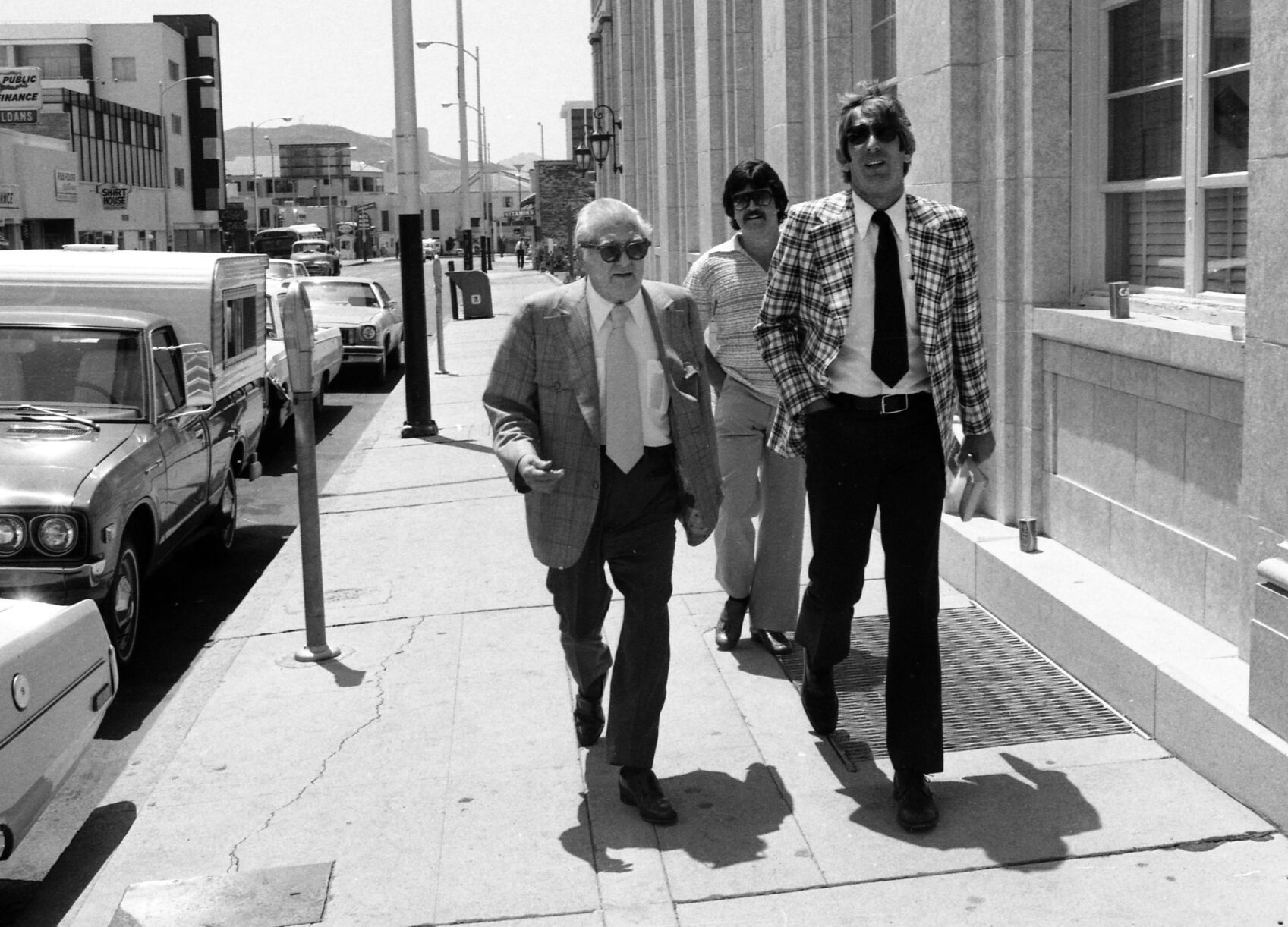
Bob Hirsh's clients over the years included reputed Mafia figures who relocated to Tucson, including Joseph Bonnano, "Bats" Battaglia and Peter Licavoli Sr. Here, Licavoli, left, enters the U.S. Courthouse in Tucson in 1976, with Hirsh and an unidentified man. Licavoli pleaded not guilty to possessing a stolen 16th-century painting at his Tucson ranch.
“’Look, Christine, I’m really on the right side of this one,’” Hirsh-Putnam remembers him saying.
Of course, he always believed to his core that he was on “the right side,” she and others emphasized, in the sense that “he believed in people’s right to a fair trial and a good defense,” as Bartolucci said. “He just fiercely wanted to support the Sixth Amendment,” which guarantees that right.
Glicksman put it this way in a Facebook post this week: “Many people disliked Bob for defending criminals. However like all criminal defense attorneys, Bob upheld all of our constitutional rights. For if it’s easier to convict with less than proof beyond a reasonable doubt it will be easier to convict the guilty but more innocent people will be convicted as well.”
“He was vilified for a lot of the cases he had and that he prevailed in,” his secretary Bartolucci said.
He was loathed by prosecutors and by victims’ rights advocates; he often blamed victims for what happened to them.
But he was loyal and caring to his clients, said his former colleagues. Bartolucci said he taught her a major life lesson, “to look beyond and become familiar with the real person. Don’t just pass judgment on people too quickly.”
Piccarreta said Hirsh had a wider variety of clients than the famous cases might suggest, including business people, first-timers in the system and “working folk.” “He was wringing a little bit of justice out of a system that was in many instances devoid of it,” he said.
“If Bob had ever decided to charge market value for his services, he would have been paid multiples of what he received,” he added.
Part of what made him exceptional was that “Bob would routinely break the rules” lawyers are trained to adhere to, such as “’don’t ask a question you don’t know the answer to’,” Piccarreta said. “But then he would take their answer and skewer them.”
For the latter part of his career, Hirsh was Pima County’s public defender from 2008-'12, mentoring and coaching an office of younger lawyers and advancing criminal justice reform. That work — like the sanctuary defense and the mentorship he provided throughout his career — he found especially rewarding, Hirsh-Putnam said.

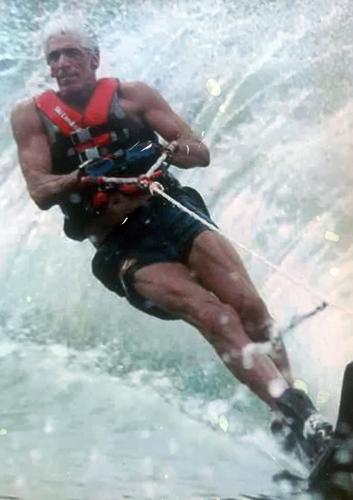
Bob Hirsh was committed to fitness, working out and taking his children and grandchildren on adventures. His son Jon became a river runner in Moab, Utah, in fact, because of the trips he took with his dad.
Through all of this, Hirsh “lived life fully, enjoyed life fully,” Piccarreta noted. “He was always the master of ceremonies at parties and a master storyteller.”
Hirsh married twice. But back when Glicksman worked with him, circa 1979-’81, “he was a single, swinging guy. He owned Samaniego House,” a downtown bar and restaurant at the time, meaning he was a part owner but also that he held court there, so to speak. “That was where everyone was on Friday night, and he was the ringmaster,” Glicksman said.
Meanwhile, “I loved my dad for just being a great dad and grandfather,” said Hirsh-Putnam, adding that “he took us on many wonderful adventures.”
“And he was super generous with his money, always paying,” said her brother Jon. “He turned me on to river running and skiing, my two favorite activities that he did with us as kids. I became a river runner,” he said.
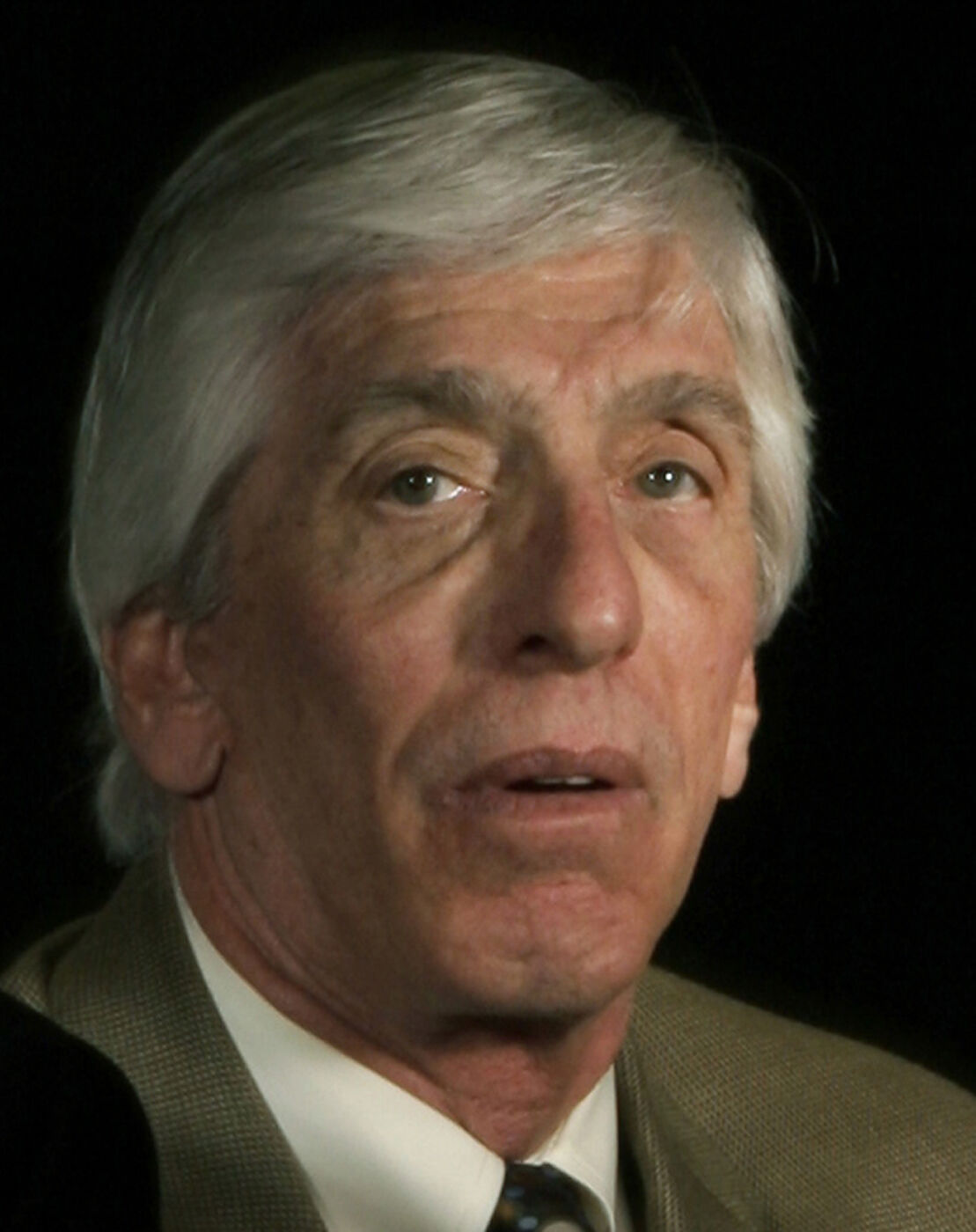
Bob Hirsh
Hirsh, who was born in Shamokin, Pennsylvania, moved with his family to Tucson when he was 10. He served in the Army and, after a tour in Germany, went to the University of Arizona (he was an avid Wildcats fan), earning his bachelor’s in 1960 and his law degree in 1964.
In 2022, the UA James E. Rogers College of Law awarded him its Lifetime Achievement Award.
His other awards included the Arizona Attorneys for Criminal Justice Vanguard Leadership Award, the Tom Karas Criminal Justice Award, the Pima County Bar Association Robert Hooker Criminal Justice Award and the UA Alumni Association Professional Achievement Award.
He is survived by sister Joan Rosenbluth (their brother, Sidney Hirsh, owner of Hirsh’s Shoes in Tucson, died in 2020); children Christine Hirsh-Putnam, Jon Hirsh and Thomas Hirsh; stepson Mark Stanoch; grandchildren Jacob, Rachel, Rio and Cheyenne, and great-grandchild Poppy.
The family plans to hold a celebration of life in Tucson this winter, with details to be announced.
Get your morning recap of today's local news and read the full stories here: tucne.ws/morning