

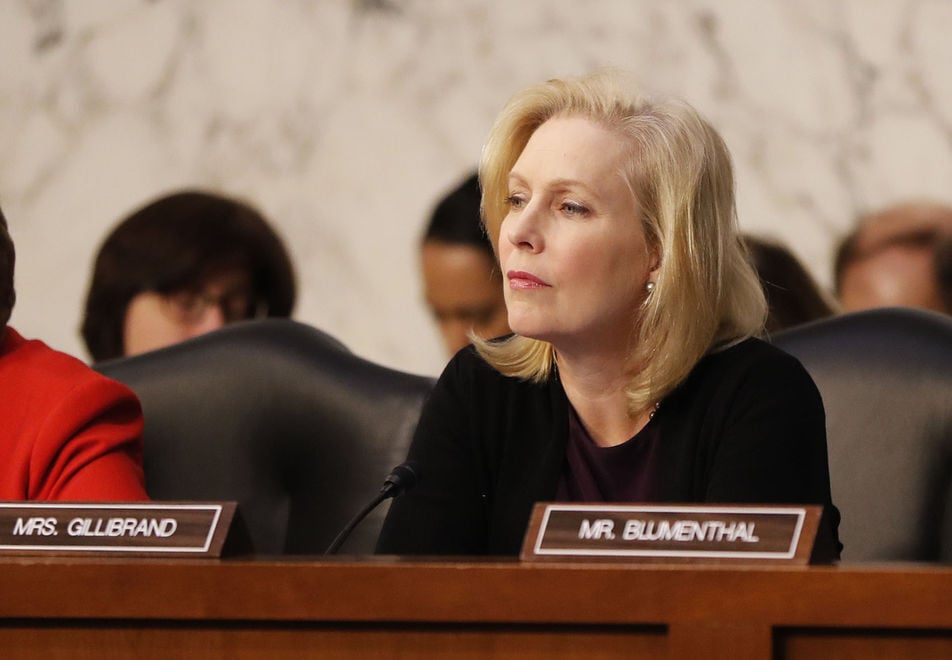
WASHINGTON – Sen. Kirsten E. Gillibrand may make it to the White House this year after all, for a bill-signing ceremony or two.
Two years after a Democratic presidential bid that gained no traction, New York's junior senator finds herself primed to witness the passage of at least one and maybe several of the measures she's been pushing for the better part of a decade. Her landmark restructuring of the military's approach to prosecuting sexual assaults is all but certain to become law. Meanwhile, several other measures that Gillibrand pushed before other Democrats did – paid family leave, enhanced child care, universal pre-K, a summertime expansion of the school lunch program – will become law if President Biden wins passage of his American Families Plan.
That would make 2021 the greatest year of accomplishment in Gillibrand's 12-year Senate career, but for Gillibrand, that's not enough. She's pushing a host of other measures, from offering banking services at the nation's post offices to providing three meals a day for the nation's school children – all while very publicly harboring ambitions for another presidential run.
People are also reading…
"I would like to run again someday in my future," she told The Buffalo News editors and reporters last month. "I don't know when that would be right, I don't know when I'd even have a shot ... But it's definitely something I hope to get to do again."
In other words, it's as if Gillibrand's failed presidential campaign left her energized, and more cheerfully striving than ever.
"These larger issues – I became more committed to bring people together around them because I saw that constituents all across the country had the same problems," Gillibrand said in a recent interview in her Capitol Hill office. "It just makes me more confident that I'm on the right track, of trying to fix these problems because people are suffering from them everywhere, not just in my state. So it makes me a more ambitious senator, which is good, and more certain that I'm on the right track, so it's helping me get things done."
Military justice reform
Gillibrand's one near-certain triumph this year will come when Congress passes, and President Biden signs, a measure that she first proposed in 2013: one that aims to deliver a genuine system of justice for the thousands of women and men who endure sexual assault and harassment in the nation's military.
Gillibrand proposed relieving commanding officers of the power to decide who should be prosecuted, and giving that power to trained military prosecutors instead. She quickly won the support of a majority of Senate Democrats and a handful of Republicans, but for years she remained far short of the 60-vote margin she needed to ensure that a filibuster wouldn't kill her proposal, which the Pentagon long opposed.
Year after year, Gillibrand kept at it, lobbying senators one-on-one. Each time she won a convert, she wrote that senator's name on a whiteboard in her office. And this month, she added the 60th and 61st name.
To hear Gillibrand tell it, that victory was born of political change and brute reality. Biden supports the measure, and when the commander-in-chief backs something, the Pentagon is more likely to follow. That's just what happened earlier this month when Gen. Mark Milley, chairman of the Joint Chiefs of Staff, reversed the Pentagon's stance on the issue.
Other top military leaders changed their position on the issue, too. Meanwhile, Gillibrand and a Republican friend, Sen. Joni Ernst of Iowa, tweaked the legislation slightly to help win over a few more Senate votes.
"Senator Gillibrand and I, of course, we worked on many other projects together," Ernst – herself a survivor of sexual assault in the military – said on CBS's "Face the Nation" recently. "This is a template. We want Americans to see that bipartisanship is alive and well. It takes friendships, it takes a lot of discussions, and certainly a partnership and finding compromise."
It takes patience, too, Gillibrand noted in an interview.
"You would never know when you first come to Congress that major change takes time," she said.
Help for families
Gillibrand's national platform has always been all about elevating women and families, but that national platform never got much of a hearing until lately. But now she's back in the Senate majority for the first time since 2014, and the measures she proposed a decade ago – such as 12 weeks of paid family leave, enhanced child care and universal pre-K – are Biden administration doctrine.
"Ten years seems to be a good amount of time to bring things to fruition," she said.
Gillibrand started modestly, dropping family-friendly bills like her paid leave proposal every two years to little notice and, in some cases, blatant disregard.
After she introduced that family leave bill several years ago, "one liberal Democratic senator literally said to me: 'This doesn't really seem like a priority right now'," Gillibrand noted.
All that started to change in 2016, when Sen. Bernie Sanders of Vermont – on a presidential debate stage with Hillary Clinton – endorsed Gillibrand's proposal for family and medical leave. As the Democratic Party moved left, it embraced what Gillibrand would eventually fashion into a "Family Bill of Rights" in her presidential campaign.
Much of what she proposed resurfaced in Biden's American Families Plan, so now Gillibrand's mission is to get that social legislation enacted into law. And she thinks she know how to do it: in one big package that combines traditional infrastructure investments – roads, bridges, broadband and the like – with what Gillibrand calls "soft infrastructure": programs that bolster families, particularly those at the lower end of the economic scale.
"If you are unable to do the entire structural rebuilding of our economy – doing both hard infrastructure and soft infrastructure – you've missed a generational opportunity to begin to rectify systemic inequality in this country," she said.
Passing such legislation will be difficult because Democrats don't have a vote to spare in the Senate. But passing such family-friendly reforms is closer than ever thanks in part to Gillibrand's efforts, said Christian F. Nunes, president of the National Organization for Women.
Noting Gillibrand's fight for paid leave, equal pay for women and a higher minimum wage, Nunes said: "She's really been the spearhead and the leader of really writing legislation that will provide empowerment and equity, and change the dynamics of the workforce."
Another run?
Sometimes it still seems as if Gillibrand is still running for something, even though she's not up for re-election until 2024. Every couple of weeks she'll have a high-profile news conference with another high-profile progressive. Recently, for example, she teamed up with Rep. Alexandria Ocasio-Cortez of the Bronx to push her postal banking proposal. Separately, Gillibrand teamed up with her longtime friend Jon Stewart, of Comedy Central fame, to promote her legislation to broaden benefits for veterans exposed to burn pits during their service days.
Gillibrand is running for something, sort of. Unlike other politicians, whose responses to questions about their presidential dreams tend to fall somewhere on the scale between coy and deceitful, Gillibrand has recently talked freely about her presidential ambitions to The Buffalo News – twice – and to Politico.
Reflecting on the White House bid she ended in August 2019, Gillibrand told The News in an interview: "I learned so much on that race and I think I benefited so much, so I would love to do it again someday. I would just like to do it and be successful, so I just have to wait to see when that time would be right."
The time clearly wasn't right in 2020. Facing off against a field of better-known Democrats and encountering some resentment for calling for the resignation of then-Sen. Al Franken, a popular progressive accused of inappropriately touching women, Gillibrand struggled to crack 1% in national polls.
That being the case, some find it odd that Gillibrand is so anxious to run for president again.
"It would be nice if she could get some other people talking about it other than herself," quipped James Campbell, a University at Buffalo political scientist and a Republican. "She's really not much of a player at this point. Maybe that'll change with these legislative successes, but I'm not sure those really are inspirational in the bigger sense, though they're very important."
Then again, nearly a quarter of America's presidents lost a race for the White House before they won one – including Biden, who won the presidency on his third try.
That's a precedent that's clearly on Gillibrand's mind.
"You know, Joe is a good example," she told The News' Editorial Board. "He never stopped trying."


