

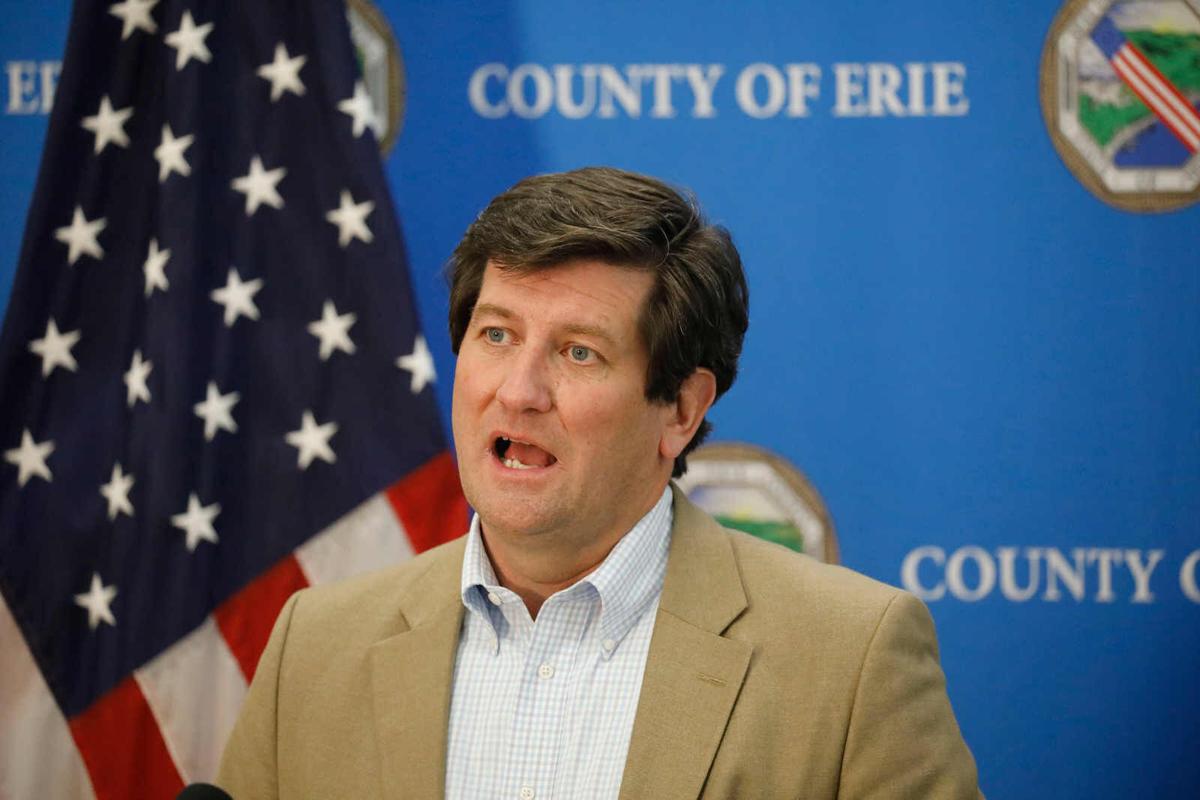
WASHINGTON – Erie County Executive Mark C. Poloncarz went to the White House this week to discuss the infrastructure funding windfall soon to land in communities nationwide, but he said he's not ready to weigh in on which big project or projects should be pursued in the Buffalo area.
"I don't want to make it sound like there's one or two projects the county is going to be focused on, at this point, when I believe that's more of a regional decision, especially when you're talking about these larger, potentially billion-dollar projects," Poloncarz said in an interview Friday.
A huge crowd gathered on the White House lawn Monday to witness President Biden signing a $1.2 trillion infrastructure bill that he called a victory for the American people.
Those bigger regional projects could include capping part of the Kensington Expressway or the extension of Metro Rail. Other longtime proposals, such as removal and replacement of the Skyway, appear to have fallen off Western New York's priority list.
And while Gov. Kathy Hochul and Rep. Brian Higgins, both Buffalo Democrats, have backed the Kensington project – which aims to reconnect the Humboldt Park neighborhood destroyed by the Kensington's construction decades ago – Poloncarz stressed that the Greater Buffalo-Niagara Regional Transportation Council will be the entity deciding which large-scale projects to seek.
People are also reading…
In saying that, Poloncarz was echoing the thoughts of Biden administration officials he met with at the White House on Thursday, including infrastructure czar Mitch Landrieu and his deputy, Samantha Silverberg.

Capping the inner-city section of the Kensington Expressway with parkland tops the governor's list of priorities for Buffalo-based infrastructure spending under the $1.2 trillion bill President Biden signed last month.
"They really stressed that your community, your county should be involved in your regional transportation planning organizations to help decide where those dollars go and what projects should be submitted," Poloncarz said.
Unlike the money doled out under the two huge pandemic-related economic stimulus bills, funding under the recently signed $1.2 trillion infrastructure bill will not go to localities in lump sums that they could spend largely as they see fit. Instead, much of the transportation funding under the bill will be parceled out to states, which will work with localities to decide which projects to fund.
However, $100 billion in infrastructure funding will be set aside for grants for projects in communities that will have to submit proposals spelling out why they should get the money.
"There are some projects that are just so large that you're going to basically have an opportunity to bid on it to show that it's a value to your region," Poloncarz said.
An estimated $4.2 billion in infrastructure funding is projected to come to the Buffalo metro area in the coming years, and much of it will likely fund smaller-scale road and bridge projects, the replacement of lead water lines and more robust broadband internet service.

"I'm talking about a vision that could dramatically change the whole waterfront environment over the next 24 months to three years," Rep. Brian Higgins said.
Meanwhile, Higgins wants to pair $65 million from a 2005 New York State Power Authority settlement with $124.5 million in infrastructure money for improvements to the Inner and Outer Harbors, along with parkways along Tifft Street and Louisiana streets to improve waterfront access.
"It's a very interesting proposal," Poloncarz said.
However, Poloncarz stopped short of fully endorsing the Higgins plan. The county executive noted that he is also interested in funding for the Renaissance Commerce Park at the old Bethlehem Steel site in Lackawanna.
While again stressing that the region will have to come together to decide how to spend infrastructure dollars, Poloncarz added: "Investing in the waterfront has always been, I think, a positive for our region."


