

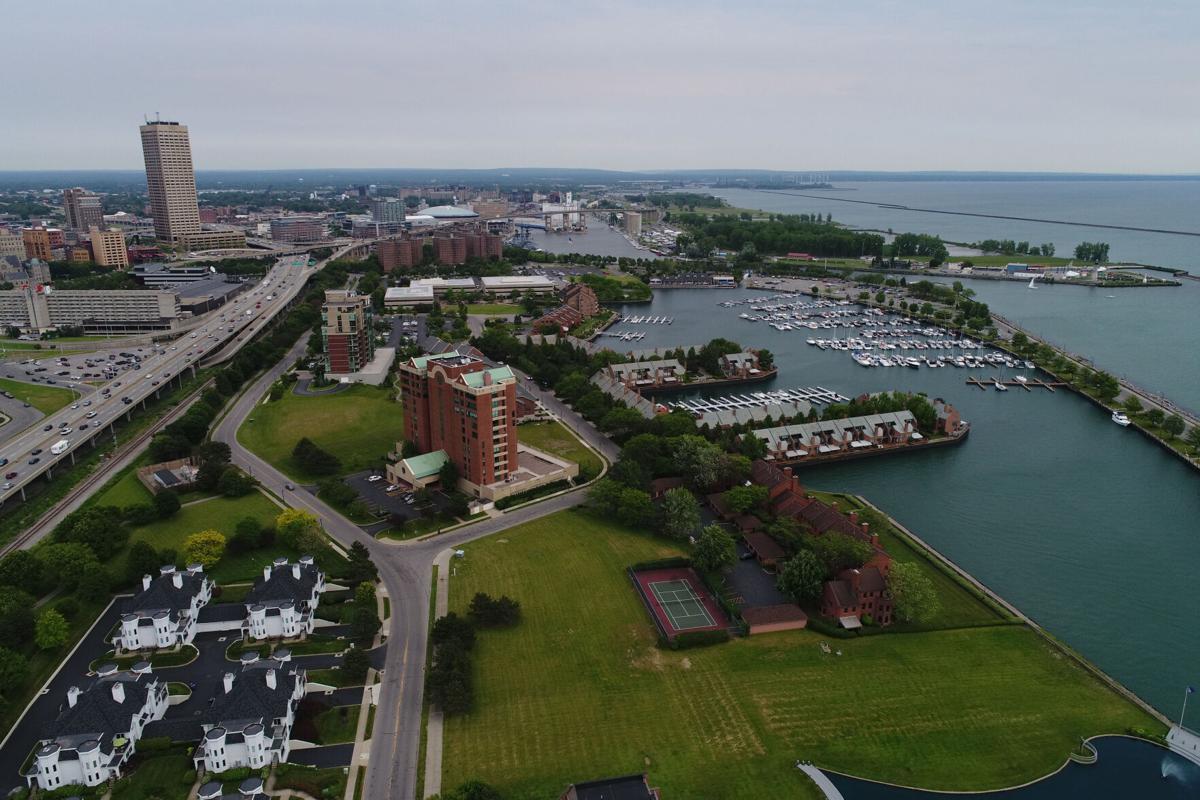
WASHINGTON – An Erie Basin Marina that doesn't look like a relic from the 1970s, but one that teems with visitors wandering down an expansive new boardwalk and visiting a new low-rise building with retail shops and maybe even affordable apartments.
A huge crowd gathered on the White House lawn Monday to witness President Biden signing a $1.2 trillion infrastructure bill that he called a victory for the American people.
A new waterfront park where the U.S. Coast Guard's facilities are now.
And new ways to get to the waterfront: parkways along Louisiana Street and Tifft Street.
Those are among the main components of Rep. Brian Higgins' vision for the next phase of Buffalo's waterfront development. They're part of a $189.5 million plan Higgins is proposing that also would revive the DL&W Terminal, build the Riverline pedestrian and bike access way in South Buffalo and install public art on the Buffalo River grain elevators.
To hear Higgins tell it, it's all easily paid for – through existing money and the infusion of tens of millions of dollars more through the $1.2 trillion infrastructure bill President Biden signed last week.
People are also reading…

"It's the largest infusion for infrastructure for Western New York certainly in 70 years and maybe even longer," said Senate Majority Leader Charles E. Schumer, a New York Democrat who compared the effort to the construction of the interstate highway system starting in the 1950s.
"I'm talking about a vision that could dramatically change the whole waterfront environment over the next 24 months to three years," Higgins said in an interview in his Washington office last week in which he presented detailed graphics spelling out his plan, which he developed with staffers in his office.
Higgins stressed that his waterfront plan was just part of what he's proposing for the use of new federal infrastructure money. He's also pushing a bus rapid transit plan for Bailey Avenue, the complete return of cars to downtown Main Street and a $500 million plan to restore Humboldt Park, among other projects.
But Higgins said his waterfront plans could be implemented more quickly than many other infrastructure projects – although they aren't his to implement. Large pieces of his waterfront plan depend on Gov. Kathy Hochul agreeing to send the Erie Canal Harbor Development Corp. $65 million from a 2005 New York State Power Authority settlement over the next two years instead of the next eight. The city would have to sign on to Higgins' proposal for the Louisiana Street and Tifft Street parkways, while state and federal officials would hold great sway over how other pieces of the infrastructure money would be spent.

Rep. Brian Higgins stressed that his waterfront plan was just part of what he's proposing for the use of new federal infrastructure money. He's also pushing a bus rapid transit plan for Bailey Avenue, the complete return of cars to downtown Main Street and a $500 million plan to restore Humboldt Park, among other projects.
So far, though, other public officials who are aware of Higgins' plans like what they see.
"The NYPA proceeds have made huge changes across the Buffalo waterfront, and expediting those funds and then tying those together with additional infrastructure money certainly would make a next round of significant impacts across the waterfront and the waterfront neighborhoods," said Steven Ranalli, president of the Erie Canal Harbor Development Corp. "So yeah, we are excited about the possibility to move even quicker."

A provision that's especially important to New Yorkers – restoring the full deduction for state and local taxes – remains in question.
A rebuilt waterfront
Money from the 2005 Power Authority relicensing agreement has already resulted in the construction of Canalside and several other major waterfront improvements, but Higgins – who pressed for the NYPA funding that fueled those earlier developments – has big plans beyond that.
At the Inner Harbor, the most noticeable change would be a $6 million reinvention of Erie Basin Marina, the first since it opened in 1974. Higgins envisions a 40-foot-wide boardwalk with decorative lighting replacing the narrow concrete walkway that's there now, along with new buildings to replace the concrete structures built there decades ago. He said those new buildings could include retail space and apartments, which would provide the city-owned facility with revenue for maintenance.
Higgins said one look at Erie Basin Marina proves that it needs a facelift.
"It's tired," he said. "The buildings don't work."
But redoing the marina is just part of what Higgins envisions for the remaining Power Authority money. In addition, his plan includes:
• 100 acres of new or improved parkland along the Outer Harbor, including a new park at the mouth of the Buffalo River where the U.S. Coast Guard's Buffalo facilities are now. (The Coast Guard already has plans to move its facilities just to the south, to a parcel along Lake Erie).
• Some $3 million in improvements to the Southern Gateway of Buffalo Harbor State Park.
• A $2.5 million public art installation on the grain elevators along the Buffalo River, modeled after a similar effort in Toledo, Ohio.
• A $3 million wheelchair-accessible trail through the Tifft Nature Preserve, which has long been planned but unfunded.
Higgins said it should be no problem for the Power Authority to provide funds for such projects earlier than planned. For one thing, he said the Power Authority has a $250 million cash surplus. For another, there is precedent for the Power Authority advancing the money it owes to the Buffalo waterfront: then-Gov. David Paterson agreed to do so in 2010, reducing the term of the Power Authority's waterfront payout from 50 years to 20.
Now, Hochul will have to decide whether to shorten the payout period even more and send $65 million to the Erie Canal Harbor Development Authority right away.
Asked about that possibility, Hochul spokesman Matthew Janiszewski said: “As a Buffalo resident, Governor Hochul has seen firsthand how investing in the waterfront has helped transform the city and the entire region, and she has long been a proponent of its continued revitalization. Governor Hochul will explore all options to help the waterfront reach its full potential.”

A move by House negotiators would restore the deduction for pretty much all middle-class homeowners and many wealthy ones, but it is by no means a sure thing.
Parkways and more
All that new waterfront parkland would be built without spending a dime out of the new federal infrastructure bill – which is likely to provide Buffalo with tens of millions more.
And Higgins said some of the first funding out of that bill ought to be used to complement the waterfront improvements by rebuilding Louisiana Street and Tifft Street as urban parkways similar to the recently reinvented Ohio Street.
"You're really creating new places along the water's edge, but you're also improving access to those places along the water's edge," he said.
Both streets are sorely in need of improvement, he said. The Louisiana Street bridge over the I-190 is deteriorating and needs to be replaced, so Higgins suggests spending $25 million in infrastructure funding to do that and to build a tree-lined bicycle and pedestrian pathway alongside a rebuilt roadway there. He also suggests spending $25 million to turn Tifft Street from a rugged, underused four lanes into a tree-lined, two-lane road with a turning lane that also provides a bicycle and pedestrian connection from South Buffalo to the waterfront.
Both are projects backed by Fair Apportionment of Infrastructure Revenue (FAIR), a group of local business leaders and citizens that pushes for Western New York to receive its fair share of infrastructure funding. Gary Hill, president of Union Concrete and Construction Corp. and a FAIR Committee board member, called Louisiana and Tifft "terrible roads" that could be improved to provide residents of the East Side and South Buffalo with far better connections to the Outer Harbor.
In addition, $10 million in federal funds remains from the aborted effort to replace the Skyway, and local officials either must use that money on related projects or return it. So Higgins is suggesting it be used at Louisiana and Tifft streets.
Beyond that, Higgins suggests using federal infrastructure money to:
• Build the $40 million Riverline, a 1.5-mile greenway envisioned for the abandoned DL&W rail line.
• Renovate the second floor of the DL&W Terminal into transit and retail space, a long-discussed project that would cost $30 million.
• Synchronize traffic lights on streets heading to the waterfront and elsewhere in the city to shorten commuting times and save energy.
All of that sounds good to State Sen. Timothy M. Kennedy, a South Buffalo Democrat and Higgins ally who chairs the State Transportation Committee.
"Our waterfront is everyone's waterfront: It is a regional asset, quite possibly our greatest regional asset," he said. "Any way that we can enhance not only our waterfront land, but the ways to get to and utilize our waterfront land, is a good use of resources."
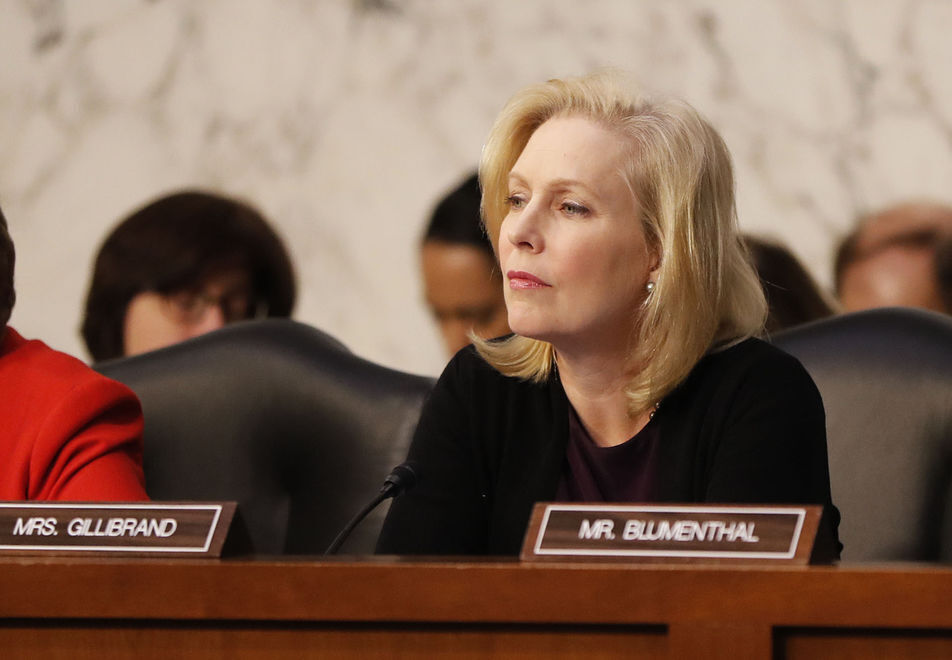
"This package will create jobs, boost our economy, deliver funding to rebuild New York’s aging infrastructure and help rebuild underserved communities," Sen. Kirsten E. Gillibrand said.
Other investments
Higgins stressed that his waterfront proposal was only part of his overall vision for transportation improvements under the infrastructure bill. He's also suggesting big investments in many other parts of the city and region.
In the short term, he's suggesting:
• A bus rapid transit project for the entire length of Bailey Avenue, which would include synchronized traffic lights, bike lanes and improved pedestrian access.
• Some $40 million in federal funds to be used to return cars to the rest of Main Street in downtown Buffalo.
• The completion of the Niagara Street reconstruction project, including the addition of bike lanes.
• Improving the Thruway interchange at Milestrip Road.
• Pedestrian improvements along Niagara Falls Boulevard in the Town of Tonawanda and Amherst.
• Completion of the River Way II Scenic Parkway Interchange in Niagara Falls.
• Other road projects in North Tonawanda, the City of Tonawanda and West Seneca.
The most ambitious project that Higgins and other local lawmakers are pushing – a $500 million restoration of Humboldt Parkway – would come later, and it may not happen at all. The infrastructure bill includes only $1 billion to reconnect communities divided decades ago by highways such as the Kensington Expressway, although funding for the Humboldt Parkway project may be available under other parts of the legislation.
For now, though, Higgins is focusing on improving the waterfront and access to it. And Buffalo Mayor Byron W. Brown thinks that is a good idea.
"It looks like a good vision," Brown said. "I think it's doable. The plan could lead to better waterfront access for all of Buffalo."
What's more, both Brown and Higgins stressed that the waterfront plan was only one part of what's likely to be a massive rebuilding effort stemming from the federal infrastructure bill.
"We want to have the greatest benefit for residents in every single section of our community," Brown said.


