

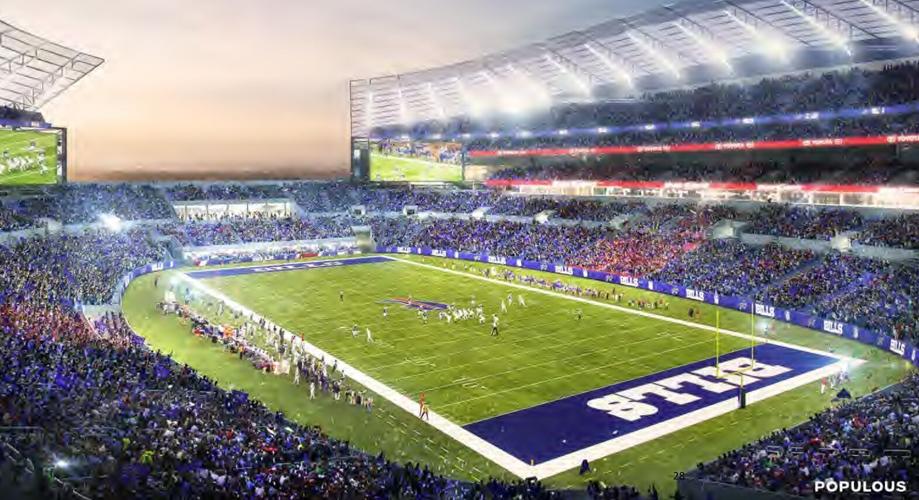
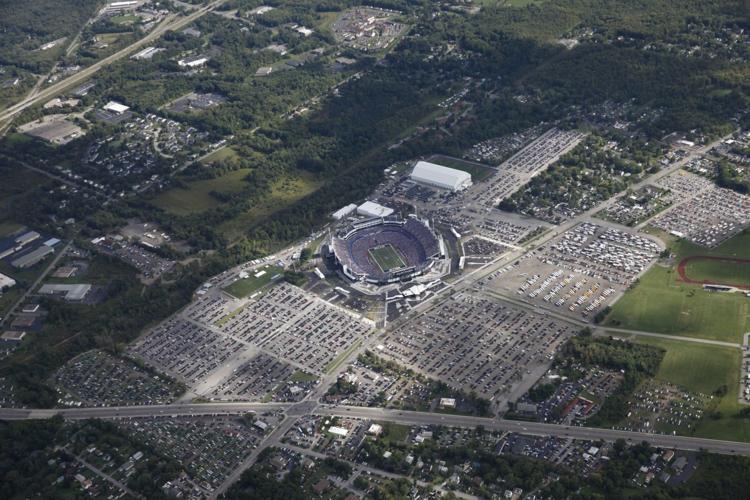
New York and Erie County on Monday provided some clarity on how much the public will spend on a new, $1.4 billion Buffalo Bills stadium in Orchard Park.
Erie County Executive Mark Poloncarz, for example, said property owners won’t see their taxes go up to pay for the county’s share of the costs.
But government officials left some specific questions unanswered.
The state and county will pay $850 million toward the stadium, which is the single largest amount of direct, upfront public funding for a National Football League stadium, surpassing the $750 million in public aid for the Las Vegas Raiders stadium.
With inflation, that $750 million committed in 2017 is comparable to the $850 million announced Monday.
Public funding would make up 61% of the cost of the new stadium, less than the 73% average public share of construction costs of NFL stadiums in smaller markets opened since 1998, a Buffalo News analysis found.
People are also reading…
Gov. Kathy Hochul, in announcing the stadium pact, said the public paid for 94% of the Cincinnati Bengals’ stadium, 91% of the Baltimore Ravens’ stadium and 86% of the Indianapolis Colts’ stadium.
“We’ve been negotiating a long time, driving a bargain that I believe is very beneficial to the taxpayers,” Hochul said in a call with reporters.
New York State
The state is investing $600 million upfront. This is money that will be included in the state budget that awaits final approval as soon as this week, Hochul's office said.
Asked how the state will fund this initial commitment, a Hochul spokesman said the money will come from a "mix of new and existing capital appropriations." He did not elaborate.
The state also has not released a proposed memorandum of understanding that would further break down the public funding commitment for the stadium.
In addition to directly subsidizing the cost of constructing the stadium, the state also would pay toward annual maintenance and repair costs.
This includes $6 million in annual state contributions to a capital improvement fund, for each of the 30 years of the stadium lease, and $6.67 million annually into a maintenance and repair fund over 15 years.
The governor’s office did not detail where the ongoing payments would come from, although the New York State budget already has an annual line item in it for capital improvements and other Buffalo Bills stadium costs.
All told, counting the upfront costs and continuing maintenance and repair costs, the state and Erie County commit to spending at least $1.13 billion on the new stadium.
Hochul said Monday the state’s investment in the stadium will pay for itself after 22 years. She noted the Bills generate $27 million annually in direct income, sales taxes and use taxes for the state, Erie County and local governments.
Those revenues will grow, as spending on team payroll grows, and will produce more than $1.6 billion over the 30-year lease, her office projected.
Negotiators, Hochul said, “made sure that it made sense for our taxpayers in terms of our commitment and our return on investment.”
Erie County
Erie County taxpayers should see no increase in property taxes with the stadium deal, even though the agreement calls for a $250 million county contribution, Poloncarz said.
“We can handle this through the dollars we have already," he said, adding, "Anyone who's saying this is going to raise my taxes – this will not raise your taxes."
The terms of the new deal would result in less cost to Erie County going forward than if the terms of the existing stadium lease deal were extended, he said.
The trade-off is that Erie County will no longer have any ownership stake. The state would become the new leaseholder and the Bills would be a tenant.
"I made my commitment to the people of Erie County that I was going to get us a fair deal, and I believe I have," Poloncarz said. "Erie County will no longer be in the football business.”
The $250 million in county money would be no more than 18% of the total estimated cost of a $1.4 billion stadium deal, he added.
Because the Bills would be responsible for covering all cost overruns, the public share of stadium construction costs may be smaller by the time the structure is built.
The county executive intends to allocate $75 million from the county's year-end budget surplus for 2021 to cover a portion of the $250 million cost.
That shouldn't burden the county since it estimates it will close its 2021 budget books with a surplus of more than $150 million. The remainder of the county share would be borrowed.
This borrowing isn't expected to raise property taxes because the county has retired roughly $130 million in prior debt service, including debt for Erie County Medical Center and the 2013 Bills lease deal, he said.
Under the earlier lease for Highmark Stadium, the county has borrowed up to $2.5 million a year since 2013 to support capital improvements to the stadium, not including other operating assistance.
Since Erie County would no longer own the stadium, the county wouldn’t be on the hook for any specific, future capital or operating assistance, Poloncarz said.
Erie County currently pays more than $6 million a year in operating and construction, renovation and maintenance-related assistance, he said.
That annual burden would go away. But the county would contribute to a capital improvement account funded through a new game-day stadium surcharge, essentially a tax added to tickets, concessions and other items sold at the stadium.
The specific surcharge amount must still be negotiated with the Erie County Legislature and ultimately collected by the county, Poloncarz said. The Bills estimate that surcharge could bring in up to $4 million a year in stadium revenue, he said, but that amount is not guaranteed and would fluctuate based on actual surcharge receipts.
"I think it's truthfully how it should be in the long run, that the attendees of the facility have skin in the game, so to speak, with ensuring the facility is a good facility," Poloncarz said.


