

A memorandum of understanding spells out some key details for a 30-year stadium deal for the Buffalo Bills.
While nonbinding, the 15-page MOU indicates what would be expected of New York State, Erie County and the Bills when a final deal is signed.
"This MOU will serve as the basis upon which all of the parties intend to proceed," the document states.
Here are 10 takeaways:
1. The nonrelocation provision is strong and "essential," but becomes less of a financial hurdle over time.
The stadium lease terms dictate the Bills remain at the new stadium for all 30 years. If the Bills leave within the first 14 years, the team would be on the hook for repaying all public contributions toward the stadium.
People are also reading…
But starting in the 15th year, the amount the Bills would have to repay declines in equal amounts each subsequent year for the remainder of the lease term until, by the 30th year of the lease, the payback amount would be zero.
If the Bills leave at any point, the state could require the team to pay for demolishing the stadium.

The new stadium deal includes a non-relocation agreement that prohibits the team from moving. The agreement gives both the state and the county the right to enforce the non-relocation terms.
2. The clock is ticking to wrap up negotiations.
The MOU is the first of multiple documents that must be negotiated and approved by the state, county and Bills. After Sept. 1, the Bills would have the right to negotiate with other parties regarding a stadium deal.
The Sept. 1 deadline, however, "shall be extended by 45 days if definitive agreements have not been reached and the parties continue to negotiate in good faith."
3. The current stadium lease remains in effect until the new stadium is ready.
The stadium lease signed in 2013 would be extended on a year-to-year basis for the existing Highmark Stadium until the new stadium is "substantially complete."
The county owns the existing stadium, and the county and the Bills will continue to maintain it. The county will conduct annual inspections and repairs to Highmark Stadium's upper deck. If it becomes unsafe before the new stadium is built, the Bills could temporarily relocate to another facility in New York State or elsewhere.
4. The Bills will not have to wait to start architectural and design work.
Other documents must be finalized and approved to complete the stadium deal, but once the MOU is signed and approved by all parties, the Bills can immediately hire architectural, engineering and design firms "at their own risk" to begin laying pre-construction groundwork for the new stadium.
Payments made by the Bills for this work will be part of the team's overall contribution to the stadium's construction.

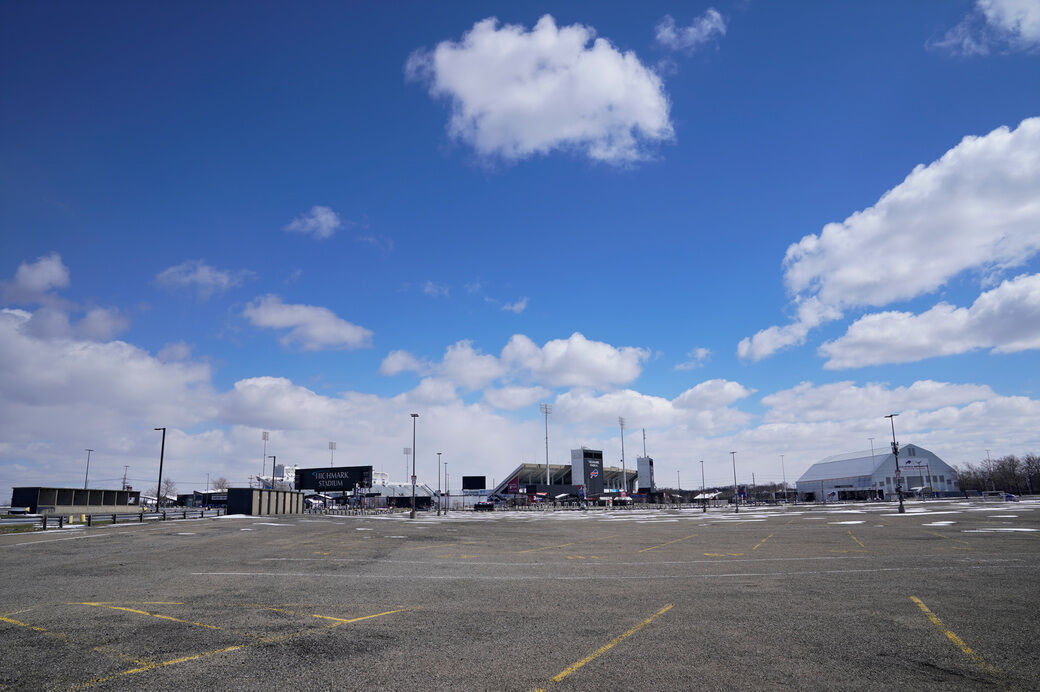
A view of Highmark Stadium, home to the Buffalo Bills, from a parking lot at Erie Community College South where a new proposed stadium would be constructed. Lee Zeldin has criticized and vowed to reopen the agreement with the team that requires the state and Erie County to pay $850 million to the total cost. Officials involved in the negotiations defended the deal and warned against upending the agreement.
5. The Bills would be responsible for all costs beyond the state and county's contributions.
The new stadium construction figure – includes demolition of the existing stadium, pre-construction and infrastructure work, parking, design, management and other costs – is estimated at $1.4 billion. However, should the overall cost grow, the state and county will not be on the hook for the additional construction costs beyond the $600 million committed from the state and the $250 million from the county.
The only exception to that would be if the cost overruns were caused solely by the actions or inactions of the county or the state.
6. The deal guarantees prevailing wages and work conditions for all construction jobs and adheres to Erie County's bidding rules.
The stadium construction agreement would include a project labor agreement guaranteeing minimum hourly compensation – a "prevailing wage" – for all construction workers. This agreement must still be negotiated between the Bills and area labor organizations.
Some local leaders and owners of nonunion construction firms have expressed concern the project labor agreement would shut out local, nonunion contractors and residents who want to work on the project. The PLA may not necessarily prevent nonunion labor from working on the project, but it would dictate minimum wages and benefits to hired workers.
In addition, the deal requires the Bills to adhere to the county's competitive bidding rules and minimum percentages for qualified minority and women-owned business subcontractors for public projects. The county rules also include requirements for apprenticeship programs.
7. The amount the state and county would contribute toward ongoing renovations and maintenance is expected to grow over time.
Once the new stadium is built, the state and county would contribute toward ongoing maintenance and improvements. That amount may vary.

The upfront public financing for stadium construction is $850 million, or 61% of the cost.
For instance, the state must contribute $6 million a year to a capital improvement fund for stadium upgrades, but the amount would be adjusted annually based on the Consumer Price Index, up to a maximum increase of 2.2% in any one year. The state would also contribute $6.67 million a year annually to a maintenance and repair fund for the first 15 years of the lease deal.
Meanwhile, Erie County would establish a surcharge, or tax, on tickets, parking and concessions at the new stadium. That revenue, expected to yield about $4 million in the first year, would flow into the capital improvement fund. As ticket prices and fees rise, that surcharge revenue is also expected to rise.
8. The MOU offers some team-related givebacks for economic development and community support.
The Bills, state and county must still settle on a community benefits agreement that outlines financial and in-kind commitments the team would make to benefit public interests. The MOU lists a few preliminary commitments to give the state and county stadium space to foster economic development, tourism, charitable and public functions.

Erie County Executive Mark Poloncarz said the Bills have committed to signing a CBA, but details about how much the Bills would contribute and where the money would flow have yet to be negotiated.
• The team would make the stadium available to Erie County for up to five civic events per year. The state could also use the stadium for civic events that the Bills would be required to staff and manage. The team would be reimbursed for those costs.
• The Bills would give the state and county $800,000 worth of team logos and trademarks each year for goods used to help promote the Buffalo area.
• The team would provide the county a suite for Bills games and other events, as well as tickets and parking passes for tourism and economic development purposes, and donate tickets, parking passes and "certain other community benefits and charitable efforts."
9. The Erie County Sheriff's Office will still provide stadium security.
The county would continue to provide stadium security, with the Bills negotiating a reimbursement to the county.
10. Stadium square footage includes a description of minimum standards for all physical spaces.
The MOU includes broad expectations for spaces that would be used by spectators, food service/modern kitchen, team, media facilities and operations.
Stadium square footage is listed as 1.35 million square feet, with the largest amount of square footage, 740,000, dedicated to the concourses. A 75,000 square-foot ancillary building would be used for maintenance, overflow and staging.
Read the new Bills stadium MOU:
News Staff Reporter Stephen T. Watson contributed to this report.


