


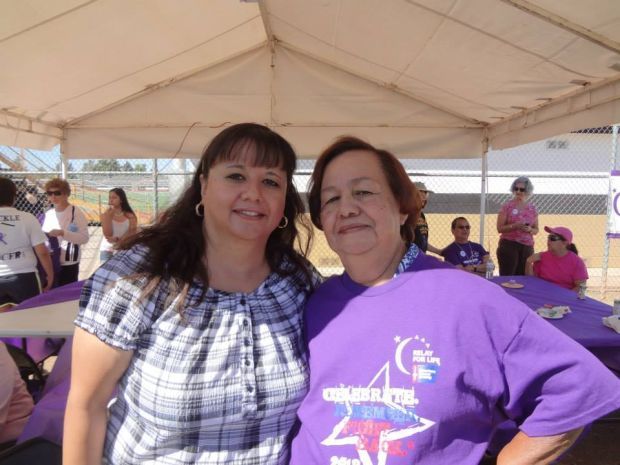
I want to share a personal story.
Laura Duarte and I are family. My mother and her mother are cousins. Her mom, my aunt Paula Duarte, suffered breast cancer. My mom had ovarian cancer.
They have survived not only the illness but the loss of loved ones. Recently, their cousin Maribel, who was diagnosed with breast cancer at 35, died. She was 41 years old.
There is a genetic malfunction that causes cancer in the Ruelas family, especially women.
We know it. We have heard about the Breast Cancer Genes BRCA 1 and BRCA 2, and some of us have been tested, wondering if we carry those abnormal genes.
According to breastcancer.org, women who inherit a defective mutation of any of these genes have a higher risk, up to 89 percent, of developing breast or ovarian cancer.
People are also reading…
Men with these mutations also have a higher risk of prostate and breast cancer, especially those affected with BRCA 2.
Laura and her mom took the test to determine if my aunt’s cancer from 40 years ago could be genetic. They both tested positive. Laura’s three brothers and two children have a 50 percent chance of carrying the same gene, BRCA 1.
Having BRCA 1 or 2 doesn’t mean cancer will develop, and can’t predict at what age they will be most at risk. But Laura no longer has any doubt.
“I wanted to be prepared in any way or do anything to avoid it,” said Laura, 43.
She had four options, a counselor told her: Do nothing, be reviewed every six months (alternating mammogram with MRI), take pills for 5 years (which could cause collateral damage) or have a mastectomy.
Despite the family history, Laura confessed that she was surprised. “I had been praying that the tests came out negative. At that time, everything comes to your mind, and now what? What’s next?”
Making a decision isn’t easy. None of the preventive measures have 100 percent effectiveness. Removing the mammary glands is the most aggressive approach. Yup, just as Angelina Jolie did and three of our cousins have done.
But even with a mastectomy, which has an effectiveness from 80 percent in ovaries and 95 percent in breast, not all the cells related to the breasts and ovaries are eliminated and there still are not enough studies that can answer the big question: Would that increase the possibility of developing cancer in a different part or the body?
Pills and special review only provide 40 to 60 percent effectiveness. For Laura, that was enough. She chose to be examined every six months.
Then a mammogram showed a little mark. She found a cancer in Stage 1 but at Grade 3, the most aggressive. It is Invasive Ductal Carcinoma (IDC), which starts in the breasts’ milk ducts. She made another decision.
A few weeks ago, Laura started a 16-session chemotherapy treatment at University Medical Center. Then comes the mastectomy. It’s crucial to prevent cancer dispersing or re-emerging, as happened to my Nanita, my mom’s adoptive mother and aunt of Laura’s mom. Cancer reappeared after 30 years in the breast that was left.
At first, Laura felt strong, she told me. She had prepared for that.
“But as the time of treatments got closer, I felt concerned, fear, anxiety. Will I be able to keep working? Will treatment be effective for me? What about my children? I see them very concerned about me and also fear,” she said about her sons Fausto, 21, and Roberto, 13. “Seeing my children like that is the hardest part.”
Laura is surrounded by her parents, siblings and sisters-in-law. She has already suffered the effects of chemo. Some days she works from home in Douglas and some days she drives to Sierra Vista City Hall where she is a junior accountant.
She strongly recommends that people with a family history of cancer take the test and be informed.
“There’s nothing we can do about that gene, but there are certainly some steps we can take to find the cancer earlier or try to reduce the risk. In my opinion, it’s worth it,” she said.
As for me, after being tested along with my mother, we discovered we have BRCA 1. The next step is to take the tests. If everything is OK, I’ll still have a decision to make. I can keep my breasts and stay alert or can do the Jolie thing.
This is a permanent battle and it involves the whole family. We’ll face it by changing our nutrition habits, increasing the physical activity and approach it with a good attitude and a sense of humor. What cancer likes least.
October was the month of international awareness about breast cancer, but any time is a good time to take preventive measures.
Liliana López Ruelas is copy editor and translator with La Estrella de Tucsón. She can be reached at llopez@tucson.com


 Tucson-born restauranteur Sam Fox leaves namesake company


