
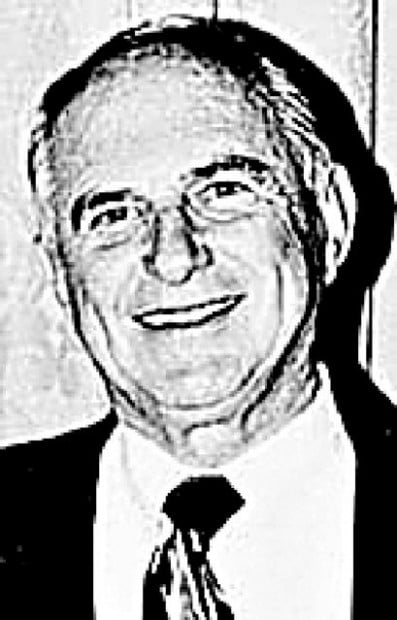
Jim Gibson believed everyone has the right to an education.
He made it his life's mission to help people meet their goals, whether through vocational training, continuing education or higher learning.
"Jim was always out there making it possible for people to get a break, making way for people to get into college who wouldn't be able to go to college otherwise," said retired educator Georgia Brousseau.
He had been serving the educational needs of Tucson students since 1954 when, at age 62, Gibson retired from his job as a dean at Pima Community College, Brousseau said. Gibson had been diagnosed with Alz-heimer's disease and decided it was better to retire while he was still providing the best service he could to the students.
He died April 11 at 78. A memorial service is planned for 2 p.m. Sunday at Catalina United Methodist Church, 2700 E. Speedway. Gibson's wife of 57 years, Mary Sue, requested that, in lieu of flowers, donations be made to the UA Department of Neurology for Alzheimer's disease research. Gibson had been participating in research studies at the university, Brousseau said, "using this tragedy that happened to him to help people."
People are also reading…
Gibson earned a bachelor's degree from Missouri State University, a master's from the University of Northern Colorado and received his Ph.D. from the UA.
He taught industrial arts at Tucson High School in the mid-1950s before taking a job, in 1957, as assistant dean of continuing education at the UA. By 1963 Gibson had proved himself to be a standout employee. He'd worked his way through the position of placement director to become director of the university's alumni association.
In announcing Gibson's new position, Richard A. Harvill, then UA president, said he was "exceptionally well-qualified."
"He has demonstrated outstanding qualifications for handling the many types of activities involved in relationships between the university and its alumni," Harvill said in a newspaper article.
Brousseau met Gibson 40 years ago just as he and Mary Sue were planning a move to New Mexico, where Gibson took a job as president of a private college. Within three years, though, the couple returned to Tucson.
"He did the best he could and he raised the enrollment rate as much as he could, but it wasn't enough, so he recommended the board to close the school," Brousseau said.
Gibson worked for a year as director of educational development for the non-profit performance troupe Up With People, before returning to academia as dean of continuing education for PCC.
Brousseau had just been elected to the college's board of governors, and Gibson lobbied her to help him expand educational opportunities in outlying areas of Southern Arizona.
"Much of my district was in what we called the community campus — Ajo, Sahuarita, Sells, Nogales," Brousseau said. "Jim approached me as a member of the board of governors to introduce me to my community even more so."
For nearly a decade, she and Gibson visited the satellite campuses, generating ideas to improve service to the students.
"He was an idea man. He was always making notes. He always had his little notebook right there with him," Brousseau said. "He reached out to people. Everywhere we went, he knew people. He knew them by their first name. He knew what their aspirations were. I always respected him and always looked up to how he cared. He absolutely believed the mission of community college and doing the job. "
Gibson didn't confine himself to administrative duties. He took leadership positions in numerous civic organizations, including the Pima Council on Aging, the Development Authority for Tucson's Economy, the Tucson Festival Society, the Pima Juvenile Court Foundation and the Jacobs YMCA, and he was a member of the Catalina church, the Masonic Lodge and the Rotary Club.
He explained his participation in community organizations during a successful 1976 run for a seat on the Amphitheater Public Schools district board:
"I have always felt that in a democracy people ought to give some time to government and the management of public affairs. I thought this would be the way I could contribute," Gibson said in an Arizona Daily Star article.
In the late '70s Gibson even found room in his hectic schedule to teach a class on time management, with another instructor, for the UA's continuing education program. In promoting the class, he told a newspaper reporter, "We're not really concerned with how efficiently you use your time but how effectively you use it."
He identified the "two major time-wasters" as perfectionism and procrastination, and challenged his fellow teacher on the best way to deal with uninvited visitors who interrupt one's schedule. While his fellow teacher advocated taking an assertive stand, telling the visitor of the interruption, Gibson considered that rude and suggested hiding from unexpected guests instead.
Even though Gibson retired from administrative duties at PCC, he continued teaching psychology part time, said Mary Memedova, who now lives in Georgia. In 1974, while working as dean of community campuses, Gibson hired Memedova to fill a faculty position. Two decades later, the tables turned when Gibson retired and Memedova became a department chairwoman.
"It amused us that he hired me as an associate faculty part-timer and 20-some years later I hired him as a part-time associate faculty member," Memedova said.
"He was always thinking about what was best for the students in every way. He always got very fine reviews in his evaluations from the students. He was a dedicated educator both as an administrator and a classroom teacher," she said.
Life Stories
This feature chronicles the lives of recently deceased Tucsonans. Some were well-known across the community. Others had an impact on a smaller sphere of friends, family and acquaintances. Many of these people led interesting — and sometimes extraordinary — lives with little or no fanfare. Now you'll hear their stories. Past "Life Stories" are online at go.azstarnet. com/lifestories.

 Vacant Tucson stores could transform into new housing