Yosbel Lingueño anxiously sent text messages to his family as he walked up to the turnstiles at the port of entry in Nogales, Sonora, last Monday.
After months of waiting to speak with U.S. officials about his asylum claim, the 32-year-old from Cuba was going to ask for urgent humanitarian relief so he could be reunited with his wife and infant son. The last time he saw his wife, she was going into labor at a Texas hospital and he was being sent back to Mexico.
Depending on what the officials decided on Monday, he would either take a huge step toward seeing his son for the first time or remain marooned in Nogales.
“I hope they give me an opportunity, that they listen to me,” Lingueño said.
As Lingueño geared himself up to speak with U.S. officials, he said he wished people would put themselves in his shoes.
People are also reading…
“I think no couple in the world would want to go through what I and my wife are going through,” he said. “To be separated from your family after leaving your country where there is a dictatorship, like there is in Cuba, and going out in search of freedom.”
He is one of 23,000 asylum seekers with pending claims under the Migrant Protection Protocols, a U.S. program also known as Remain in Mexico in which asylum seekers are sent to Mexican border towns to wait for hearings in U.S. immigration courts, according to federal data compiled by the Transactional Records Access Clearinghouse at Syracuse University.

Some 23,000 people with pending asylum claims are believed to be waiting in Mexican border towns for their chance to get a hearing in U.S. immigration courts.
The program left asylum seekers, many of whom came from Honduras, Guatemala, Cuba, and El Salvador, living a precarious existence as foreigners on the U.S.-Mexico border. They were pushed further into limbo when the coronavirus pandemic hit. U.S. officials repeatedly postponed hearings and in July they announced that hearings wouldn’t resume until the pandemic was brought under control.
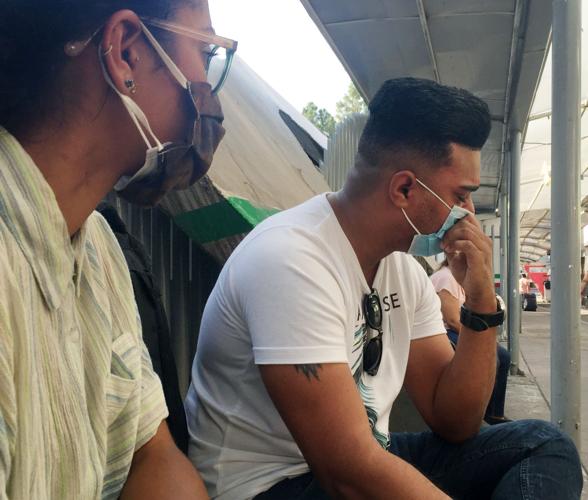
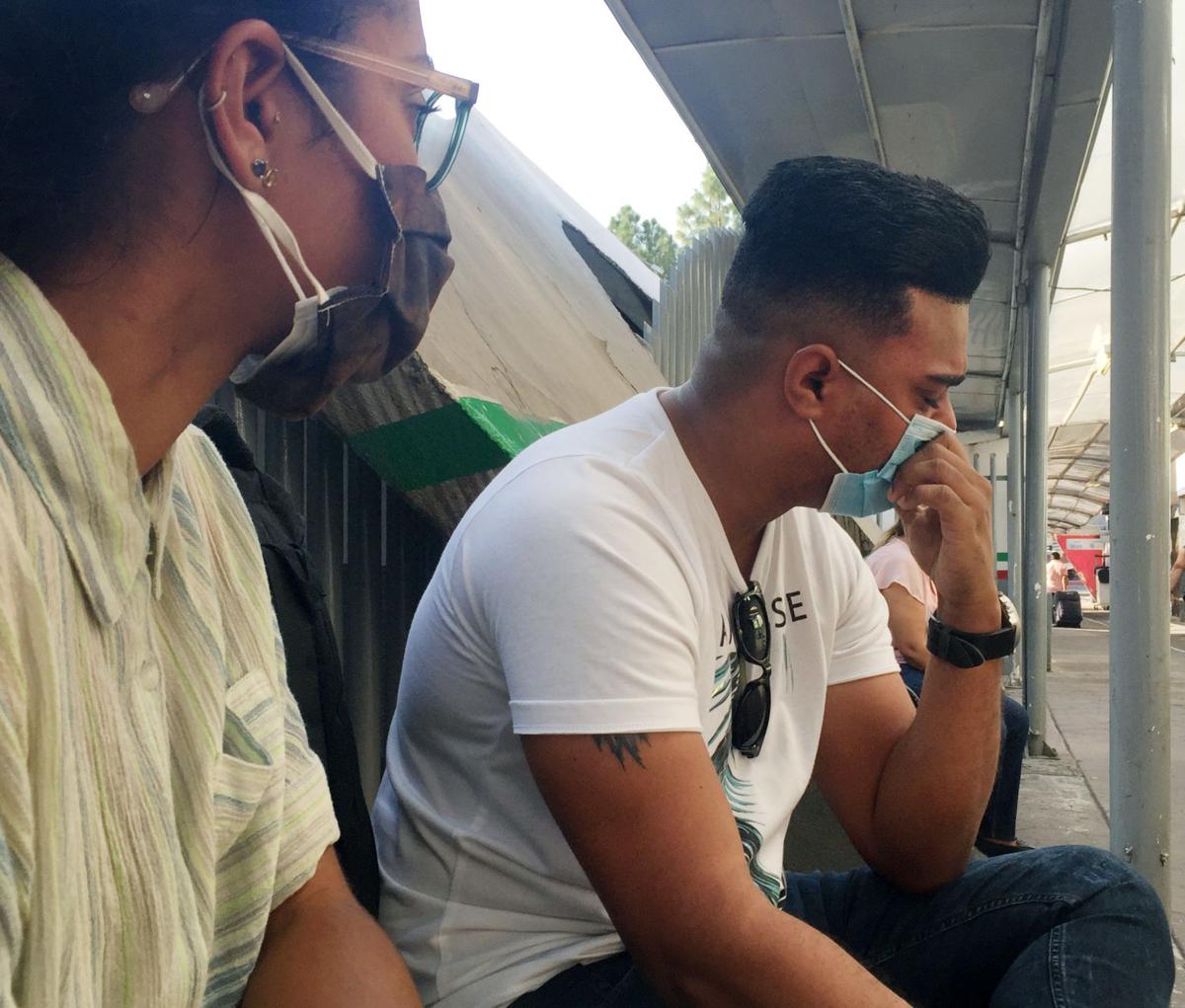
“This has affected me a lot. I can barely sleep,” Lingueño said as he sat on a metal bench outside of the Nogales port of entry, where hundreds of asylum seekers have waited for their turn to speak with U.S. officials since the program was set up in Nogales in January.
“Now that I’m apart from my wife, I feel, I don’t know, it has affected my nerves,” he said. “I don’t know what’s happening to me. It’s very difficult, very difficult all of this.”
The road to the benches outside the Nogales port of entry began when Lingueño was a young boy in Cuba and his parents raised him to reject the dictatorship. As an adult, he pushed back against repressive policies and ended up facing political persecution. He and his wife, Yarlenis Viltres, 22, sold their home and fled Cuba last year.
They made their way to southern Mexico and then to Nogales, where they spent months facing discrimination and threats for being Cuban. The threats eventually forced them to move to a different neighborhood and then another city. All the while, Viltres’ pregnancy advanced. She had a history of difficult pregnancies, most recently a miscarriage caused by a Cuban police officer striking her in the abdomen.
Lingueño said they are “trying to respect the laws,” even taking a dangerous, and ultimately fruitless, 10-hour bus ride to an immigration court hearing in El Paso in May that was postponed without their knowledge, as the Star reported June 14.
Fearing for the health of Viltres and their safety in Mexico, they decided to cross the river at the Texas border in early July. Soon after they crossed, Viltres was rushed to a hospital for an emergency cesarean section. While she was in labor, U.S. officials sent Lingueño back to Mexico.
Since then, Viltres and their infant son have lived with a relative in Texas. Lingueño is still waiting in Nogales for a chance to see his wife again and meet his son. Lingueño said he talks to his wife every day and tries to lift her spirits.
“We’ve been together six years and we have never spent so much time apart,” he said.
His next hearing is scheduled for late October, but Alex Miller, a pro bono lawyer with the Florence Immigrant and Refugee Rights Project who is helping Lingueño with his asylum claim, said it is “exceedingly unlikely” his case will proceed on that date due to the pandemic.
Instead, Lingueño’s separation from his wife and son could extend indefinitely, despite them needing his support, Miller said.
The grinding stress of their predicament is never far from the surface, says Lingueño, echoing what many asylum seekers have told the Star since January. Breaking down briefly, Lingueño used his hand to cover his face then quickly composed himself as he prepared for the walk to the port of entry.
After waiting in line, Miller passed a manila folder with Lingueño’s documents through the turnstiles to a customs officer. She told the officer she had contacted the port director the previous week about Lingueño’s request for humanitarian parole so he could be reunited with his family. The officer took the folder, said he would be back soon, and disappeared into the building.
Lingueño gripped the straps of his backpack as he waited in front of the turnstiles for U.S. officials to decide his future. Inside his backpack, he carried clothes, official documents and his barber tools. He was hoping his scissors and combs would help him earn money to support his family if officials allowed to him to go to Texas. He had made a little cash cutting hair in Nogales to supplement the dwindling funds they brought with them from Cuba.
As Lingueño and Miller waited for the officer to return, U.S. immigration officials dropped off a half-dozen young men carrying their belongings in plastic bags, as thousands of deportees had done before. A group of women followed them a few moments later, including a woman carrying a sleeping toddler whose dangling arm swayed in time with his mother’s steps.
While the minutes ticked by, a slow-moving line of people waited to cross the border and go about their daily business in Arizona. A heavyset man balanced a small crate of Coca-Cola bottles on a railing. An elderly woman pushed a small green bag in a handcart. A pair of young women chatted and laughed. One by one, they showed their passports to a customs officer and stepped through the turnstiles while Lingueño looked on.
Four customs officers eventually appeared on the other side of the turnstile. They handed back the manila folder and told Miller that “no decision has been made” on Lingueño’s request. With just a phrase spoken through a turnstile, Lingueño’s future was decided. He would remain in Nogales for the foreseeable future.
Lingueño and Miller returned to the metal benches and Miller explained the situation to Lingueño. When she was finished, he squared his shoulders, thanked her, said “adelante,” onward, and walked back to the streets of Nogales.
Customs and Border Protection did not respond to an inquiry from the Star about Lingueño’s case.
Lingueño’s experience at the port is typical for asylum seekers in the Migrant Protection Protocols who ask for humanitarian parole, according to Luis Guerra, a legal advocate for the Catholic Legal Immigration Network.
The officers at the port frequently say to wait for a decision from the higher-ups, he said. Rather than allow asylum seekers into the ports and have a conversation, they decide to not even process them.
With the pandemic, “the government now has an excuse to say it’s too dangerous for you to go to court,” Guerra said. “The result is people with little to no resources don’t actually have an avenue to move forward.”

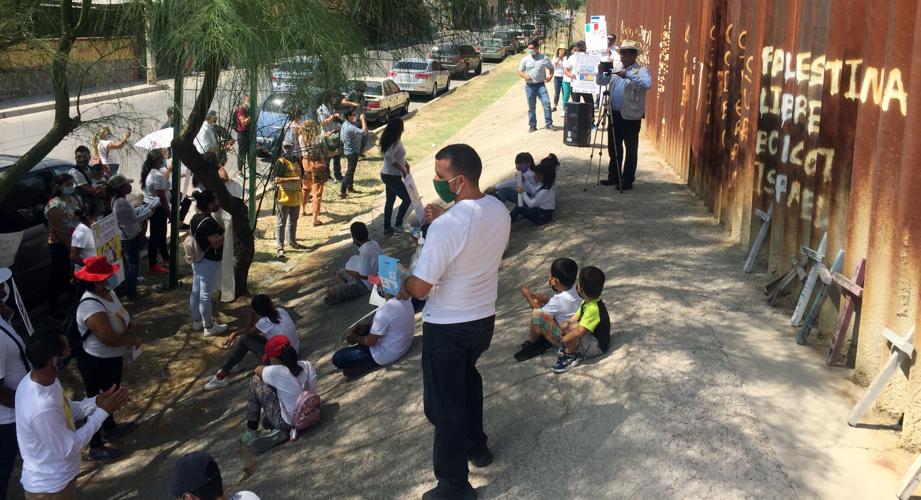
Asylum seekers, many of whom have been waiting in Nogales, Sonora, for months, gathered near the border fence Monday to assert their right to ask U.S. officials for asylum.
While much of the U.S. public is aware of the family separations that occurred in the spring of 2018, the Migrant Protection Protocols and other policies are “variants” of what people know as family separation, Guerra said.
“It’s not just an officer saying ‘you go this way and you go that way,’ Guerra said. “It’s policies that give people no real alternatives and, due to trying to survive, there are really tough decisions that have to be made that result in family separation.”
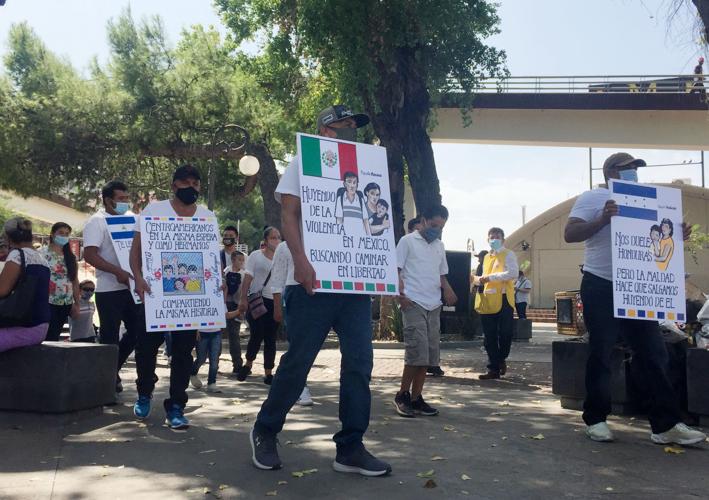
Two hours after Lingueño left the port of entry, dozens of asylum seekers from Cuba, Honduras, Venezuela, and Nicaragua, including at least a dozen children, gathered at a small plaza nearby.
They carried signs saying they were fleeing violence and had a right to ask for asylum. Some signs said they loved their home countries but couldn’t stay.