

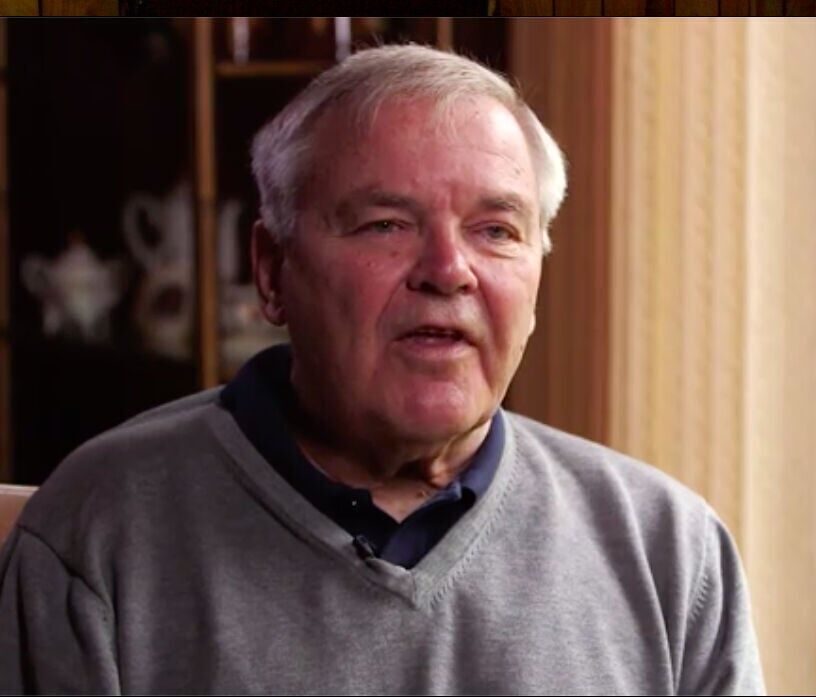
Betsy Wieland still remembers her first date with the man who would become her husband.
It happened six decades ago at the Park Meadow restaurant near the Buffalo Zoo.
"Every two or three minutes, he would get up, walk outside and press the (traffic) light so everyone had to stop at that corner," Wieland said.
It was classic Paul Wieland: a random prank performed for no other reason than that it made people laugh.
Wieland soon had a much larger audience to try his jokes on: the 16,000-seat Memorial Auditorium, where he served as director of public relations for the Buffalo Sabres from their creation in 1970 until 1995.
Tributes from across the sports and journalism worlds poured in last week when Wieland died after a brief illness. He was 84.
People are also reading…
'Zaniness' created laughs
"He was lovable," said Lee Coppola, a retired investigative reporter and St. Bonaventure journalism school dean who first met Wieland when they were reporters for The Buffalo Evening News in the 1960s. "I think people admired and were attracted to his zaniness."
As a young reporter, Wieland won multiple journalism awards, including a 1966 first place Page One award for a story he wrote about robbers threatening Mr. and Mrs. Seymour Knox at their home in East Aurora.
Decades later as a journalism professor, Wieland would tell the story of how the Knox estate was off-limits to reporters as police investigated the theft. So Wieland talked a New York State trooper he knew into giving him a ride to the crime scene, where he interviewed family members and got the story.
After Wieland left The News to work in public relations for General Motors, Seymour and Northrup Knox were awarded a National Hockey League franchise in Buffalo. They hired Wieland and gave him full authority to "imagineer" the Sabres' public image, which he did with flair.
Wieland used April Fools' Day as a way to grab attention for the team, sending out fake news releases that sometimes fooled local reporters. in 1977, he announced the team was replacing the ice in the Aud with "Sliderex," a plastic surface he said was developed in a cow barn in Nova Scotia.

"When they made Paul Wieland, trust me when I tell you they threw away the mold," Mike Harrington writes.
In 1982, he announced in a news release that President Ronald Reagan had named the Sabres "America's Hockey Team." Wieland created a fake Time magazine cover and a White House proclamation signed by the president. When an Associated Press reporter called to say Wieland might have committed a federal crime by forging the president's signature, his response was, "Bring it on!"
"Working with Paul was a joy, number one, but you never knew what he was going to do. You’d say, 'Oh no!' But he did it," said Coppola, who Wieland hired to write scoreboard messages for Sabres games.
In a magazine that was handed out to fans before games, Wieland once "wrote about a farmer in Canada who grew hockey sticks, and according to the wind, he would change the hockey stick so it would conform to the bend in the blade the player wanted," Coppola said. "I just laughed. That was the basis of many of his pranks, is he tried to make them believable."
Wieland's greatest coup, though, was helping the Sabres draft a player who didn't exist. Wieland, former Sabres coach George "Punch" Imlach and the team's scouting director created a fictional player – named Taro Tsujimoto – they said was based in Japan.
The gag went on for months, fooling Sabres players, the NHL commissioner and even team owner Seymour Knox, according to "Sabre Rattler: How a rogue p.r. man in Buffalo shook up sports," a 2014 article on the now-defunct website Sports on Earth.
Ran TV program at St. Bona
For all of his humor, Wieland pioneered ideas that were adopted nationally. The Sabres were among the first teams to put their games on cable TV. Wieland also came up with the idea to play both the American and Canadian national anthems at hockey games, Coppola said.
Wieland told those closest to him that teaching journalism at his alma mater, St. Bonaventure, brought him immense pride, said Anna Bulszewicz, a 2007 Bona graduate and former TV news reporter/anchor who now runs the broadcast journalism program at St. Bonaventure.
Bulszewicz said Wieland's teaching style – filled with anecdotes from his days running Sabres broadcasts – helped him connect with students.
"He tells you there’s a space for you in the world to be you," Bulszewicz said. "That is not in a textbook and that takes a specific kind of human being. If the world had more of that, we would have people living more purpose-driven lives because they believed in themselves. That’s what Paul did for me."


