
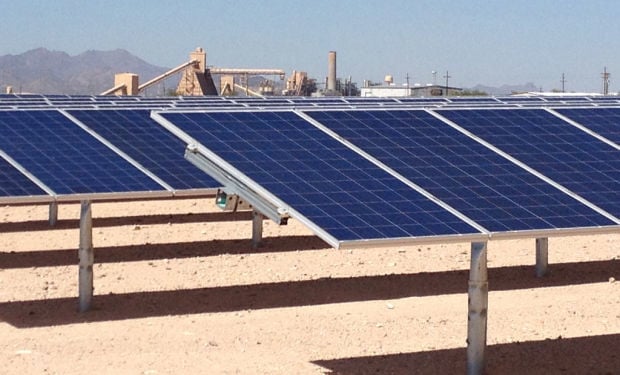
A German energy giant dedicated its first solar-energy installations in the U.S. on Monday under sunny skies in Tucson.
The 10-megawatt (AC) Valencia Solar photovoltaic project was built to serve Tucson Electric Power Co. by E.On Climate & Renewables, part of one of Europe’s biggest investor-owned utilities.
On Monday, officials of TEP and E.On dedicated the array at East Valencia and South Craycroft roads, as well as a 5-MW installation that has been online at the University of Arizona Science and Technology Park on South Rita Road since the end of 2012.
The Tucson installations are the first installations in a solar push in North America by E.On, which has until now focused on wind-energy installations in the U.S., said Christophe Jurczak, CEO of E.On’s Global Solar business.
“We expect that this will be the first in a long series of constructions” in the U.S., Jurczak said at a dedication ceremony.
People are also reading…
TEP is buying the energy the arrays produce under a 20-year power purchase agreement, said Carmine Tilghman, TEP director of renewable resources.
Jurczak said his company was glad to launch its U.S. solar operations in Tucson, where the UA Tech Park’s Solar Zone hosts several different new solar-energy technologies.
“This is probably one of the most innovative places in the world for solar technology,” he said.
Ken Marcus, director of the UA Tech Park, noted that the Solar Zone is home to installations by seven companies using nine different solar technologies.
E.On is testing several sun-tracking technologies at its Tucson-area solar farms. Both the Valencia and Tech Park sites use polycrystalline silicon solar panels made mainly in China by JA Solar and Canadian Solar.
But each array uses different, single-axis tracking mechanisms to track the sun as it moves through the sky for optimum efficiency. Part of the Tech Park installation features a dual-axis tracking system from California-based Qbotix Inc. that employs a robotic system on rails to constantly adjust each panel for optimum sun-gathering.
TEP is building out its utility-scale renewable-energy resources, including contract power projects, to meet a state mandate that it incrementally increase the amount of renewable energy it generates to 15 percent of its retail power sales by 2025.
The companies declined to divulge the cost of the projects, which qualify for federal renewable-energy tax credits, citing confidential contract terms.
TEP’s Tilghman said the price TEP will pay for the power from the E.On arrays also is confidential. TEP’s cost for power from renewable projects under purchase agreements have ranged from about 10 cents to 14 cents per kilowatt hour since the utility began soliciting such projects a few years ago, Tilghman said.
By the end of 2014, TEP expects to have more than 228 MW of solar capacity, enough to power more than 45,000 homes annually.
E.On’s biggest renewable-energy project in the U.S. is a wind farm in Roscoe, Texas, that is rated at 781 MW (AC).


 U of A’s fall enrollment down more than 20%, sources say