

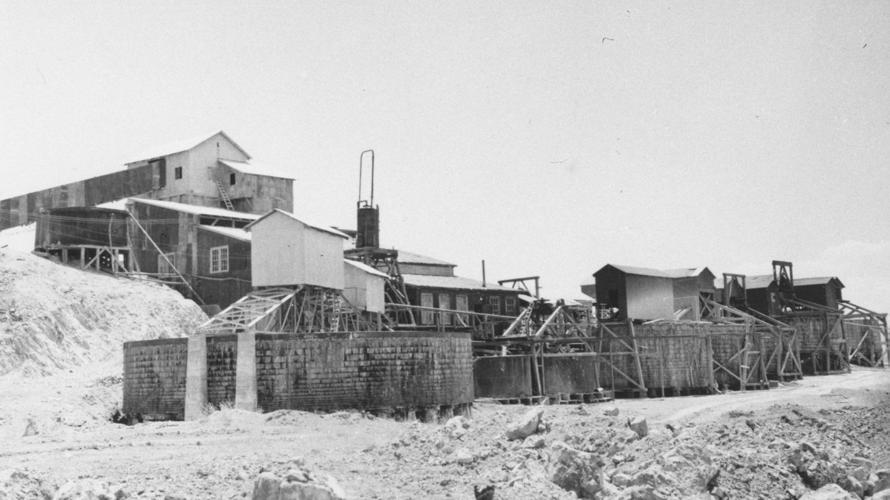
The Katherine Mine is located in Mohave County, about 12 miles north-northwest of Oatman and roughly 2 miles east of the Colorado River.
Discovered by S.C. Baggs in September 1900 while on an excursion with his father, Stanley Baggs, and John Vanderburg, was a quartz and feldspar mixture mixed with native gold.
The sample assayed at $30 a ton in free gold.
The mine was christened Katherine, after the sister of S.C. Baggs and daughter of Stanley Baggs, who operated the mine for several years.
Mining in the Union Pass district probably dates back to the late 1860s when a group of prospectors from Fort Mohave discovered the Sheeptrail-Boulevard properties.
Evidence of an old Enfield rifle with a stock engraving bearing “1863,” along with other notable mining artifacts found in a cave in the surrounding Black Mountains, substantiates this conjecture.
People are also reading…
The New Comstock Mining Co., along with the North American Exploration Co., with whom they leased the property, developed the Katherine Mine down to the 300-foot level in 1904.
Milling operations were undertaken at the Sheeptrail mill at Pyramid, the end results of which produced 2,000 tons of ore.
The Arizona-Pyramid Gold Mining Co. acquired the property in 1904.
Transportation problems, coupled with deficiencies in the amalgamation process, hindered the mine’s productivity for years. San Francisco investors who had stock in the mine were adversely affected by the San Francisco fire of 1906, and also withdrew support.
Operations resumed in 1919 with a new shaft sunk and a 150-ton mill and cyanide tanks built under the direction of the Katherine Gold Mining Co.
Sensationalism abounded in the Katherine district with promoters in both San Francisco and nearby Kingman proclaiming the deposit to compare to that of the gold mines of Cripple Creek, Colorado.
A free town lot was offered to miners whose first-born daughter was christened Katherine. The town consisted of a post office established in 1921 and comfortable accommodations, including a large boarding house large enough to feed the 100-man mining crew in 30 minutes.
Total production of the Katherine Mine through 1933 reached $1.7 million in gold and $100,000 in silver.
By 1934, the Gold Standard Mining Corporation employed 40 men and had a 300-ton capacity mill treating 60 tons of ore a day, including ore from the nearby Roadside, Arabian and Tyro mines.
By 1942, rising costs involved in ore extraction and government regulations in the form of Limitation Order No. 208 issued by the U.S. War Production Board forced the mine’s closure.
Skilled labor was needed to develop nonferrous metal mines, including aluminum, copper, lead and titanium needed for the U.S. military during World War II. The main shaft was flooded with Colorado River water.
By this time, the district yielded more than $3 million, of which 85 percent was gold and the balance silver. Since then, multiple lessees worked the site, including William Ground of Kingman in 1959.
The Katherine Mine has since been reclaimed with the main shaft plugged. The area where the headframe once was has been replaced with a pump that supplies water to nearby homes.
The historic town has since been removed.
Archivist, historian and author William Ascarza’s forthcoming book is “In Search of Fortunes: A Look at the History of Arizona Mining.” For more information, contact M.T. Publishing Co. at 1-812-468-8022 or go to http://goo.gl/FS545A online.

 101 homes to be built on NW Tucson corner