

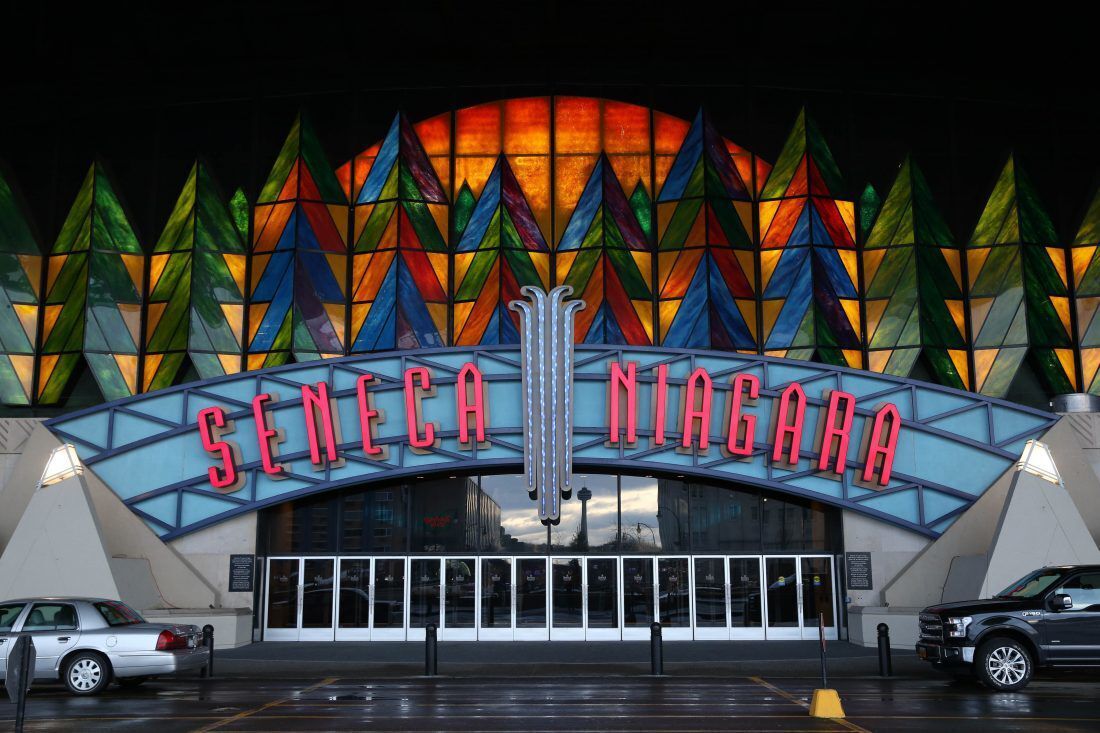
ALBANY – A federal judge in Buffalo this afternoon sided with an arbitration panel that earlier this year said the Seneca Nation of Indians wrongly withheld at least $255 million in casino revenue payments to New York State.
U.S. District Court Judge William M. Skretny said the tribe and state explicitly agreed in a 2002 compact that disputes arising over casino matters between the two sides would be handled through binding arbitration.
Two of three members of an arbitration panel – formed by the state and tribe – last spring said the Seneca Nation had no legal right to withhold $255 million in casino revenue-sharing payments to Albany.
The federal judge said the law is clear that a binding arbitration award involving state and Seneca disputes had to be upheld by federal courts “so long as there is a ‘barely colorable justification for the outcome reached.’ "
People are also reading…
The judge said that was a standard “that is easily met here."
The judge also rejected a request by the tribe to have the matter go for a review before the U.S. Department of the Interior.
The tribe halted casino payments – it shares 25% of slot machine proceeds with the state in return for casino gambling exclusivity in a large Western New York area – in 2017 as it argued the precise language of the 2002 compact was silent about specific payments after the 15th year of the legal agreement.
In April, the arbitration panel said the tribe owed New York $255,877,747.44 for payments through December 2018. Another $100 million or so may have accrued since that time, taking the tribe’s tab considerably higher than the April award.
“The court confirmed what we've said all along: The Seneca Nation needs to fulfill their obligations, make their neighbors and the state whole, and pay what they owe in exchange for their exclusive gaming rights. It is our hope that they end this charade, stop using the courts to delay, and pay what they owe," Richard Azzopardi, a senior adviser to Gov. Andrew M. Cuomo, said in a statement this afternoon.
In a statement, Seneca Nation President Rickey Armstrong Sr. said the compact agreement is clear but the arbitration panel "interpreted that a new, unwritten obligation exists" and that interpretation was upheld by a court.
"We understood the reality that the arbitration and court proceedings may not ultimately uphold the language of the Compact as written. Yet, it is our obligation to defend our agreements, so they are not compromised for the benefit of others," he said. "We will take the time to review today's decision and determine how the Nation will proceed.”
If the Seneca Nation does not appeal, the judge’s ruling would pave the way for resumption of casino payments not just to the state, but also a number of localities throughout Western New York. Those communities, such as Niagara County and Buffalo, get 25% of the state’s share as local “host” fees.
Skretny said that while the arbitration panel’s decision has “widespread, directly inverse ramifications” for the state and tribe, his legal task was to consider an “exceedingly narrow question": whether the panel “manifestly disregarded” any laws in reaching the decision it did. No violation of law occurred, the judge wrote.
The arbitration panel was composed, per the terms of the 2002 compact, by a state appointee, a tribal appointee and a third member jointly selected by the first two individuals. It was the tribe’s direct appointee who sharply disagreed with his colleagues when they ruled in favor of the state.
The compact agreed to 17 years ago by the state and tribe has since led to the opening of three casinos in Western New York: Niagara Falls, Buffalo and Salamanca. That legal agreement explicitly said disputes were to be resolved via binding arbitration. But it also included a provision that the Senecas could challenge a casino arbitration decision in just one place: federal district court in Western New York.
Skretny rejected all of the tribe’s legal points, except one: He turned down a request by the state to have the Seneca Nation pay Albany’s legal tab for the cost of the dispute. The amount of that ongoing legal bill was not immediately available.
“The Nation has not shown that the arbitrators intentionally defied governing law, engaged in egregious impropriety, or dispensed their own brand of industrial justice," the judge said of the Senecas.
Citing previous federal cases, the judge said the required proof needed to overturn a binding arbitration award is very high “since courts afford great deference to arbitration decisions."


