

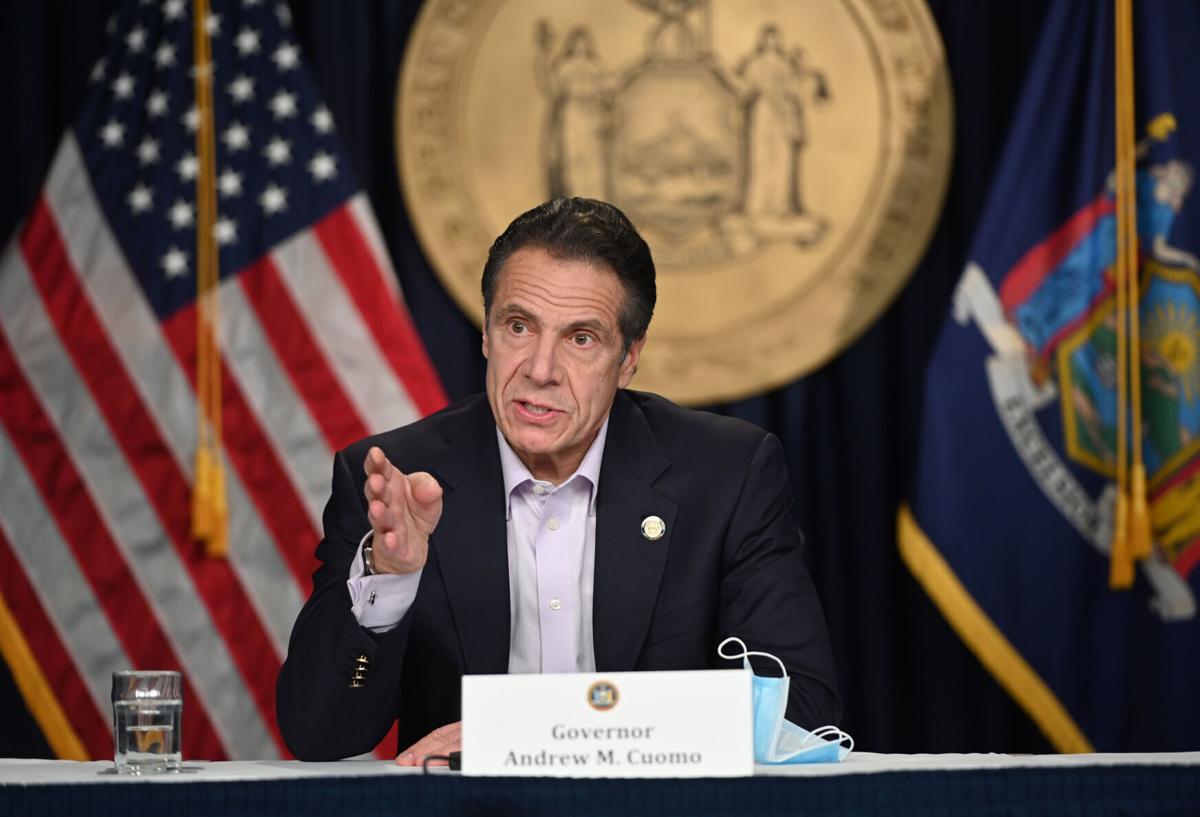
A spike in the Covid-19 infection rate is not inevitable just because we're in the holiday season, Gov. Andrew M. Cuomo said Monday.
But Cuomo said 75% of the spread of the virus occurs during in-home gatherings.
"Fifty percent of the spread is asymptomatic. People don't even know they have it," Cuomo said during his daily news conference. "That's where the spread is coming from.
"Thanksgiving was our first test and what you're seeing from the data is, we did not have the spike that other places had."
Cuomo said the virus spread faster in areas of the nation where there was more travel and more large gatherings.
"The question is, what happens as you get close to Christmas?" Cuomo said. "If we stay smart, a spike is not inevitable. If we get through the holiday, then it's just a sprint, us versus the vaccine. We just have to make sure we don't have a spike coming out of the holiday season."
People are also reading…
He said he was especially concerned about the Finger Lakes region, where the infection and hospitalization rates have been rising, because it borders on Western New York.
"They have done a reversal with Western New York," Cuomo said. "Western New York was a real problem, and now Finger Lakes are a worse problem, and Western New York has flattened for the time being, and that's good news."
The Finger Lakes, which includes such local counties as Genesee, Orleans and Wyoming, has a seven-day average of 8.28% positive tests for the virus.
Western New York, which comprises Erie, Niagara, Cattaraugus, Chautauqua and Allegany counties, had a 6.42% seven-day average for positive testing.
But Cuomo noted that there is a lot of travel between the two regions.
"You can't have two contiguous areas where one has a low infection rate and one has a high infection rate, because the high infection rate ends up infecting the low infection rate, so the Finger Lakes are a problem in and of themselves," he said. "They're also a problem for Western New York."
Cuomo said that so far, 38,000 New Yorkers have been vaccinated, which he said was more than twice as many as any other state.
Cuomo said nearly 500,000 more doses of Moderna and Pfizer vaccine will be arriving in New York in the next few days.
So far, 45,650 doses have been sent to Western New York. Health care workers were first in line, and Cuomo said nursing home workers and patients began to receive the vaccine Monday.
"There's no governor, no county executive or no mayor who controls the process," Cuomo said. "This is entirely done by medical professionals. We get the vaccine, we distribute the vaccine to a regional hub hospital. That hospital does the vaccinations for that region. We define the categories of people who are eligible. Basically we follow federal advice on that."
"We have already distributed more vaccine and our hospitals have vaccinated more people than any state in the nation," Cuomo declared.
New York will receive another 346,000 doses of the Moderna vaccine and another 120,000 doses of the Pfizer vaccine this week, Cuomo said.
The priority populations are being expanded this week to include federally qualified health center workers, emergency medical technicians, coroners, medical examiners and funeral home workers, and other congregate care workers and residents.
The federal program to vaccinate nursing home workers and staff began in New York on Monday. Each facility will have three vaccination days, and the nursing home program is to be completed within six weeks. Statewide, 618 nursing homes are enrolled, 62 of them in Western New York.
Cuomo also announced that the state intends to assemble community vaccination kits, which will take the vaccine to communities not well served by health care infrastructure, such as communities of color. The kits, which even include tables and chairs, will require about 10,000 square feet of space, and a statewide task force has been chosen to create an operational plan.
"There is a very real resistance to taking this vaccine, especially in the Black community, where there's a history that would give one a right to be skeptical," Cuomo said. "We need a public education to combat that."


