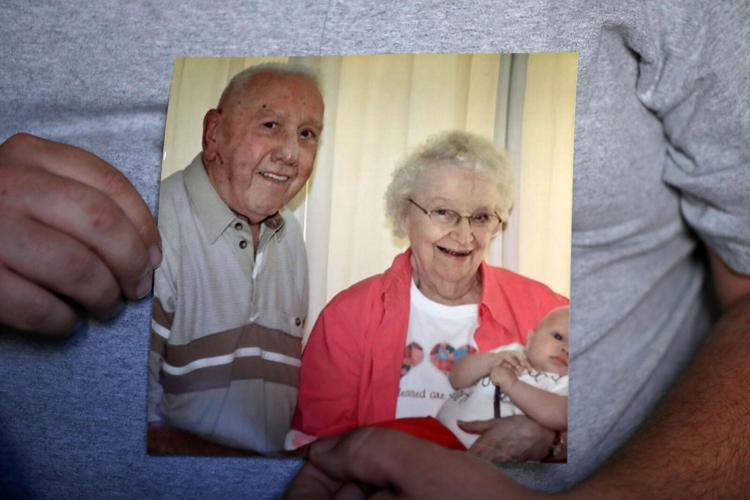
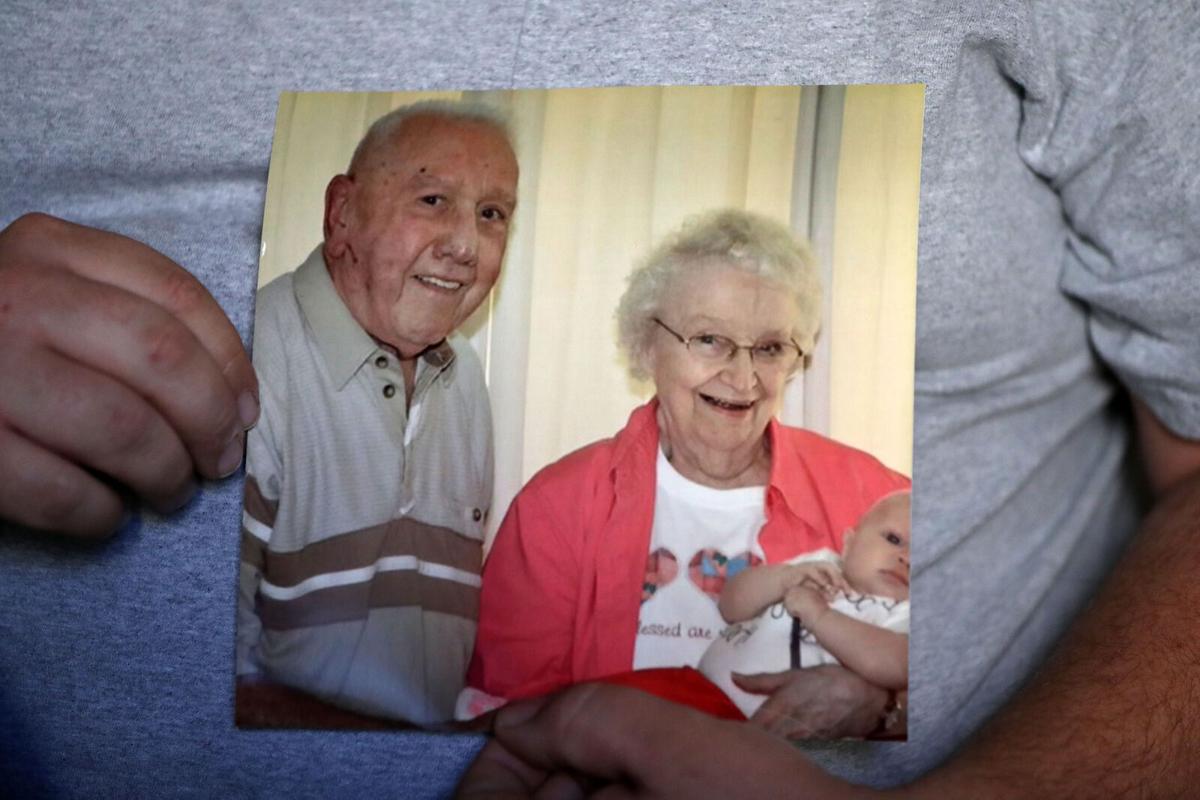
The photo Connor Kolb holds at his dining room table in Orchard Park shows his grandparents next to one another, smiling.
He'd like to see that again.
For more than a year, however, his grandparents, Albert and Sally Hulin, have been apart.

Connor Kolb holds a photo of his grandparents Albert and Sally Hulin as he sits at his kitchen table in Orchard Park Tuesday, December 14, 2021. Kolb has been trying to get his grandparents into the same nursing home for about six months, but that is proving difficult amid staffing shortages.
Sally, 88, went into a West Seneca nursing home in mid-December 2020. And when 93-year-old Albert ended up in a local hospital in June and it was decided he couldn't return to the couple's longtime Depew home, his family tried to get him into the same nursing home as his wife of 70 years.
But there were no beds available there. So after a lengthy hospital stay, Albert went to live at a Williamsville facility in August.
Ever since, their family has been trying to bring them together again, without success.
People are also reading…
"I can't imagine that we're the only family that's going through a situation like this, where you have two elders who are separated," Kolb said.
Behind the family's struggles to find one nursing home that can admit both their grandparents is an industry that executives readily call broken – held back by a system that was stressed before the pandemic and is now facing a major staffing crunch.
As much of the attention has revolved around hospitals' labor woes, the staffing situation at nursing homes is likely even worse.
Nationwide health care employment is down by 450,000 since February 2020, and almost all of the loss has come from nursing and residential care facilities, according to the U.S. Bureau of Labor Statistics. Nursing and residential care facilities had 11,000 fewer employees in November than just one month earlier.
The nursing home workers who remain are juggling more responsibilities. Some are burning out and quitting, faster than they can be replaced.
Making matters worse is that many nursing homes have failed to keep pace with the wage increases offered by other industries, something executives blame on Medicaid reimbursement rates from the state that don't cover the cost of care.
With less staff, nursing homes are operating less beds and curtailing admissions — which means fewer available spots for people such as Kolb's grandparents.
Kolb and his family hope a spot opens up soon, though they've been provided no timeline on the wait. Kolb said his grandparents are receiving quality care in their respective nursing homes. The family just wishes they could be in the same facility.
The last time his grandparents were apart this long was when Albert was in the Korean War. The two also weren't together for their 71st wedding anniversary, on Nov. 4.
"Knowing that they can't be independent and then dealing with trying to get them together in the same place, I never in a million years thought it would be this difficult to find a place," Kolb said. "It's been over six months at this point trying to get them together, so they can just be together again."
Ripple effect
Capacity-strained hospitals also are desperate for nursing homes to open up more beds.
Case management teams at the region's hospitals have been constantly searching for available beds across New York and sometimes into neighboring states for patients who no longer require hospitalization but need to be in nursing homes, rehab facilities or group settings. Hospitals refer to them as Alternate Level of Care patients.
There are other factors pressuring local hospitals, from employee shortages to difficulties discharging patients who need to be in long-term care facilities that don't have room.
Erie County Medical Center started to see its number of ALC patients rise over the summer, housing an average of 50 on any given day in recent months — three to four times the levels earlier in the pandemic, said Dr. Sam Cloud, ECMC's associate medical director and an attending physician in the emergency department.
Cloud said the average ALC patient is in the hospital for more than a month. In an extreme example, he said ECMC recently discharged an ALC patient who had been at the hospital for 453 days.
As of Wednesday, ECMC had 37 ALC patients. That figure has dropped a little, Cloud said, because of the arrival of 12 National Guard members at Terrace View Long-Term Care facility, which has helped the ECMC-run nursing home open up more beds.
Those National Guard members, some of the 120 people Gov. Kathy Hochul deployed to assist in nine nursing homes and long-term care facilities across the state, will work at Terrace View until mid-January.

The help arrives just as Erie County reported its highest-ever weekly count of new Covid-19 cases – 5,535 in the week that ended Saturday.
Even at 37 patients, however, that has taken nearly two full hospital zones at ECMC out of commission, straining capacity that already is crunched from staffing challenges and Covid-19 hospitalizations.
Problem has been a long time coming
In many ways, Cloud said, the country hasn't come to terms with the baby boomer populating aging and having chronic health conditions.
And then the pandemic happened, worsening many of the dynamics that already were at play. If the nursing homes can't take patients out of the hospital, Cloud said, it causes operational problems all around.
"The baby boomer population is a large population, and so a certain percentage of those patients eventually are going to end up in a nursing home," he said. "We've got to have the beds available to them as they age."
A broken system
Robert T. Mayer regularly gets calls from family members – people just like Kolb.
"The system is broken. I actually received three phone calls yesterday morning from families looking to place their loved one," the Weinberg Campus president and CEO said earlier this month. "It's challenging because it's hard to find staff.
"There's a lot of reasons for it, I think, but without staff, we have to kind of curtail our admissions to some extent," he said.
Some nursing home workers at Weinberg Campus in Amherst decided to leave the field during the pandemic, and the nonprofit has struggled to hire replacements. Like many health care employers, the campus has turned to expensive agency workers to help in the near term.
Mayer said Weinberg Campus has 60 to 70 positions that it's trying to fill. When they do decide to hire someone, it can take three to four weeks to complete the hiring process following background checks, fingerprinting and health screenings. More and more, Mayer said, candidates offered jobs simply don't show up for their orientation.

Just under 200 nursing home workers at Weinberg Campus in Amherst are working without a contract while they weigh a job action should their fight for a multiyear contract stall. Complicating matters more is a long-delayed sale of most of the campus.
To fix the staffing issues, 200 union nursing home workers at Weinberg Campus say their employer needs to raise wages.
The workers, represented by 1199SEIU United Healthcare Workers East, are seeking better staffing levels, higher wages and a pension increase. Union employees there have been working without a contract since their one-year extension expired Oct. 31.
Reimbursement rates are an issue
Nursing homes have struggled to raise wages, something industry executives attribute to New York's Medicaid rates not covering the cost of care.
"I agree, this is hard work and our people deserve to be compensated fairly," Mayer said. "But on the flip side, we deserve to be reimbursed appropriately."
The state's Medicaid program funds 72% of the care in New York nursing homes, according to LeadingAge New York, which represents 400 nursing homes, senior housing, adult care facilities and other providers across the state.
Those reimbursement rates, which LeadingAge said have declined significantly in recent years, have made it difficult to cover rising costs, including the recruitment and retention of workers. The organization this month called on Hochul to immediately increase Medicaid reimbursement rates.
Most hospitals are now full which has resulted in elective surgeries being postponed. Why are they full? Obviously because of Covid, but there is also another reason. Nursing homes don’t have enough staff and therefore can’t admit patients from the hospitals. Why don’t nursing homes have enough staff? This is because New York State does not reimburse nursing homes for what it costs to care for Medicaid patients.
In 2020, the Health Department said, the reduction to nursing homes for Medicaid services totaled $87 million. That was followed up by a $5 million net decrease this year.
Some relief could be on the way: The state's nursing home reform act appropriated $128 million – $64 million each from the state and federal government – in the fiscal year 2022 budget to support staffing costs in nursing homes.
Those funds will be distributed between January and March, the Health Department said.
That money can't come soon enough.
"Since the start of the pandemic almost two years ago, the state has not distributed any financial relief or targeted funding to nursing homes, despite the mounting workforce challenges that are directly impacting residents and elderly New Yorkers," LeadingAge said in a statement.
The human cost
While all this goes on, the stopgaps of sending out National Guard members and the elusive long-term fixes, people like Kolb and his family wonder what needs to happen to resolve the situation.
Is it just a backlog of people needing nursing homes that needs to clear? Do pay structures for staff need to change and, if so, why can't nursing homes bake all that money for travel workers into the wages of permanent employees?
All Kolb knows is that it's keeping his grandparents apart.

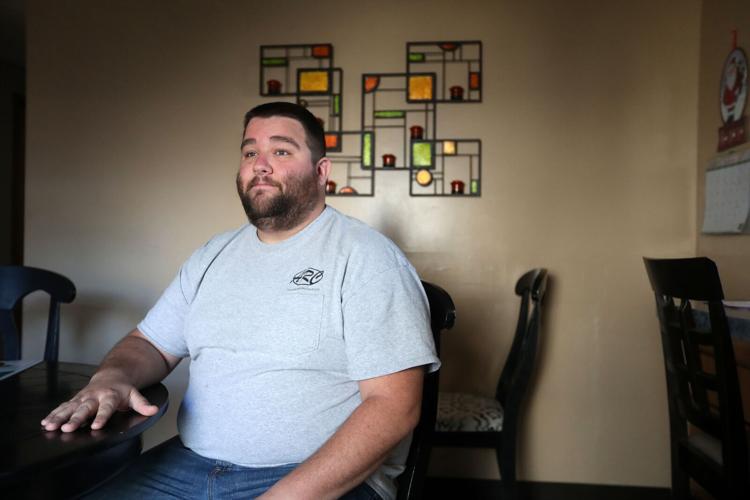
Connor Kolb sits at his kitchen table in Orchard Park Tuesday, December 14, 2021. Kolb has been trying to get his grandparents Albert and Sally Hulin into the same nursing home for about six months, but that is proving difficult amid staffing shortages.
As he attempts to bring them together, he can't help but think of all the times they were there for him.
All of the school events while he was growing up, for instance. Even if his parents couldn't make it and were working, grandpa Al and grandma Sally were there.
Later in life, when Kolb and his brothers decided to start their own business, WNY Snow Removal, his grandparents were a constant source of support.
While his grandma's memory can be shaky on events that happened in the last five years, Kolb said she'll sometimes pack her bags and say she's ready to go home so she can take care of her husband. His grandfather, Kolb said, knows it's been a year since he's been with his wife.
“They just want to be together," Kolb said.
Like they were in that photo.