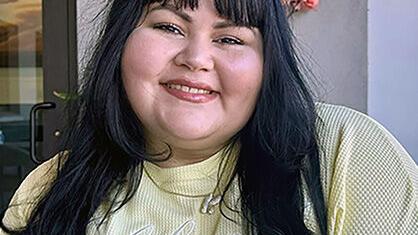
The deportation case against Tucson DACA recipient Karla Toledo has been terminated, about two weeks after the 31-year-old was arrested at her home and detained for four nights at Eloy Detention Center.
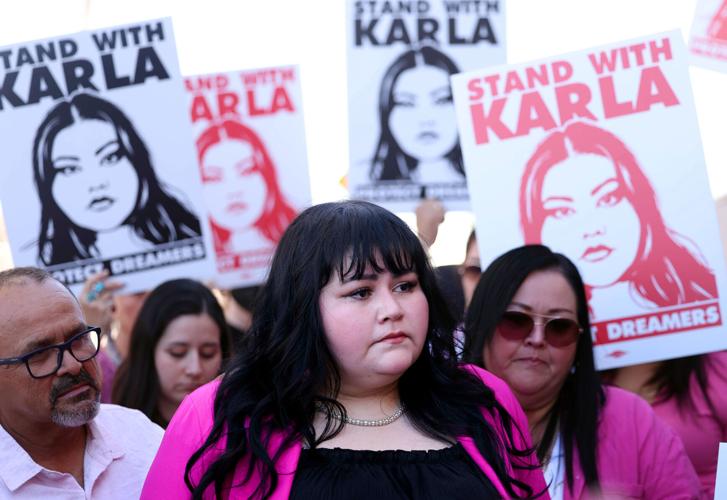
"I'm not the only one going through this," said Toledo on Wednesday morning, speaking in Spanish to supporters and journalists gathered outside the federal building in downtown, which houses Tucson's immigration court.
"Last year they detained more than 200 DACA recipients. We're under attack," said Toledo, who has had protection under the Obama-era DACA program, Deferred Action for Childhood Arrivals, since 2012.
Toledo — who has lived in the U.S. since she and her mother left Obregón, Sonora, when Toledo was a year old — said her DACA status is current through July, but her renewal application seems to be stalled.
People are also reading…

Karla Toledo, a DACA recipient arrested by federal agents in Tucson last, is no longer facing a deportation effort, her attorney said Wednesday. The case, however, could get refiled.
"I've been checking every day, but nothing has happened yet," she said. "I'm still really nervous. ... I have hope that everything will be okay, but we have to prepare for anything."
Toledo's immigration court hearing, scheduled for Wednesday, was canceled after immigration judge Irene Feldman signed an order Tuesday dismissing the deportation case against Toledo, without prejudice, said Toledo's attorney Mo Goldman Wednesday.
"Without prejudice" means U.S. Department of Homeland Security can still pursue another removal case against Toledo, he said.
"That means they can come back and get her again. We cannot stand for that," Goldman said. "If they do, I think we need to be even more outraged, because that shows retaliation. It shows the level of cruelty that this government can stoop to."

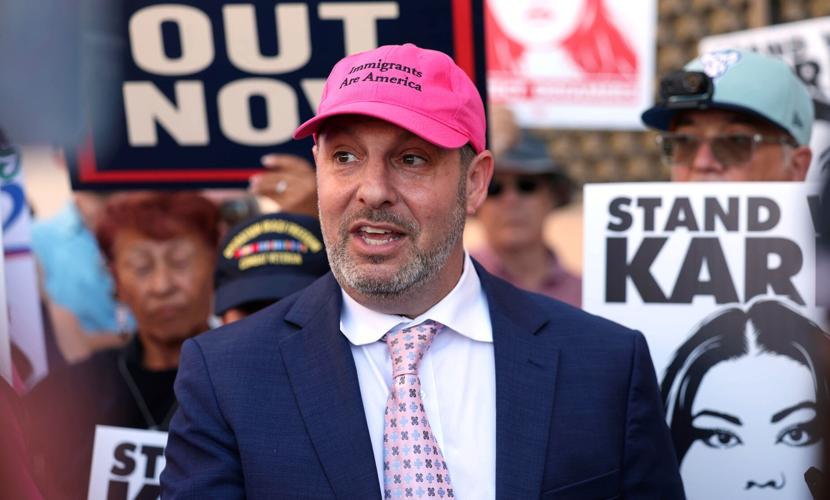
Mo Goldman, the attorney for Karla Toledo, said Wednesday that the deportation case against her has been dropped, though federal officials can refile.
DHS claimed in a May 20 statement Toledo had assaulted an officer who "was attempting to apprehend another individual" on the day she was arrested.
No criminal charges have been filed against Toledo for the alleged assault, a spokeswoman for the U.S. Attorney's Office in Arizona confirmed Wednesday.
DHS works to 'de-legalize'
Under the second Trump administration, U.S. Citizenship and Immigration Services' processing of DACA renewals has slowed, which Goldman and other advocates say is an intentional effort to "de-legalize" more immigrants so that ICE agents can reach their arrest quotas.
"The government is purposely dragging their feet on the processing of DACA renewals," Goldman said. "They have tens of thousands of applications for new DACAs that they're not processing. They're taking people's money, to the tune of about $500 per application, and not doing anything about it. They're just sitting on these applications."
Both Goldman and ICE's attorney filed motions to terminate Toledo's deportation proceedings.
Asked for the reason for the dismissal, an ICE spokesperson said in a June 4 email, "ICE may decide to file a motion to dismiss an alien’s immigration proceedings for a variety of reasons, such as exercising prosecutorial discretion, prioritizing enforcement resources, or clearing dockets, among other things."
Goldman said ICE's reversal was likely due to the public outrage over Toledo's arrest.
The deportation case against Tucson DACA recipient Karla Toledo has been terminated, about two weeks after the 31-year-old was arrested at her home and detained for four nights at Eloy Detention Center.
Toledo spoke on Wednesday to supporters and journalists gathered outside the federal building in downtown, which houses Tucson's immigration court.
Video by Grace Trejo, Arizona Daily Star.
"Sixteen days ago, she was abducted from her home by rogue ICE officers who didn't have proper warrant or documentation to do what they did to her," Goldman said. "She is everything that is right about this country. She's somebody that we need in this country, and she represents not only an individual, but tens of thousands of other Dreamers and people with DACA who are currently facing de-legalization."
Former President Barack Obama created DACA by executive order in 2012 to allow children brought to the U.S. without authorization before 2007 to obtain temporary status in the U.S., which must be renewed every two years, and to secure permission to work.
The program was intended as a stop-gap measure to protect the population of so-called "Dreamers," in anticipation that lawmakers would create a path to citizenship for the group. But 14 years later, Congress has yet to act.
"We need to continue to put pressure on our elected officials to come up with a comprehensive solution to our immigration issues, because this administration is going to continue to de-legalize people, and they're doing it to dehumanize them," Goldman said.
Though DHS claims DACA does not provide legal status, Goldman said the program represents a promise that if participants shared their information with the government, and submitted to regular background checks, the U.S. government would "defer" deportation proceedings against them.
"'Deferred action' explicitly is for people not to be deported," he said. "It was based on a premise of prosecutorial discretion, in that the government has the discretion to not deport people who are low priority, like Karla."
But DACA was never meant to be permanent, he said.
The deportation case against Tucson DACA recipient Karla Toledo has been terminated, about two weeks after the 31-year-old was arrested at her home and detained for four nights at Eloy Detention Center.
Toledo spoke on Wednesday to supporters and journalists gathered outside the federal building in downtown, which houses Tucson's immigration court.
Video by Grace Trejo, Arizona Daily Star.
"The mechanism of DACA was a band-aid, because Congress neglects to do their job and pass a Dream Act or some other form of immigration reform to protect people like Karla, like other undocumented immigrants in this country," Goldman said.
The Trump administration is now also targeting legal immigrants, and making it harder for those in the U.S. on valid visas to apply for permanent residency, Goldman said. Unauthorized immigrants often have no real pathway to regularize their status, making it all the more urgent that lawmakers take action on comprehensive immigration reform, he said.
"We need to put more and more pressure, again, on the government to do the right thing, because they are not," he said.
No evidence provided for DHS claims
Toledo's May 18 arrest was captured on her home's surveillance video. It shows several immigration officers chasing Toledo's husband into their home, before two of the officers forced the door open and entered the home without a judicial warrant.
In the surveillance video, Toledo then confronted the officers, pushing one out of her home and demanding a warrant, before they arrested her.
Toledo was released from Eloy on May 22, after her family posted bond. Goldman said the quick release was an admission that Toledo was unlawfully detained.
"They arrest her, they detain her and then they release her," he said. "When has ICE done that recently? They have not been doing that at all. That was an admission of guilt on their part."
In a phone interview from Eloy Detention Center last month, Toledo told the Arizona Daily Star that an ICE officer in Tucson's ICE field office told her she'd be charged with assault unless she helped the agency take custody of her husband, who became undocumented after DHS canceled his Temporary Protected Status.
U.S. Immigration and Customs Enforcement declined to respond to the Star's questions about whether Toledo's detention was an effort to coerce her into turning in her husband, who is from Venezuela.
The agency has also refused to share an administrative warrant — a document issued by ICE, which does not allow for entry into private spaces — that would show whom officers were targeting the day Toledo was arrested.
The deportation case against Tucson DACA recipient Karla Toledo has been terminated, about two weeks after the 31-year-old was arrested at her home and detained for four nights at Eloy Detention Center.
Toledo's attorney spoke on Wednesday to supporters and journalists gathered outside the federal building in downtown, which houses Tucson's immigration court.
Video by Grace Trejo, Arizona Daily Star.
ICE also claims Toledo illegally entered the U.S. in 2024, citing the alleged violation as the basis for her arrest. But ICE has refused to provide any evidence of the claim, which Toledo and her attorney deny.
Toledo traveled out of the U.S. in 2024 under "advance parole" permission, which allowed for multiple returns to the U.S., Goldman said. A port officer legally admitted Toledo back into the U.S. at the time, he said.
On Wednesday, Toledo expressed gratitude for the outpouring of support she's received, and called for greater attention to the rising number of people held in ICE detention. She urged all DACA recipients to prepare themselves by gathering relevant documents and learning about their rights.
"Prepare for the worst, but hope for the best," she said.
Contact reporter Emily Bregel at ebregel@tucson.com. On X, formerly Twitter: @EmilyBregel

Emily Bregel
Border reporter