In 2007, Mike Brown applied for a green card for his wife, Virginia Carrillo, an undocumented immigrant from Mexico. They met several years earlier at the Boeing plant in Mesa where he built Apache helicopters on the assembly line and she worked as a janitor.
Because Carrillo had entered the United States illegally, she was required to return to Mexico for her green card interview at the U.S. consulate in Juarez. The couple anticipated Carrillo would come back quickly with her green card, the document that allows immigrants to live and work permanently in the United States.
Instead, Carrillo was barred from returning for 10 years, a penalty for having lived in the United States illegally for more than a year. It didn't matter that Carrillo's husband, Brown, was a U.S. citizen and the couple shared a U.S. citizen son, Bryan, who was 3 at the time.
The couple managed to survive the prolonged 10-year physical separation. But they had to overcome many financial and emotional struggles, including raising Bryan and later two more young children, Kylie and Mikey, while Brown lived in Mesa and Virginia lived in Mexico.
People are also reading…
During the more than decade-long separation, Brown supported his family financially. Four or five times a year, Brown also loaded up his pickup with furniture, clothes, and toys and drove 15 hours from Mesa to spend one- or two-week vacations with Carrillo and their children in El Nacimiento, a village of 300 people in the mountains of Sinaloa in northwestern Mexico where Carrillo is from.
"It was hard. It was hard. It was very hard at times," the 62-year-old Brown said, recalling the 10-year separation, which ended on April 9, 2019, when Virginia finally was approved for her green card at the U.S. consulate in Juarez.
The next month, Brown drove down to El Nacimiento to pick up Carrillo, and the entire family of five returned to Mesa. Brown remembers the moment they crossed the border on the way to Mesa with Carrillo, together as a family for the first time in the United States.
"We were just ecstatic, just very happy that finally . . . she was able to come up here," Brown said.

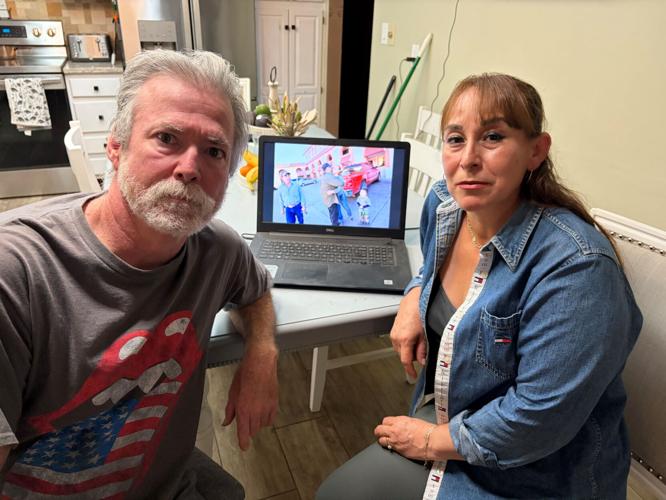
Michael Brown and his wife, Virginia Carrillo, pose in front of a computer image of them saying goodbye in Mexico in 2007 when she was barred from returning to the U.S. for 10 years for living in the U.S. illegally.
New Trump policy could extend separations
Prolonged family separations became more rare after then-President Barack Obama made policy changes in 2013 that made it easier for undocumented immigrants to overcome the three- and 10-year bars when they showed up for green card interviews at U.S. consulates abroad, U.S. State Department data shows.
But under a major new Trump administration policy, a whole new wave of immigrants eligible for green cards through U.S. citizen relatives could now face the same prolonged family separations the Browns endured, according to immigration experts.
The policy, announced May 21, attempts to engineer a massive shift in the processing of green cards from inside the country to U.S. consulates abroad by directing immigration officers to use their discretionary powers to grant adjustment of status only in "extraordinary" circumstances.
The new policy likely will face legal challenges on the grounds that it violates decades-old practice enshrined under immigration law passed by Congress.
But as it stands, hundreds of thousands of immigrants married to U.S. citizens could face separation from them for years, said Carl Shusterman, an immigration lawyer in Los Angeles who was a federal immigration prosecutor in the late 1970s and early 1980s.
"Families would be broken up and kids would have to be with one spouse or the other spouse but not with both parents," Schusterman said. "This could be a real disaster."
About 1 million green cards were granted annually from 2015 to 2024, with about 54% approved to immigrants already in the U.S. through the adjustment of status process, and the rest to people abroad through U.S. consulates, according to the Department of Homeland Security.
In fiscal year 2024, about 800,000 immigrants adjusted their status from within the United States, according to U.S. Citizenship and Immigration Services data. So under the policy that is the number of people "who could be required to leave their families, jobs, and lives behind to go through consular processing abroad," Jeanne Batalova, a senior policy analyst at the Migration Policy Institute, wrote in a post on LinkedIn.
"In practical terms, this policy means months or years of de facto family separation for U.S. citizens and their children whose immigrant spouse or parent has to leave the country to apply for a green card, and significant disruption for U.S. employers who have invested heavily in hiring and retaining immigrant workers," Batalova wrote.
Of the 800,000 immigrants who adjusted their status to legal permanent residents from inside the country, about 403,000 received their green cards through immediate U.S. citizen relatives, including spouses, children or parents.
Since the policy was announced, Trump administration officials have provided more clarification, stating that immigrants who provide an economic benefit or whose presence is in the national interest wouldn't have to go back to their countries to seek green cards, an apparent reference to high-skilled immigrants seeking green cards through employers.
As a result, the policy appears to mainly target undocumented immigrants who entered legally with visas and then stayed after their visas expired, or those who were paroled into the United States, said Julia Gelatt, associate director of the U.S. immigration policy program at the nonprofit Migration Policy Institute.
It used to be that undocumented immigrants who overstayed visas, such as a tourist visa, and were eligible for green cards through a U.S. citizen spouse or citizen child over 21, could become permanent residents through a process called adjustment of status. Unlike undocumented immigrants who entered illegally, they avoided the three- and 10-year bars because they didn't have to leave and go back home, which triggers the bars, Gelatt said.
The new policy, however, seeks to treat undocumented people who overstayed visas or who were paroled into the country the same as those who entered illegally, Gelatt said. By pushing visa overstayers and parolees to go back home to apply for green cards, they, too, would face the three- and 10-year bars as those who entered illegally, Gelatt said
"Now, basically anybody who's living in the United States without status, it sounds like under the new memo, will be unable to get a green card within the United States except maybe through the asylum process," Gelatt said.
The most likely outcome, Gelatt said, is that most undocumented immigrants previously able to apply for green cards from within the United States will "hunker down" and hold off applying until there is a more immigrant-friendly administration rather than risk going back to their home countries and face the three- and 10-year bars.
Jessica Vaughan, director of policy studies at the Center for Immigration Studies, said she favors the new policy because she believes it will restore integrity to the immigration system and make it more fair to immigrants who don't enter illegally or overstay visas.
She argues that visa overstayers and parolees should face the same three- and 10-year bars as undocumented immigrants who entered illegally, even if it results in a new wave of prolonged family separations that causes hardships for U.S. citizens.
"I don't think that those who lived here illegally should necessarily have a quick and easy path to a green card and expect that the government is just going to excuse that without a consequence," Vaughan said. "I believe the problem of people abusing our immigration laws is greater than the problem of individual families."
She estimates about 200,000 immigrants who overstayed visas could have to return home to apply for green cards under the new policy and therefore be subjected to the three- and 10-year bars.
Like Gelatt, Vaughan doesn't think the policy will result in a big increase in prolonged family separations because most visa overstayers and parolees will abandon the idea of applying for green cards to avoid the three- and 10-year penalties.
Even so, "they will be vulnerable to deportation," Vaughan noted, which could still result in family separations.

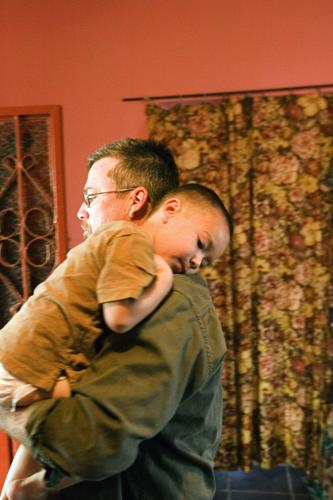
In 2008, Mike Brown comforts his son, Bryan, 3, in the village of El Nacimiento, Sinaloa, Mexico.
Clinton signed get-tough immigration policy
The three- and 10-year bars were part of a get-tough immigration law passed by the Republican-controlled Congress and signed by then-President Bill Clinton, a Democrat.
The law included a provision that bars undocumented immigrants from returning for either three or 10 years once they departed. Immigrants who had lived illegally in the United States for more than six months but less than a year faced a three-year bar. Those who had lived in the United States illegally for more than a year faced a 10-year bar.
In 2013, then-President Barack Obama's administration introduced a policy aimed at preventing the painful, prolonged family separations caused by the three- and 10-year bars.
The Obama policy granted provisional waivers to green card applicants before they left the country if they could demonstrate a prolonged separation would cause extreme hardship to immediate relatives who were U.S. citizens or legally permanent residents. The waivers were only previously granted after the immigrants had returned home for their green card interviews.
Approval of the provisional waivers virtually guaranteed immigrants wouldn't get hit with the three- and 10-year bars once they went back to their home countries for green card interviews at U.S. consulates.
The Obama-era policy was effective at reducing prolonged family separations. That's because most undocumented immigrants who go through with the process of applying for a green card in their home country at a U.S. consulate arrive with a provisional waiver already in hand, the data shows.
In 2024, about 16,000 green card applicants facing 10-year bars arrived at U.S. consulates abroad with provisional waivers in hand, nearly five times as many who arrived without provisional waivers, according to U.S. State Department data. All but four of those who arrived with provisional waivers overcame the 10-year bar and received green cards, the data shows.
Vaughan expects to see a big jump in applications for provisional waivers under the new Trump policy. It's possible the Trump administration may also tighten the extreme hardship standards, making it more difficult for green card applicants to receive the waivers and overcome the bars, she said.

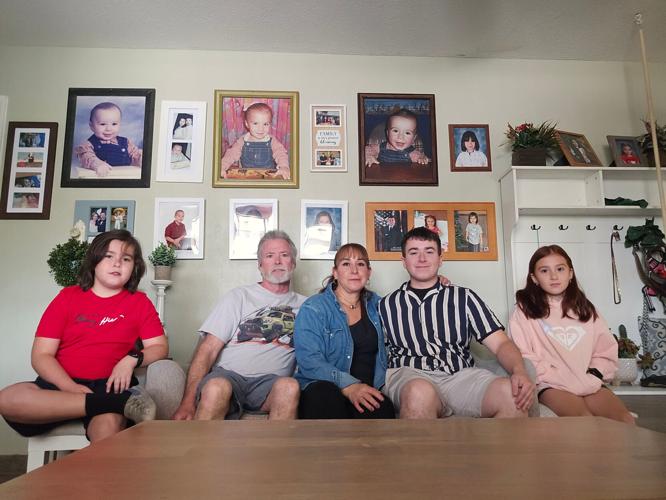
Mike Brown (second from left), his wife, Virginia Carrillo, their son Bryan, flanked by their other children, Mikey and Kylie.
More families could face similar hardships
The Brown family's experiences show how the new Trump policy could create many hardships for U.S. citizens whose immigrant spouses are hit with the three- and 10-year bars.
After Carrillo was barred from returning for 10 years, the couple decided their son, Bryan, should live with his mother in El Nacimiento.
They lived with Carrillo's mother and father, where she helped them tend chickens and grow corn and peanuts on a tiny ranch. There was no running water in the house, so sometimes she bathed Bryan outside in a plastic bucket.
Brown visited them four or five times a year during his vacations, driving his pickup truck 15 hours each way from his home in Mesa.
In the early days, Brown said he saw a therapist to deal with the emotional trauma of being separated from his wife and son.
"It was despondency," Brown said.
He remembered visiting his doctor one day and hearing a boy talking in the next room. The boy was about 4, the same age as Bryan.
"I just heard him say, daddy, daddy, and I just" snapped, Brown said, snapping his fingers. "I was just inconsolable. My doctor was like, 'Are you OK?'"
The separation also was hard on Carrillo, 48.
At first, spending 10 years apart "seemed like an eternity," Carrillo said, sitting on a sofa in her living room in Mesa. "But once you accept the idea, you get used to it."
Carrillo wanted to have more children so Bryan wouldn't be alone.
But at first they waited while Brown wrote letters to members of Congress to see if they could help Carrillo return early. After years went by and nothing happened, they started trying to have children. But the long-distance separation made that difficult, Carrillo recalled.
Carrillo finally gave birth to their second child, Kylie, in 2014, and their third, Michael, in 2016. Brown couldn't attend the birth of either child because of the separation. And when Kylie was born with red hair and white skin, it caused a mini scandal in the hospital.
"Es una gabacha!" ― She's a little American ― the doctor told her, presuming wrongly that Carrillo had cheated on a Mexican husband with an American.
Carrillo said she didn't tell many people she was married to an American because she was afraid she could be kidnapped by criminal organizations and held for ransom.
Sinaloa is home to the powerful Sinaloa drug cartel. Carrillo felt safe in her village. But sometimes she saw cartel members driving through back roads in dark SUVs, and one day a neighbor was killed by cartel members, she said.
Carrillo now works two jobs in Mesa. Several days a week, she helps her sister clean houses. She also works a 2 p.m. to 11 p.m. shift five days a week as a custodian for Mesa Public Schools.

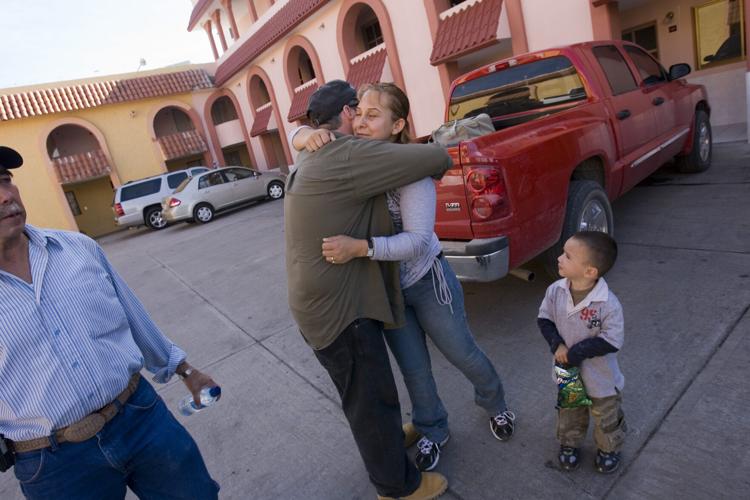
In 2008, Virginia Carrillo hugs her husband, Mike Brown, as he leaves to return to Mesa, Arizona, while their son, Bryan, 3, looks on. Carrillo remained in Mexico after she was barred from returning to the U.S. for 10 years.
A culture shock for returning son
Bryan, now 21, can't remember the first time his dad drove back to Mesa, leaving him in Mexico with his mother.
It was the Christmas holidays and Bryan was spinning around on his tricycle, a Christmas present, when Brown got in his pickup truck without him.
"Home, home," Bryan kept saying, pointing at the pickup, as recounted in a 2008 story in The Arizona Republic.
"No," Brown told him, picking up the boy. "This is your home, now."
Bryan grew up in Mexico with his mother until he was 7, speaking only Spanish. When Brown came to visit, they went fishing and hiking.
Then in the summer of 2011, Brown brought Bryan back to the United States to live with him so Bryan could attend schools in Mesa.
On the drive to the United States, Bryan suddenly realized he was leaving his mother in Mexico.
"We were well on our way, and I kind of saw it pop into his face and he started crying," Brown recalled.
The adjustment from living in a small village in Mexico to living in Mesa in the United States was huge, Bryan said.
"I didn't really have much knowledge about the United States before coming here," Bryan said. "We always just called it el otro lado, the other side. So I didn't have no notion of what it was going to be like. It was definitely a culture shock, though."
Mesa seemed like a huge city with "a lot of people, a lot more noise, a lotta things that were completely different from the little town of El Nacimiento," Bryan said.
In El Nacimiento, Bryan attended a tiny school with three classrooms where students in multiple grades were taught.
When he started second grade at Lowell Elementary School in Mesa, Bryan felt lost.
"This was like a ginormous school pretty much. Like a lot of buildings, a lot of rooms, different grades, and so I kind of didn't understand all of it. Very nerve-wracking," Bryan said.
Even though he was a U.S. citizen by birth, culturally "I felt pretty Mexican," Bryan said.
What's more, he only spoke Spanish.
"I remember the first question I ever asked in Spanish was, Where is the bathroom?" Bryan said.
The teacher didn't understand him. But Bryan said there were a lot of kids "who were like me who didn't know a lick of English. So obviously, they'd translate, and then eventually I got to a point where I could speak English on my own."
Every summer, Bryan returned to Mexico to live with his mother and his younger sister and brother in El Nacimiento.
At Westwood High School, Bryan joined the Air Force ROTC. Then in November 2023, after he finished high school, Bryan enlisted in the U.S. Marines. He's now a lance corporal stationed at Camp Pendleton.
"What appealed to me the most about the Marines is just the brotherhood," Bryan said, "because no matter how hard it gets, you always have your brother next to you."
Brown said he was proud when Bryan joined the Marines. He doesn't hold any animosity toward the United States for the prolonged separation his family endured.
"I don't really look at it like that," Brown said.
Looking back, Brown said, the prolonged separations caused many other hardships. Since his two youngest children were born in Mexico, he had to go through the process of getting them U.S. birth certificates before he could bring them to the United States to live. But there were some upsides, too.
"We've got three kids who have the benefit of knowing two cultures," Brown said. He and Carrillo also plan to live in a three-bedroom house they built in El Nacimiento someday when they retire.
But in the end, he still views the policy itself as needless and unfair.
"I didn't think it was making anything better. I don't think it made the United States any better, and it definitely wasn't making our family any better," Brown said.