Tucson DACA recipient Karla Toledo, who was released from ICE detention Friday afternoon, is denying the U.S. Department of Homeland Security's allegation that she assaulted a law enforcement officer before being arrested Monday at her home.
In a Thursday night phone call from Eloy Detention Center, while she was still detained, Toledo also vowed to keep speaking up for immigrants' rights, as the Trump administration escalates its "attacks" on immigrants with protection under the Deferred Action for Childhood Arrivals program, known as DACA.
Toledo said a U.S. Immigration and Customs Enforcement official in Tucson threatened her with criminal charges for assaulting a law enforcement officer — unless she helped ICE take her husband into custody. The conversation took place in Toledo's cell Monday, while she was still detained at the Tucson ICE field office before her transfer to Eloy, she said.
People are also reading…
"He said basically he could take those charges off of me, if I turned in the other person living in my house," Toledo, 31, told the Arizona Daily Star. Toledo said her husband is a Venezuelan national, who had Temporary Protected Status until the Trump administration canceled it.
The ICE official identified the alleged assault as the moment Toledo pushed a federal agent out of her home — captured on her home-surveillance footage — after he and another agent forced their way inside without a judicial warrant, Toledo said.
Toledo said she told the officer her actions were justified, as the man was unlawfully in her home and wearing plain clothes, except for an unofficial vest that said "POLICE."
"They were just wearing those green vests and normal clothes. It could have been anybody," Toledo said. "They were coming into my house with no warrant."
No criminal charges have yet been filed against Toledo for the alleged assault, a spokeswoman for the U.S. Attorney's Office in Arizona told the Star.
Mo Goldman, one of Toledo's attorneys, said for charges to be filed, another law enforcement agency would have to agree with ICE about the assault accusation.
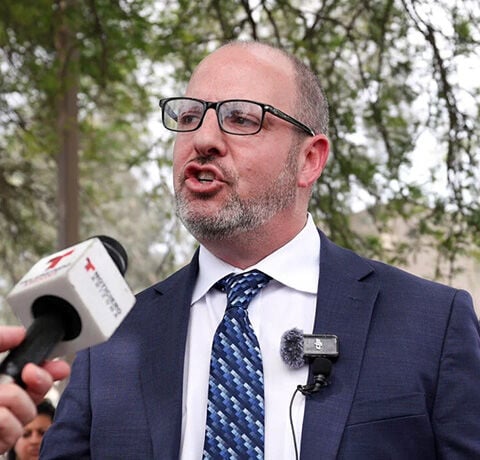
Goldman
"They (ICE) don't have jurisdiction to charge her with assault. They'd have to take it to a different law enforcement agency and see if they’ll press charges against her," Goldman said Friday. "From my perspective it doesn't look like she committed an assault. She was inside her own home and they were trying to come in. They didn’t have legal rights to enter the premises. ... It wasn’t a situation where she was putting the person in a position where they’ll be harmed in any way."
An ICE spokeswoman said she was working on a response to the Star's Friday morning query about Toledo's claims.
On Thursday, Toledo's family paid the $1,500 bond offered by ICE, and Toledo was released from ICE custody on Friday afternoon, Goldman said. ICE hasn't yet formally started any deportation proceedings for Toledo, he said.
"We'll have to see what they do next," Goldman said.
Toledo's DACA status is valid through July, and she's already applied to renew it, as DACA recipients must every two years.
Former President Barack Obama created the DACA program through executive action in 2012 as a temporary measure to defer the deportation of immigrants brought illegally to the U.S. as children, until Congress could create a legislative path to permanency for the population. Fourteen years later, Congress still hasn't acted.
ICE's target unclear
In a Wednesday media statement, an unnamed DHS spokesman claimed Toledo had assaulted a law enforcement officer who "was attempting to apprehend another individual." The same day, Toledo's attorney, Mo Goldman and a group of supporters held a news conference to refute DHS's claims, which Goldman called "fiction."
Toledo, who has lived in the U.S. since she was a year old, said she acts as a Spanish interpreter for a number of immigrant-rights nonprofits that work with Tucson's Rapid Response network, which receives reports of ICE activity locally and sends trained observers to bear witness. Toledo said she's learned her rights as an immigrant in the U.S. while interpreting during "know your rights" sessions.
On Monday, about 8:30 a.m., Toledo's husband, who has asked the Star not to use his name, saw ICE agents in his front yard and ran inside, closing the door just before the pursuing agents reached it. An agent then pushed the door open so hard that he fell onto the floor inside, Toledo's husband said.
Two agents entered the house until Toledo, who was inside getting ready for work, yelled at them to leave. Standing just inside her front door, on the home-surveillance video, Toledo is heard refusing the agents entry and demanding a judicial warrant signed by a judge, not just an administrative warrant generated by ICE. Agents didn't show any warrant, she said.
Toledo said the agents didn't seem to be after her, at least not at first: During the encounter, an agent claimed they were in "hot pursuit" of her husband when they entered the home — "hot pursuit" can be an exception to the 4th Amendment's protections for private spaces — but the agents seemed to have him confused with his twin brother, Toledo said. They showed her a photo of his twin, she said.
Toledo said she's been with her husband since soon after he arrived in the U.S. from Venezuela in 2022, and they were married in October 2025.
The agents didn't know her husband's name until later in the interaction, after Toledo assumes they ran his license plates to find out. The five or six agents outside her home were all communicating with one another, and seemed to learn more about her as the encounter went on, she said.
Toledo argued with agents at her front door for five to 10 minutes, as they kept telling her to come outside, she said.
"It felt like forever," she said from Eloy. "I was really nervous. ... Since they'd come in (the house), I was afraid they would come in again."
The moment she stepped out her home, an agent grabbed her and put her in handcuffs, she said.
"I was kidnapped," she said. "They didn't let me show them my active DACA. They didn't let me do anything."
U.S. Rep. Adelita Grijalva, a Tucson Democrat, managed to visit Toledo on Monday while she was detained at the Tucson ICE field office, as Toledo’s family and friends held a protest outside the ICE office.
"While I am relieved Karla was released, she should never have been detained in the first place," Grijalva said in a Friday statement, after Toledo’s release. "ICE has still failed to answer why agents entered her home without a warrant signed by a judge, or why they attempted to smear her name with unsubstantiated allegations about what occurred."
Staying positive
The Board of Immigration Appeals issued an opinion in April arguing that DACA alone doesn't automatically protect enrollees from deportation.
Alba Jaramillo, a community organizer with Tucson’s Coalición de Derechos Humanos and a friend of Toledo, said Toledo’s arrest is a "wake-up call."
Jaramillo, who is also co-executive director of the Immigration Law and Justice Network, said the recent BIA ruling "has politically empowered Trump to arrest and detain DACA youth."
"We cannot trust that this administration will provide due process, nor can we trust that they will refrain from using violence to meet their arrest quota," Jaramillo wrote in a text message. "Immigrant youth are in danger of government sponsored kidnappings. We must demand that Congress act swiftly to pass legislation to protect DACA youth."
Toledo said she's kind of a test case for Trump's DHS, as it escalates its attacks on DACA recipients, as DHS seems to be testing how far they can go in targeting immigrants with DACA protection.
Most of the DACA recipients arrested or deported by Trump's DHS so far seem to have an issue such as a criminal record or expired DACA status, she said.
But Toledo has no criminal record, has current DACA status, and she knows her rights, she said.
"I feel like I'm the guinea pig, for a lot of DACA students. There have been other deportations of DACA students, but they've had pending cases. In my case, I have an active DACA," she said.
Though not a permanent legal status, DACA was a promise to not deport individuals brought to the U.S. as children, who have been raised in this country, she said. Toledo was a baby when she left her birth town of Obregón, Sonora.
For DACA recipients, "we don't know anything else," she said. "If you have DACA, you know the United States way more than your own country."
There has long been bipartisan support for legislators creating a path to citizenship for immigrants brought illegally to the U.S. as children. A 2025 Gallup poll found 85% of respondents, including 71% of Republicans, supported the idea.
Toledo said she hopes something good can come out of all the attention to her arrest, and to her robust defense of her rights caught on the surveillance video. She wants to show others they can speak up for themselves and resist unlawful actions by federal agents, she said.
"I feel like this can help me be more of a testimony to other people, that they're not allowed to get in your house," she said. "I feel like there is a lot of worry in the DACA community. So being able to be an advocate and speak up more for our rights and continue doing what I was doing before, I think it can help a lot of our community."
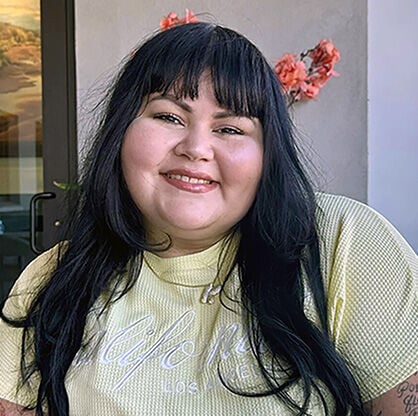
Toledo
Toledo has a large social media following, and she said she will "absolutely" discuss what happened to her with her hundreds of thousands of followers.
"I hope after this I can feel safe and in the clear, but at the same time I’m not going to stay quiet," she said on the Thursday call from Eloy. "I'm trying to not just think about myself. ... Yes, it really sucks being here (at Eloy). I feel really sad, I feel anxious because I’m stuck here. At the same time, I’m trying to look at the positive and say, I think this is going to be good somehow."
Still, Toledo wishes she'd known even more about her rights on Monday morning, because she would have ended the interaction with the agents sooner.
"I feel I needed to know more, to be a little bit more stern and close the door on them," she said, "because I could have done that."
Contact reporter Emily Bregel at ebregel@tucson.com. On X, formerly Twitter: @EmilyBregel

Emily Bregel
Border reporter