There's been no shortage of opposition to the buildup of border fences over the past few years and now there's website devoted to the cause.
Here's the website: NoBorderWall.com
This is the description of the the site's purpose from an email sent out by Scott Nicol, No Border Wall spokesperson:
"This site is designed to be a comprehensive guide to the U.S.-Mexico border wall--its history, its ineffectiveness, types of wall designs, and the problems it has caused. There is also a geographical breakdown that details the damage walls have caused in specific regions. With loads of information and citation links to documents and newspaper articles embedded throughout, it is our hope that this site will become a point of entry into the issue for reporters, researchers, policy makers, and the general public.
People are also reading…
The updated website comes at a particularly important time, with candidates for office as far from the border as Rhode Island running on border militarization. This often includes calls for more border walls, even double-layered walls from coast to coast, despite the tremendous financial, social, and environmental cost that this would inflict upon the United States. National policies of this magnitude must be based on facts, rather than misleading sound bites. That is why we have made every effort to ensure the accuracy of the information that is presented on the website."
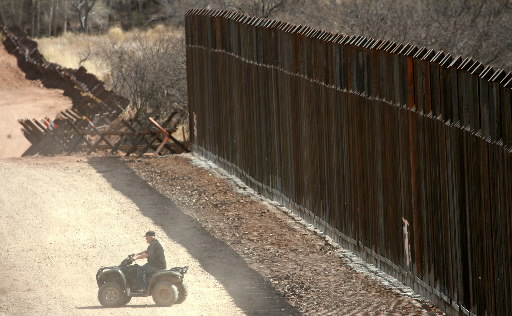
There are currently 71.3 miles of pedestrian border fences in the Border Patrol's Tucson Sector, which covers from New Mexico to Yuma County. That's up from 11.3 miles in 2000, Border Patrol figures show. Pedestrian fences are the 12-18 foot high fences that are designed to stop people and vehicles.
There are also 139 miles of vehicle barriers up in the Tucson Sector, up from 2 miles in 2000. Vehicle barriers are waist- or chest-high barriers designed to stop vehicles but not people or wildlife.
While it could take years to fully comprehend the environmental toll of border fencing, critics say it is bound to create problems for the land and wildlife. But Border Patrol officials say the fencing is beneficial to the environment and wildlife because it is cutting down on the trash left behind by illegal immigrants.
As I wrote in this March 2009 story about the debate over the fences — Border fences grow, as does debate that rages over them — Border Patrol officials acknowledge that the barriers are not a panacea but say they deter, slow and funnel traffic, providing them with a tool that gives them the upper hand in the eternal cat-and-mouse game with smugglers. They credit the fences, along with the increase in agents, for a decrease in apprehensions in the Tucson Sector over the past five years.
The fences have not been cheap, either, as the GAO reported in a January 2009 report, which I wrote about: Border fence averaged $3.9 million per mile.
And as so often the case with high-priced DHS projects, a September 2009 GAO report found that despite a $2.4 billion investment to build 264 miles of fencing and 226 miles of vehicle barriers in the last five years, the impact of these barriers on border security is unknown because it has not been measured.
"Until CBP determines the contribution of tactical infrastructure to border security, it is not positioned to address the impact of this investment," the report said, referring to Customs and Border Protection.
---------
**Update**
I received an email from the website's spokesman, Scot Nichol, who expanded on why he launched the website now.
"This is a critical time in the struggle to prevent hundreds of miles of additional border walls from being built. With mid-term elections less than a month away, politicians from all over the country are calling for the erection of more border walls. Some go so far as to demand that double-layered walls stretch continuously from the Pacific Ocean to the Gulf of Mexico."
South Carolina Senator Jim DeMint, who hopes that his backing of Tea Party candidates will give him a power base in the Senate, has twice this year introduced amendments that would require hundreds of miles of additional border wall, ignoring the fact that at an average cost of $7.5 million per mile his new walls would cost taxpayers $2,647,500,000.
Even more extreme than DeMint is Kansas Representative Todd Tiahrt, who is running for the Senate. He has introduced legislation that requires continuous double-layered border walls along the entire 2,000 mile long border.
From Rand Paul in Kentucky to Michael Gardiner in Rhode Island, conservative candidates are trying to outdo one another in their support for more and more border walls, in an effort to show voters that only they (certainly not their opponent!) can secure our nation's borders and keep us safe. Most of their claims regarding spillover violence and the effectiveness of border walls are at best urban myths, and at times outright lies.
No Border Wall launched its new website in an effort to present the facts. Any discussion of the future of the border, and those of us who live here, should be based in fact, not simply sound bites that appeal to the irrational fears and misconceptions of voters in Kansas or South Carolina or Kentucky.
If, as many predict, there is a big shift in Congressional control, those who campaigned on border walls will feel obliged to follow through. As we saw with the Secure Fence Act (passed just weeks before the mid-term election) once legislation is passed it is extremely difficult to do anything about it. We need to work to educate people now."