

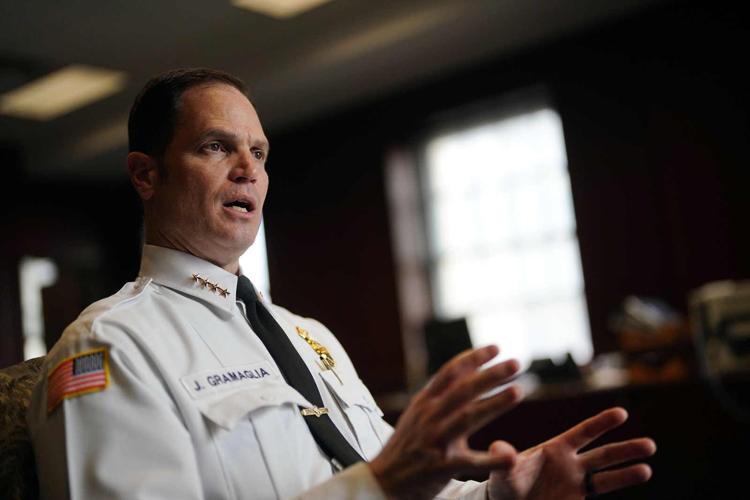
In the pre-dawn hours of the day Joseph Gramaglia was sworn in as Buffalo's 42nd police commissioner, a crisis unfolded at an apartment building on Hertel Avenue.
A man armed with a knife was wounded by two police officers after he lunged at them, body camera footage later showed.
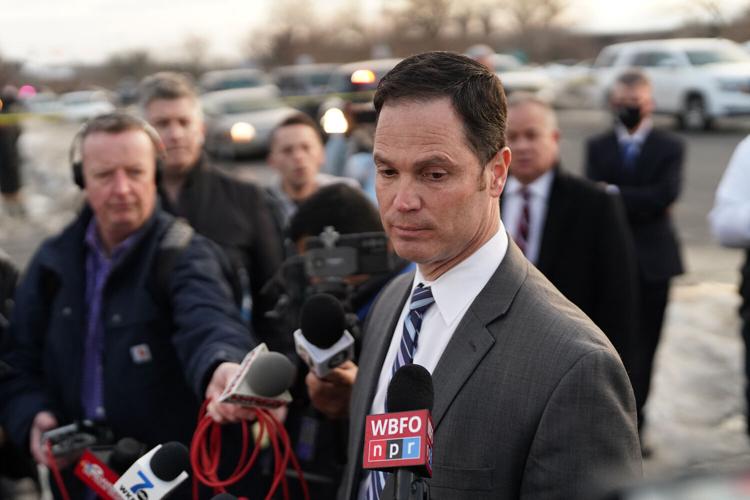
"They tried everything they could. I don't know what you could have done differently," Gramaglia told reporters about the March 14 police shooting.
Ten days later, Gramaglia made good on a promise to University District Council Member Rasheed N.C. Wyatt to appear at a town hall meeting to address residents' questions about crime and policing.
People are also reading…

"There are a lot of guns flowing in this community, and our problem right now is not just guns, but ghost guns," Gramaglia said, addressing one resident's concern about the city's burgeoning gun violence.
The following week, he was standing before reporters again at Erie County Medical Center after a cross-town police chase that ended with three police officers and a suspect wounded.
That weekend, nine more people were shot in three separate incidents during a 24-hour period.

Buffalo Police Commissioner Joseph Gramaglia said one officer was in stable condition after surgery and the others sustained non-life-threatening injuries.
It's been a busy start for the new commissioner.
Gramaglia, 50, who has been in the Buffalo Police Department since 1996 and has supervised every detective unit in the department, most recently served as one of two deputy police commissioners. In February, after Byron Lockwood retired, Mayor Byron Brown appointed him interim commissioner and his nomination was confirmed in early March.
"It's definitely been challenging," Gramaglia said of his first month.
Son of a trooper
Gramaglia was born in Poughkeepsie and grew up in Lackawanna. His father, also Joseph, was a state trooper for 25 years and he said he always wanted to be a police officer when he grew up. One of his earliest memories was putting on a police office costume he got for Christmas, he said.
After graduating from Bishop Timon High School in South Buffalo, he got his associate degree in criminal justice from Hilbert College and then a bachelor's in communication at SUNY Fredonia State College. Years later, he returned to school to get a master's degree in public administration at SUNY Buffalo State College. He wrote his thesis on police opinions about body cameras based on surveys he conducted with Buffalo and Rochester police officers.
Gramaglia was a familiar face to many in Buffalo. He often serves as the spokesman to the media following a major incident. He's also involved in the national law enforcement circles, frequently attending conferences to learn the best practices in policing.
Last summer, he was invited to take part in the Police Executive Research Forum's senior management institute.
"Buffalo hadn't sent anyone in 20 years," said Chuck Wexler, executive director of the nonpartisan policing think tank. "He has a perspective of saying: How can we make the Buffalo Police Department and the community of Buffalo the best in the country. I think that's what he's going to bring to the position."
Gun violence strategies
Gramaglia comes to his new role during a time of intense scrutiny of the criminal justice system in the U.S., following the murder of George Floyd by a Minneapolis police officer and the protests and riots that followed. At the same time, Buffalo, like many other cities across the country, is grappling with a spate of gun violence that skyrocketed during the pandemic.
"Schools were closed. Entertainment was closed. ... There was nowhere for people to go out," Gramaglia said. "The shootings just exploded. And it was disheartening to the department and to the officers that were working so hard."
So far in 2022, the rate of gun violence has slowed, with shootings down 34% compared to the same period last year as of Wednesday. However, the number of people shot in Buffalo remains worse than average, according to data released by the Buffalo Police Department.
Gramaglia has begun rolling out several new strategies to reduce shootings in the city.
"We want to be very focused on those carrying guns and the trigger-pullers. We don't want to have encounters with people who are just trying to live in neighborhoods that are plagued with gun violence. We want to be very, very focused on getting to the right people and also preventing violence from occurring. ... The more we can prevent, the more we save lives, the more time we allow for our investigators to work on the crimes they're already dealing with."
2022: New Buffalo Police Commissioner Joseph Gramaglia talks about a new departmental initiative to use data to target areas of high crime with proactive patrols.
For the last several weeks, Buffalo police, working with the Erie County Sheriff's Office, State Police and FBI, have executed a series of search warrants at addresses where illegal activity involving guns and drugs is suspected.
Later on the same day of the raids, another squad of police are sent in. They are community police officers with the Neighborhood Engagement Team. They go door to door to answer questions about the police searches earlier in the day and to listen to what the neighbors on the street have to say.
The idea, said Gramaglia, is for officers to take a little extra time and effort to explain what they're doing – and by doing so, building a better relationship with the public.
"We should explain to people why we did what we did, or why we didn't do something. ... It's that communication," Gramaglia said.
In the near future, he hopes to have door hangers that the officers would leave at addresses around a raided house to alert the neighbor about what took place and direct them to online surveys.
How to cool hot spots
Another strategy police are using is based on a plan that reduced gun violence in Dallas. The strategy involves identifying crime "hot spots." But it's not about blanketing an entire neighborhood with police and pulling over everyone driving in a zone, Gramaglia said. Instead, police are looking at highly granular data – down to the block.
"We've put the entire city into 500-foot-by-500-foot grids. We have an overlay grid over the city and and then look at them by individual districts. We are looking at shootings and shots fired and other gun crimes within those grids. We're looking at 90-day trends and we're looking to see where those hot spots are developing," Gramaglia said.
They look at what time those crimes are happening and who they involved.
When the hot spots become evidence in those small areas, each district directs officers – if they're not in the midst of responding to 911 calls – to go to one of those locations.
"We're telling them to go to these grids for 10 to 15 minutes per hour. Park, put your flashers on, get out of the car and start networking and engaging," Gramaglia said. "You make your presence known. ... If there's a gang house or if there's a drug house, we're parked in front of that and we just disrupted their activities for those 10 to 15 minutes we're going to be there. Then we're going to come back later."
The goal is to deter crime, so patrol officers aren't expected to make arrests – unless a crime takes place, Gramaglia said. "Then by all means they're going to do it."
The method can work for other kinds of crimes too, such as robberies or even loitering, he said.
"We recently had some robberies in a district and the chief took the initiative and started doing directed patrols. We knew who it was. There was a couple of juveniles that were doing robberies a few days in a row and we got over there, and you know, the robberies have stopped," Gramaglia said.


