

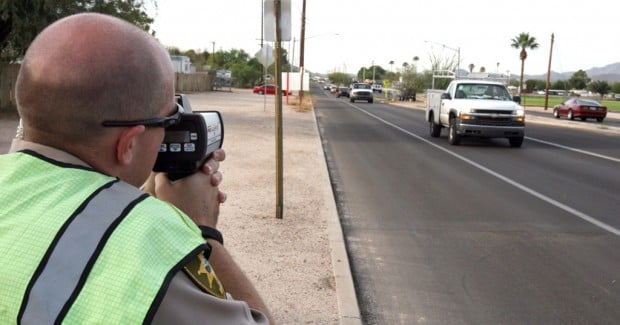
Deputy Ryan Roher hasn't written a traffic ticket in about a month.
Roher, of the Pima County Sheriff's Department traffic unit, hasn't been giving violators a break, but he's using new technology that authorities say will save the county money and make the process of issuing traffic tickets and attending court more convenient and efficient.
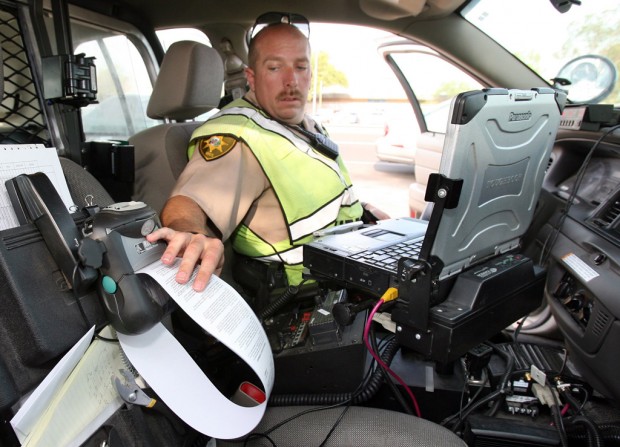
The Sheriff's Department has implemented an "e-citation" program that equips deputies with devices to scan driver's licenses, take the signatures of motorists and dispense traffic tickets.
The department also has set up a video link that lets deputies attend civil traffic court and interact with judges and those accused of violations from the confines of the nearest sheriff's substation.
Video monitors with cameras built inside, along with other equipment, have been installed in most substations.
People are also reading…
As a result, deputies do not have to drive downtown to attend court when someone wants to fight a ticket.
The equipment and training for the e-citation program cost $82,340. The total cost for the video court program is about $19,740, according to county documents.
The county is paying for the equipment and training for both programs from its photo-radar camera program, said Assistant County Administrator Lindy Funk-houser.
Authorities say the programs will save the county money, increase efficiency, allow deputies to get back on the street more quickly and cut down on the time deputies and motorists spend in traffic stops.
"It's an opportunity to promote safety to the public," said Lt. Lisa Sacco, special operations commander.
"We can interact with more people because it won't take as long" to write tickets, Sacco said.
The department hopes to install 25 e-citation units in patrol vehicles by no later than mid-September, once the testing phase is complete, Roher said.
Three deputies are currently equipped with the devices, including a motorcycle deputy who carries a smaller version of the computer used to retrieve motorist information, he said.
Those deputies carry a laptop computer with software to quickly access motorist information in the Arizona Motor Vehicle Department's database and import vehicle registration information onto a traffic ticket.
Deputies carrying e-citation equipment also have PalmPilot-like devices for motorist signatures, a scanner that allows them to swipe driver's license information and a small printer that dispenses traffic tickets that are almost the size of department store receipts.
Once a deputy records a driver's license, the motorist's information appears on the computer screen. The deputy inserts additional information by typing into open fields on the screen or using drop-down menus. After the ticket is issued, it is automatically sent to the Sheriff's Department and Justice Court databases.
That means Sheriff's Department and court workers do not have to manually type in the ticket information.
Roher has used the equipment on traffic stops for the last three months and has tested the devices for the last six months, he said.
Roher said that in some cases, the time it takes for him to issue a ticket has decreased by about eight minutes.
"We try to have a 10-minute stop time or less. With the e-citations, I've been able to write tickets in two minutes or less," he said.
The Tucson Police Department also uses e-citation equipment, said Sgt. Maria Hawke, a Tucson Police Department spokeswoman.
Tucson police officers have similar equipment, but only motorcycle officers use devices that allow them to swipe driver's licenses, Hawke said.
Motorcycle officers have used the equipment for about six years, while officers in patrol cars have carried it for three years, she said.
TWO-WAY VIDEO
The Sheriff's Department has used the video court system for at least six months, said Deputy Ed Curtin of the traffic unit.
Deputies attend court by sitting in front of a screen with two-way video that allows them to see the judge and the defendant.
The cameras and video monitors have been installed at the Green Valley, San Xavier, Foothills and Ajo district offices, Curtin said.
Deputies receive notices for trial when someone wants to go to court, but they can send an email asking for the proceeding to be done via video.
On a recent day, Curtin attended a trial where he had cited the driver for an improper left turn.
Curtin gave testimony as he sat in a conference room at the San Xavier district office, 2545 E. Ajo Way.
Curtin works from 6 p.m. to 2 a.m. and usually attends court during his off-time, he said.
"I don't have to deal with parking downtown, even in a police car," he said. "You're not losing a deputy out of the field for sometimes two hours."
Most civil traffic trials last between 10 to 15 minutes, he said.
The case with the woman who made the improper left turn took about 20 minutes.
The judge found her guilty but reduced her fine.
Curtin went home right after the hearing to get ready for his night shift.
Contact reporter Jamar Younger at jyounger@azstarnet.com or 573-4115.


