

Should school buildings reopen?
Students, parents and teachers in Western New York have various but passionate opinions on a topic that will directly impact their lives.
And the residual effects likely will impact everyone.
Reopening classrooms – or not – will affect the economy as well as the spread of Covid-19, along with a host of other things.
There’s a case to be made for keeping schools closed and continuing instruction this fall through Google Classroom, Schoology and Zoom, among other things, until the pandemic is under control.
There’s also a case to be made for students and teachers returning to their classrooms and resuming education as it used to be, albeit with the addition of masks, social distancing, hand sanitizer and one-way stairwells.
People are also reading…
The governor soon will make the call on whether schools will reopen.
Reopen the schools
Many students are eager to go back to school, where they can once again spend time with their friends, even if they have to wear masks, maintain social distance and adapt to new routines and protocols.
“I think it would be safer to be home, but I would rather be at school,” said Caoilin Schaeffer, a rising junior at Sacred Heart Academy, a Catholic school in Amherst. “I have not heard a single one of my friends say they don’t want to go back.”
Throughout the spring, she was able to see her friends during classes on Zoom, and her school even held assemblies with a few hundred people on Zoom. That helped. But it’s not the same as seeing her friends in person.
Gov. Andrew M. Cuomo will announce in the first week of August whether the infection rate in Western New York is low enough to reopen classrooms. Right now, it seems very likely that he will give it the green light, based on the current data.
If that happens, each school will follow its own plan for reopening. There are countless possible configurations.
In some places, all the students might return five full days a week in person. In other places, students might be divided into groups, with each group attending in person a couple of days a week and doing remote learning the rest of the time. Or a school might have all of the elementary students return in person and have the older kids learn remotely.
Many experts agree with Caoilin – the social and emotional needs of kids need to be taken into account. The American Academy of Pediatrics is among the high-profile groups of experts who support reopening the schools, with adequate safety measures in place, including facial coverings and social distancing.
Caoilin’s mother, Bridget McGuinness, also supports students returning to school. She trusts that the school will implement adequate measures to ensure students’ safety. Sacred Heart has been sending families information every week with updates.
“I think the better you are at communicating the plan and addressing concerns, the more confidence people will have,” said McGuinness, who has a master’s degree in epidemiology.
Sacred Heart did a good job teaching students remotely, mother and daughter said. Still, they want to see schools reopen.
So do Kelly Brownell, a speech pathologist at St. Mary’s School for the Deaf, and Anna Caci, a reading specialist at the school. For some students, school is where it’s easiest for them to communicate with other people, they said.
“They really do need the social aspect,” Caci said. “I really do wish school would go back. A lot of students’ emotional needs aren’t being met.”
Working with them over Zoom for the past few months was valuable, but it doesn’t replace seeing them face to face, Brownell said.
“Parents are not meant to be their teachers,” Brownell said. “They’re meant to be their parents.”
Larry Scott, a school psychologist in the Kenmore-Town of Tonawanda school district, said at this point, based on the data, he would feel comfortable returning to school in September with masks and social distancing in place.
“As a mental health professional, I know there are things that come up daily with kids and not being there on a regular basis with them, providing support, it is concerning,” Scott said.
But, like many others who support reopening schools, he acknowledges the number of people fearful of returning to the classroom and the uncertainty of how that might play out for districts.
“It absolutely is a major concern,” said Scott, who is also a member of the Buffalo Board of Education. “I would say most teachers want to return, but there are a good amount concerned about what returning is going to entail and a good amount that are either in that age group that are vulnerable or have pre-existing health conditions that make them vulnerable.”
The discussion on reopening schools has not included enough acknowledgement of the inequities between wealthier schools and the poorer urban and rural districts, said Eve Shippens, a Buffalo teacher.
“We already don’t have enough pencils and textbooks,” said Shippens, an environmental science teacher at East Community High School. “How are we supposed to provide masks for 33,000 students?”
Still, she said she would return to her class if schools do reopen in person for September.
“Not because I don’t think it’s a risk,” Shippens said, “but I really miss the kids that much.”
Keep schools closed
Some parents say that if their children are expected to attend school in person for any amount of time, they will opt out and keep their children home.
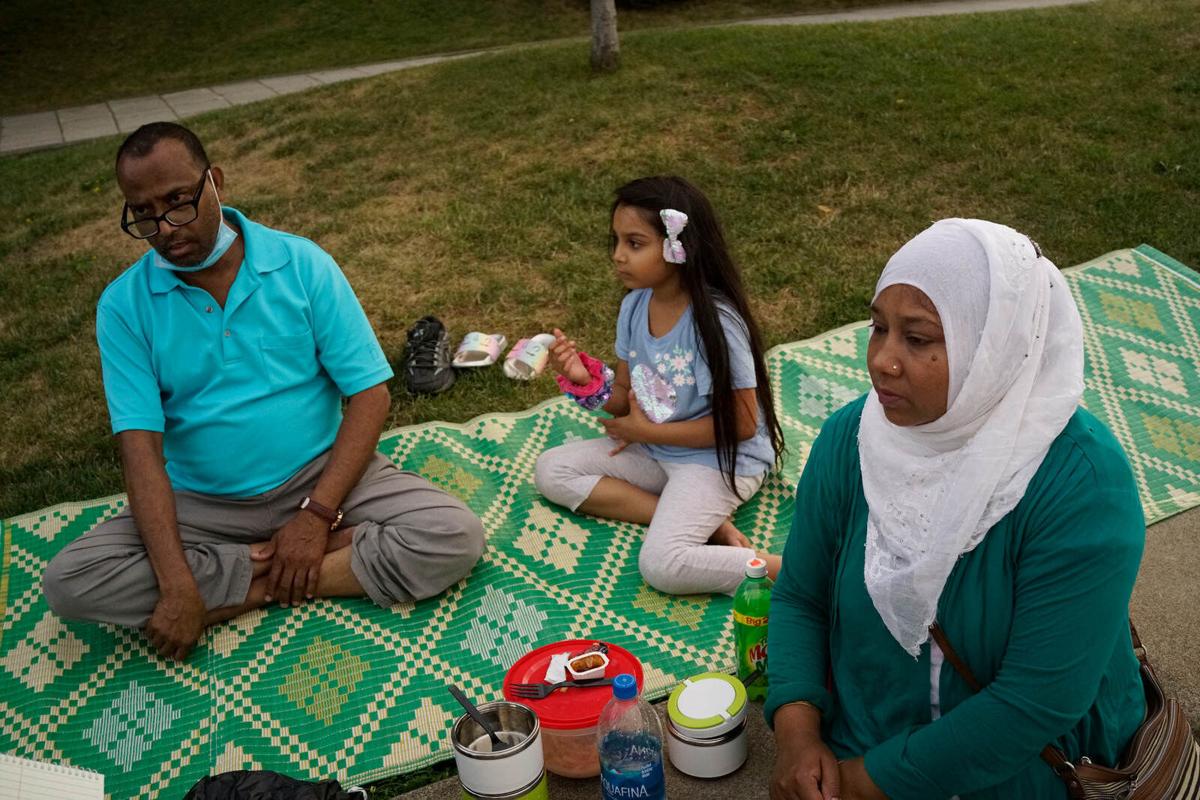
“How can we keep all the children in school with this disease when there is no medicine, no vaccine?” said Mohammad Patwary, whose daughter is going into third grade in Buffalo. “This is the 21st century. She can take her classes online.”
It’s not clear at this point what schools will do if some parents keep their children home. Some schools may offer students a remote alternative. Some may require those students to home-school. Either way, many parents are considering their options.
Erin Simmons and her daughter, Adriana Mattison, were satisfied with the job that Buffalo United Charter School did with remote instruction in the spring and want to see online learning continue in the fall.
They both think the risk of spreading the coronavirus far outweighs the benefits of reopening school.
“The bottom line is, it’s deadly,” said Simmons, who has a close friend who had Covid-19 and was hospitalized for three months.
Simmons, who works at a group home, was able to arrange her schedule in the spring so that she was home during the week when her daughter was working with her teachers online. But even if she had to lose hours at work to accommodate online school, she would gladly do it.
“I’d rather take a pay cut than have to bury somebody,” Simmons said.
Remote learning also has its advantages, they both said. Rather than being confined to set hours for learning, they can spread out the work throughout the day and take breaks when they want to. And Simmons is available for help when her daughter has questions.
“Being in the school with a full room of classmates is just more risky than it would be doing it virtual,” said Adriana, who is going into seventh grade. “You don’t want to go to school if somebody’s actually going to spread it.”
Not every family was satisfied with distance learning in the spring. Michael Hinderliter, who lives in South Buffalo, has two children, one entering eighth grade and the other entering ninth grade. After schools closed in March, their remote instruction was unorganized and inadequate, he said.
But teachers in summer school are doing a much better job, he said. His child who is entering ninth grade has found summer school to be much more organized. There are four subjects covered, and each one is taught for a period of time, followed by a break. Instruction is held consistently from 9 a.m. to 2:30 p.m. Monday through Friday.
“School is always needed for social interaction and learning first and foremost,” he said. “But with the current virus situation, no teacher, student or staff should have to be put at risk daily. Schools should remain closed until January.”
There’s a lot of fear and uncertainty among educators over returning to their classrooms, said Chris Cerrone, a social studies teacher at Hamburg Middle School.
“We know that teaching is a people profession, we need to be in person to best help our students, but the unknown about the impacts of the virus on both students and staff is extremely scary,” he said.
There is no path forward to a safe return to school without emergency funding from the state and federal governments, he said.
“How do districts pay for the extra staffing, bus runs, supplies and improvements to aging buildings needed to provide a safe and healthy learning environment without the proper funding?” said Cerrone, who is also a school board member in Springville.
Some parents are lobbying their local schools not to have students return in person when the school year begins. A group of parents in the Williamsville Central School District are circulating an online petition asking their district to continue remote instruction throughout the fall or possibly even the entire school year.
“Our students, teachers and the staff who help keep our schools running should not be asked to put their lives at risk,” the petition reads. “We are unwilling to have the school system be responsible for even one death of a student, teacher, caregiver, or staff member.”
The parents are offering dozens of suggestions on ways the district might be able to improve remote instruction and better utilize technology.
“We will NOT, however, approve of sending our kids into certain danger by exposing them unnecessarily to a highly communicable, unpredictable virus, stemming from a desire to ‘return to normal’ or because patience has run out,” the petition reads. “The risks appear no different in the second half of 2020 as they did in the first half.”


