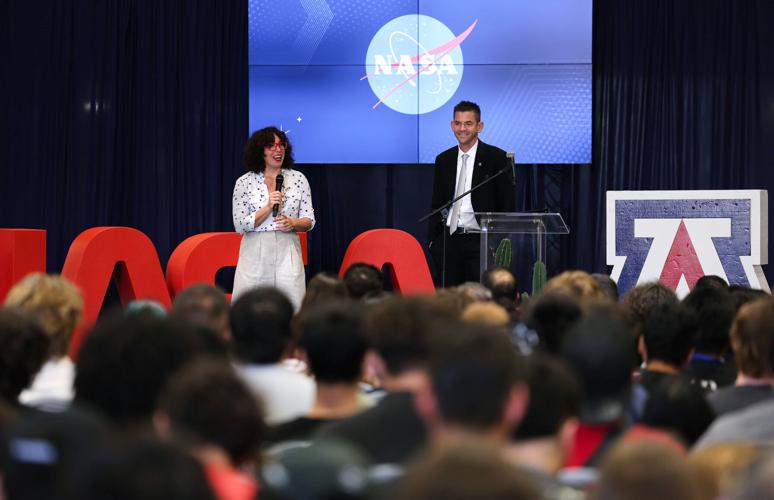
NASA administrator Jared Issacman speaks at the University of Arizona NASA Inspiration Tour inside Bear Down Gymnasium.
Video by Grace Trejo, Arizona Daily Star.
NASA Administrator Jared Isaacman downplayed the prospect of deep cuts to his agency, during an appearance in Tucson Wednesday to highlight the University of Arizona’s outsized role in space exploration.
Though the Trump administration’s proposed budgets for the past two fiscal years sought to slash 46% from NASA science programs, Isaacman said the agency has not seen dramatic funding reductions or layoffs.
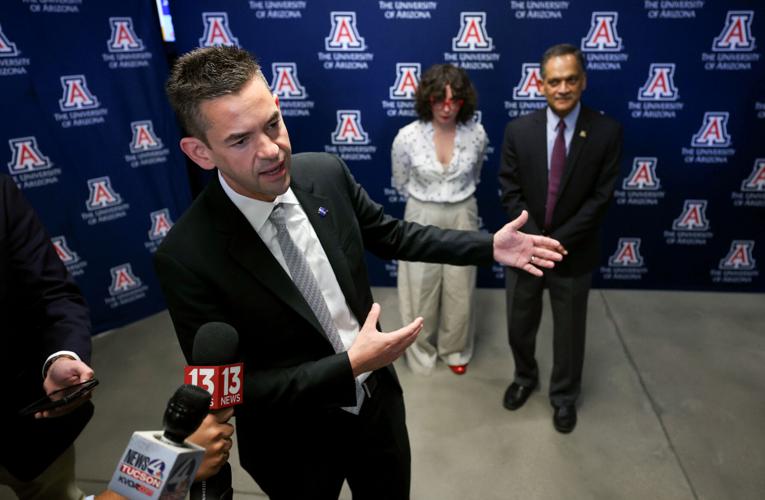
“There actually hasn't been any deep cuts,” the administrator said in a meeting with reporters after his appearance at the U of A. “The president's job is to propose a budget. Congress' job is to appropriate. NASA's budget has remained flat for many years.”
But with all its recent success, Isaacman thinks the nation’s space program might be due for a raise.
“Obviously, the president has challenged us many times, in a world where we have a $40 trillion national debt, to see if (we) can do more with less,” he said. “And then what did we do in 2026? We put a lot of wins on the board,” including the Artemis II flight around the moon in April, a record number of new astrophysics missions and the recent launch of the Nancy Roman Space Telescope, under budget and months ahead of schedule.
People are also reading…
“FY 28 will be the first budget cycle since I've been confirmed as a NASA administrator, and I think NASA's done a pretty good job this past year,” Isaacman said. “Let's see how the budget shakes out in the years ahead.”

Erika Hamden, left, University of Arizona professor of astrophysics and director of the Arizona Space Institute, leads NASA Administrator Jared Isaacman through a town hall-style Q and A during the NASA “Inspiration Tour” stop Wednesday at Bear Down Gym.
His stop at the U of A was part of a nationwide “Inspiration Tour” — with visits to NASA partner facilities, contractors, universities and even some NFL games through early November — to celebrate the nation's strengths and its future in space exploration and aeronautics.
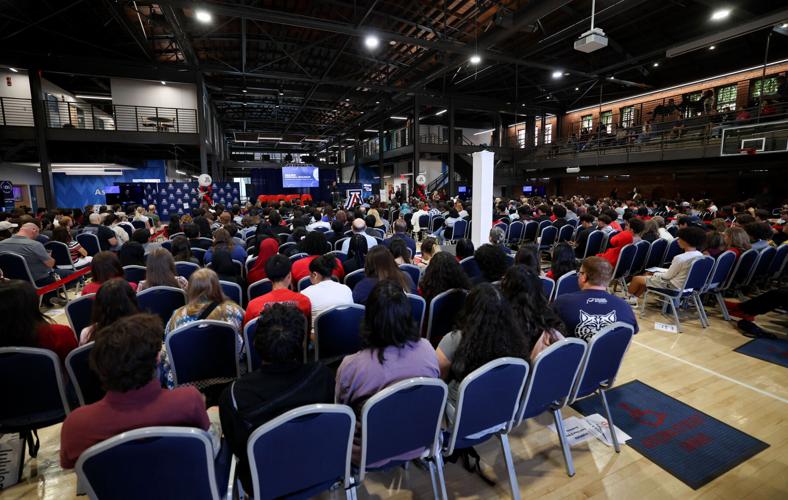
The event at Bear Down Gymnasium drew more than 800 people, including several hundred students from the U of A and a dozen area high schools.
Isaacman told the crowd about ambitious plans to return to the moon and establish a permanent base there, explore the outer solar system with nuclear-powered space probes, and one day land astronauts on Mars to plant the American flag.
“And that's where we need many of you, and many more just like you across America, to help us advance humankind even further,” he said. “We need engineers, we need scientists, we need technicians, entrepreneurs, researchers, operators, explorers. We need astronauts.”

High school and college students fill Bear Down Gym for the NASA “Inspiration Tour” on Wednesday.
The 43-year-old Isaacman is a billionaire entrepreneur, fighter jet pilot and commercial astronaut, who has flown in space twice and was one of the first two civilians to conduct a spacewalk.
He was sworn in as NASA’s 15th administrator in December 2025, after a messy confirmation process that saw the White House withdraw his initial nomination in the midst of the president’s brief but ugly public feud with Elon Musk, a close ally of Isaacman.
During his speech Wednesday, the NASA chief namechecked numerous U of A contributions to NASA success stories, including the instruments on the James Webb Space Telescope, the camera on the Mars Reconnaissance Orbiter and what he called the “badass” OSIRIS-REx asteroid sample return mission.
He even mentioned Apollo 8 astronaut Frank Borman, who grew up in Tucson.
“What an absolutely amazing university for contributing to this great mission of discovery that’s going on in space right now,” he said. “And it's been this way really since the beginning of our space program.”
Joining Isaacman on stage were U of A President Suresh Garimella, Arizona Space Institute director and astrophysics professor Erika Hamden and NASA Astrophysics Division director Shawn Domagal-Goldman.
After his remarks, Isaacman took a few questions from the audience, including one from a person who wanted to know how many petition signatures it would take to get him to come back to be a commencement speaker at the U of A.
Isaacman was also asked about black holes and how to speed up development timelines to get more missions launched in a shorter amount of time.
His most detailed answer came in response to a question about the increasing amount of human-made debris circling the Earth, where it poses a hazard to crewed and uncrewed spacecraft alike.
He said careful vehicle design and responsible launch and reentry practices can prevent the dangerous accumulation of orbital litter, but not every spacefaring nation is doing their part.
“Number one has got to be to stop adding to the problem. That is really the only realistic thing that we can do,” Isaacman said. “I think the U.S. industry is doing a really good job at that. You can't say the same about everyone in the international community.”

NASA Administrator Jared Isaacman answers questions during the NASA “Inspiration Tour” Wednesday at the University of Arizona's Bear Down Gym.
The release of the administration’s proposed NASA budget in April sparked outcry in the scientific community. The Planetary Society called it “an extinction-level event for space science,” with more than 50 active and proposed missions facing termination.
One of those missions was featured in a video played during Wednesday’s event: the U of A-led OSIRIS-APEX probe, which is already flying through space on its way to a scheduled rendezvous with the asteroid Apophis in 2029.
That project was zeroed out by the White House in each of its past two budget proposals, though Congress eventually restored the funding for fiscal year 2026.
Lawmakers have not finished appropriating funds for the new budget year, which begins on Oct. 1.
The federal government — and OSIRIS-APEX — will be operating under a continuing resolution that’s set to expire on Dec. 11.
See the University of Arizona asteroid mission's snapshots from Earth flyby


 NASA's latest telescope launch has Tucson ties