More than 60 years ago, astronomers at the University of Arizona used detailed photos of the lunar surface to help guide the Apollo missions.
Now U of A researchers are working on a special camera that will one day take pictures from the surface of the moon to inform future exploration there.
The EMission Imager for Lunar Infrared Analysis in 3D, or EMILIA-3D for short, will collect high-resolution infrared and stereoscopic imagery of the moon’s dusty, craggy surface to study the interplay between light and shadow.

An artist's rendering shows the EMission Imager for Lunar Infrared Analysis in 3 Dimensions, or EMILIA-3D, mounted atop a robotic NASA lander on the moon.
"Data returned by EMILIA-3D will feed into a sophisticated thermal model that shows how heat may transfer through the surface horizontally as well as vertically,” said Sarah Sutton, principal investigator for the three-sensor package and photogrammetry program lead at the U of A’s famed Lunar and Planetary Laboratory.
People are also reading…
“Ours will be the first measurements of the lunar surface at this scale to support and improve 3D thermal models. This will help fill an important gap in data, since most images of the lunar surface are taken by the Lunar Reconnaissance Orbiter, which are comparatively low-resolution at this scale."

University of Arizona scientist Sarah Sutton is principal investigator for the EMILIA-3D lunar camera.
The Tucson-based project is one of three science payloads selected by NASA earlier this year for eventual delivery to the moon on board an uncrewed Commercial Lunar Payload Services lander, planned as part of the space agency’s broader Artemis campaign to return humans to the moon and build a permanent base there.
Even the smallest of shadows on the moon’s surface can harbor water ice and other chemical compounds, known as volatiles, that vaporize at low temperatures.
The EMILIA-3D team hopes to learn more about these volatiles and the physical properties of the lunar soil itself, including insight into its geologic history and how it responds to disturbances like the blast from a landing thruster on a spacecraft from Earth.
Such information could prove to be useful when it comes to designing the instruments and equipment that people will use someday to explore and even settle on the moon.
Andy Ryan led the project through the proposal process when he was a staff research scientist at the U of A. He now works as the head of mining and payloads for the deep-space mining company AstroForge, though he continues to serve as co-investigator and science-team lead for EMILIA-3D.
"Understanding how human exploration affects volatiles, such as water, will be important before Artemis astronauts land at the lunar south pole," said Ryan, whose daughter’s name just happens to be Emilia. "Homing in on the correct physics will have important implications for where water ice could be stable and if human activity could destabilize it."

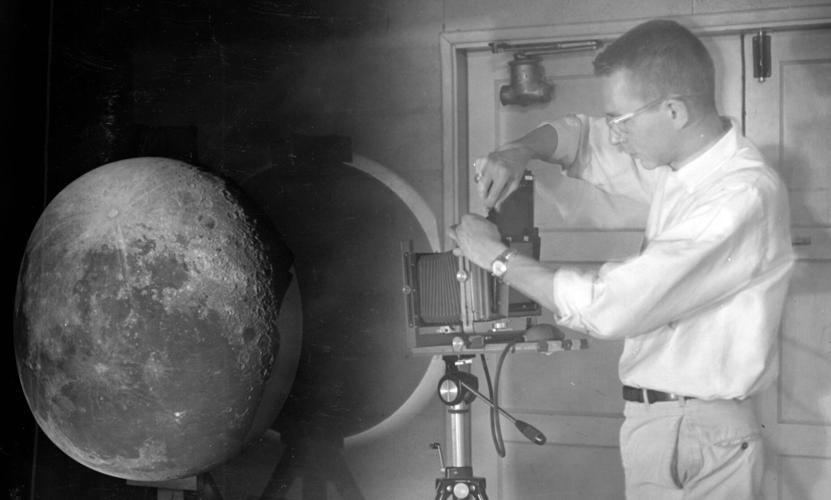
William Hartmann projecting photographic plates of the moon onto a white hemisphere to create the Rectified Lunar Atlas during moon mapping work at the University of Arizona in the early 1960s.
No specific launch date has been set, but EMILIA is not expected to fly until 2029 at the earliest.
The team will spend the next 24 months building the instrument, which is designed to operate from any lander anywhere on the moon.
Its thermal imager and two eye-like stereovision cameras will be mounted on a gimbal so they can scan the surface from the base of the lander to the horizon every eight hours for two weeks, recording the changing shadows throughout the long lunar day.
The roughly $9 million creation will freeze to death once the sun sets on its landing site. “There is no survive-the-night capability,” Sutton said.
In addition to the U of A, the EMILIA-3D team includes scientists from Northern Arizona University, the University of Central Florida, Colorado University, the University of Hawaii-Manoa, Edmundson Photogrammetry and Mines Paris-PSL.
The project continues a long Tucson tradition of scientific innovation aimed at getting to know Earth’s closest celestial companion.
When prominent astronomer Gerard Kuiper founded the Lunar and Planetary Laboratory in 1960, one of its primary missions was to produce the first atlas of the moon based on photographs instead of drawings.
Such detailed mapping would be vital to the success of the Apollo program, born from President John F. Kennedy’s pledge to land a man on the moon by the end of the 1960s.
The LPL eventually produced five photographic lunar atlases, including one made by projecting telescope images on a white globe and photographing it from different angles.
But mapping the moon by telescope had its limits, so Kuiper helped lead the effort to collect the first close-up pictures by crashing a series of uncrewed probes into the lunar surface with television cameras onboard. After a half-dozen spectacular mishaps and a congressional investigation, Ranger 7 finally accomplished the task on July 31, 1964, revealing the lunar surface as a chalky, undulating plain pockmarked with countless impact craters.

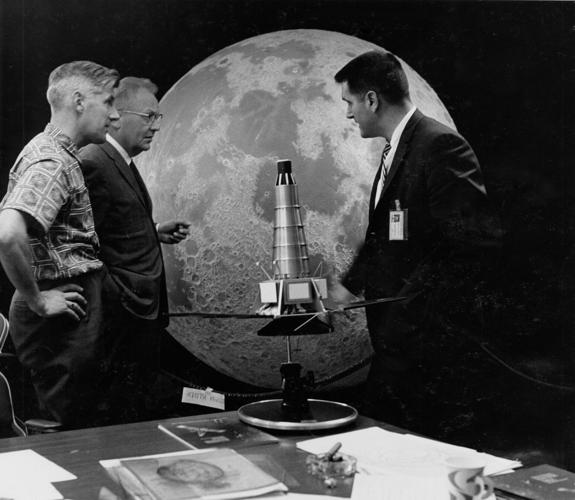
NASA Ranger program participants, from left, Ewen Whitaker, Gerard Kuiper and Ray Heacock pose with models of the spacecraft and the moon. The Cold-War-appropriate sign hanging at the bottom of the globe reads in pseudo-Russian: “Keep yer mitts off.”
The Ranger program immediately gave way to the Surveyor program, also with Kuiper in a prominent scientific role. That NASA initiative sent seven robotic spacecraft to the moon from June 1966 through January 1968 to demonstrate the feasibility of landing there.
Five of the probes set down on the surface with varying degrees of accuracy and success. The other two were lost to a malfunction and crash.
The EMILIA team is hoping for a better outcome.



 NASA's latest telescope launch has Tucson ties