NASA’s latest space telescope blasted off from the Kennedy Space Center early Sunday morning, and several University of Arizona researchers with connections to the mission planned to be there for the show.
At least a half-dozen faculty members and students were expected to make the trip from Tucson to Florida to watch the launch of the Nancy Grace Roman Space Telescope.
The $4.3 billion robotic spacecraft was carried into orbit by a SpaceX Falcon Heavy rocket that lifted off at about 4:26 a.m. Tucson time Sunday. The event was broadcast live on various NASA platforms and other streaming services and social media channels.

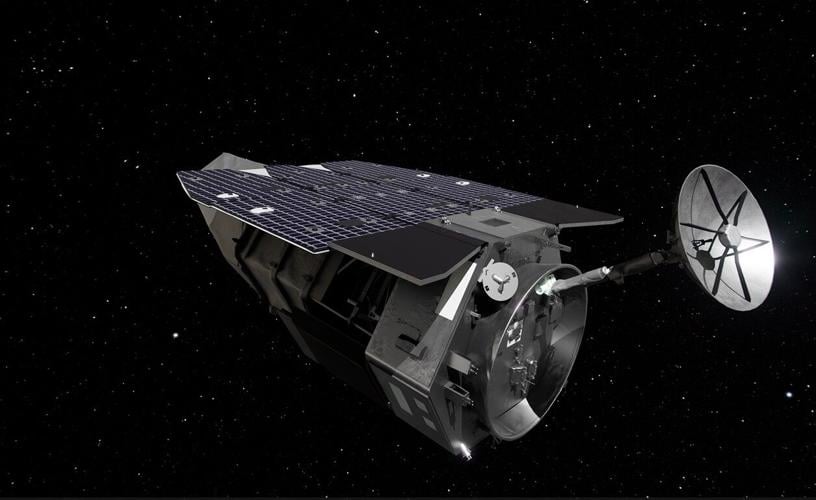
A rendering of the Nancy Grace Roman Space Telescope in space.
Roman is built to see the cosmos in widescreen, using a 300-megapixel infrared camera that gives it the same resolution as the Hubble Space Telescope but with a field of view at least 100 times larger. Each image captured by Roman’s Wide Field Instrument will cover a patch of sky roughly the size of a full moon and gather data up to 1,000 times faster than Hubble.
People are also reading…

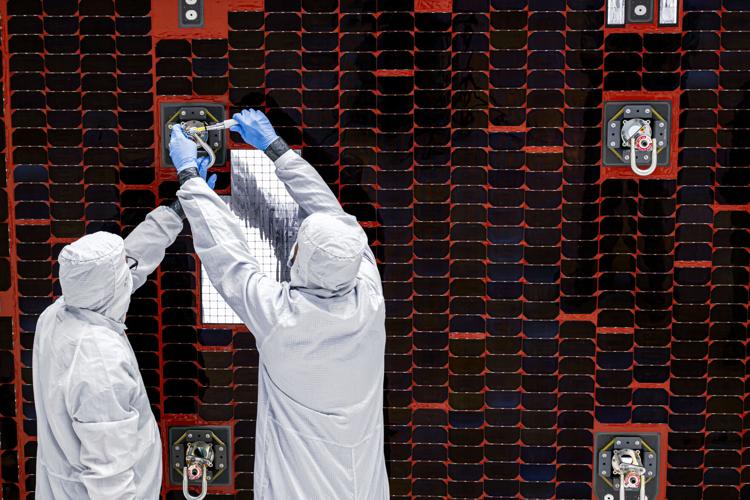
Technicians at NASA's Goddard Space Flight Center install the solar array sun shield on the Nancy Grace Roman Space Telescope on June 16, 2025.
It’s also equipped with a secondary device called a Coronagraph Instrument, designed to test out the most advanced technologies ever flown in space for directly imaging planets around other stars.
Scientists at the U of A will play a variety of roles in Roman, from helping to pick prime targets for observation to interpreting the data the spacecraft beams home in hopes of untangling the mysteries of dark energy, dark matter, exoplanets and other foundational questions about the universe.
The university will direct at least nine NASA-approved investigations made possible by the new telescope, including such research topics as supermassive black holes, cosmic dust, galaxy formation and gravitational lenses.
Tucson teammates
Astronomy and physics professor Elisabeth Krause from the university’s Arizona Cosmology Lab is heading up a wide-field science team tapped by the space agency to study dark matter and dark energy with unprecedented precision using a technique honed at the U of A known as kinematic lensing.
Fellow astronomy and physics professor Tim Eifler is leading a working group that will interpret Roman’s staggering stream of cosmological data using part of a new university-wide, high-performance computing system set to arrive this fall.
"We'll be able to do things like determine how much dark energy and dark matter are in the universe," Eifler said. "This infrastructure will take us from catalogs to cosmological interpretation."
U of A astronomy associate research professor Schuyler Wolff is leading the observation planning working group for the Coronagraph Instrument, which she called “a crucial pathfinder for a future Habitable Worlds Observatory," a proposed space telescope specifically designed to search for signs of life in other solar systems.

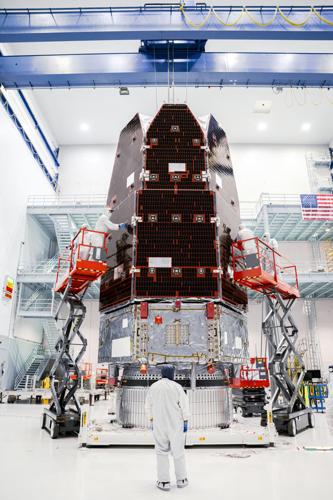
Technicians work on NASA’s Nancy Grace Roman Space Telescope at the Goddard Space Center on Nov. 25, 2025.
Wolff is among those who traveled to Florida to watch Sunday’s launch, along with Steward Observatory assistant research professor Ramya Anche, astronomy associate professor Ewan Douglas, Lunar and Planetary Laboratory associate professor Ty Robinson and graduate student Nick Schragal.
Wolff, Anche and Douglas contributed to the development of the coronagraph — as did LPL director Mark Marley and astronomy postdoctoral research associate Justin Hom — and all of them are lined up to conduct science with it once it begins operations.
U of A postdoctoral research associate Zarah Brown didn’t quite make it onto NASA’s exclusive list of people invited to observe the launch from Kennedy Space Center, but she headed to Florida anyway with her boyfriend and her young son. After three years as a volunteer with Roman’s observation planning team, she didn’t want to miss the big day.
Brown said they would probably watch the rocket go up from a park or beach near the space center.
A NASA animation shows the Nancy Grace Roman Space Telescope’s roughly month-long journey from launch on Sunday to its orbital home about a million miles from Earth.
“I'm really excited to have my kiddo see his very first rocket launch before he turns 3,” she said.
Roman empire
After Sunday’s successful launch, Roman will spend the next month or so cruising away from the sun to reach its new home about a million miles from Earth. There, it will join NASA’s James Webb Space Telescope in an orbital sweet spot where gravitational forces keep objects on a steady path with minimal effort.
After several months of commissioning, Roman should be ready by January to begin its science mission, which is currently scheduled to last five years with an option for five more.
The telescope is named for the late Nancy Grace Roman, NASA’s first chief astronomer and first female executive. She has been described as “the mother of the Hubble Space Telescope” and a key architect of the agency’s modern science program.
At more than 42 feet long and 14 feet wide, the spacecraft is about the size of a tour bus. It weighs around 18,000 pounds, including its 410-pound primary mirror measuring almost 8 feet across and 1,000 pounds of electrical cables that would stretch for 45 miles if laid out end to end.
Once it’s operational, Roman is expected to deliver 1.4 terabytes of raw science data each day, almost enough to fill the hard drive of a standard gaming computer.

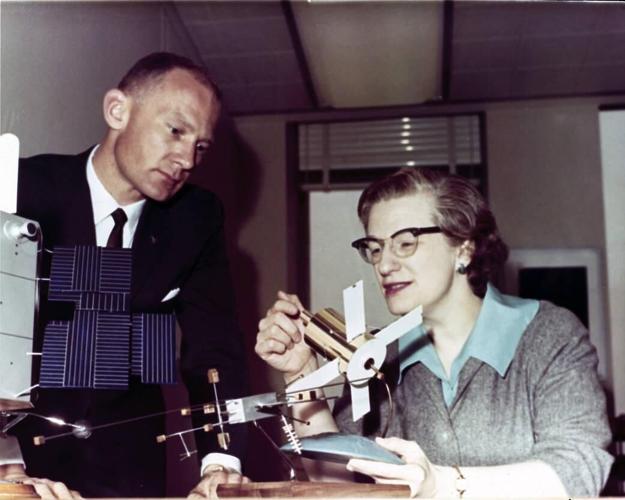
Nancy Grace Roman, NASA's first chief astronomer, explains the Advanced Orbiting Solar Observatory to astronaut Buzz Aldrin in 1965.
All of that data will be made publicly available as soon as it is processed, with no periods of exclusive access. “Anyone can just look at it or use it to do the science that they want to do, which is really awesome,” Brown said.
Roman will also work in tandem with Hubble, Webb and Euclid space telescopes, the ground-based Vera C. Rubin Observatory in Chile and the proposed Habitable Worlds Observatory to probe more of the sky and reveal additional objects worthy of further study.
Both of the new telescope’s instruments are designed to operate simultaneously. While Roman collects its massive wide-view surveys, the coronagraph will employ its suite of “bleeding-edge technology” to block the glare from individual stars so it can directly image the planets and dusty disks that surround them, Brown said.
“The challenge of direct imaging is that you're basically looking at something very faint next to something extremely bright. It's like trying to take a picture of a firefly flying around a lighthouse,” she said.
Picturing planets
The Coronograph Instrument could prove to be as much as 1,000 times more powerful than other existing devices, with the ability to pick out planets that are 100 million times fainter than their stars.
Brown’s role is to develop complex predictive models to help researchers validate the observations they make with the coronagraph, since this kind of direct imaging of exoplanets hasn’t really been done before.
“There's a whole process called digging the dark hole, where you have to basically tune the instrument to block out the center portion of the light, and that takes a lot of time — tens or more hours,” she explained. “My work is helping put error bars on the brightness, so we can ensure that we will successfully observe the targets that we're planning to observe, but we don't spend any more time than is necessary, since time on the instrument is really precious.”
All of this work is expected to lead to newer and better ways of looking for — and at — the faint, reflected light of planets circling stars far from our own. It’s our only window into these distant worlds, at least for the time being.
“To get to the closest exoplanet going at the speed of the fastest rocket we've ever built would take something on the order of like 10,000 years,” Brown said. “So we're not in any short amount of time going to be able to travel to any of these planets. Looking at the light that comes from them is our best and only way of understanding what they're like.”

U of A postdoctoral research associate Zarah Brown.
Brown was already scheduled to travel to Florida to attend the first post-launch meeting of the observation planning working group on Monday and Tuesday. She said she couldn’t resist the chance to extend her trip by a few days so she could watch the blast-off in person.
As an added bonus, Sunday also happened to be her birthday.
“So this is like the best birthday present I could ever get,” Brown said. “I'm so excited. It's going to be the best birthday ever.”