The Arizona Board of Regents approved the University of Arizona’s capital plan for this year, which includes five new projects totaling $160.9 million.
Those projects are:
Dealing with deferred maintenance needs: This year’s plan includes fire alarm upgrades, elevator code compliance, plumbing and street repairs, building automation and utility infrastructure upgrades. Total cost: $55 million, out of which $45 million is financed through system revenue bonds, which means the university sells bonds to investors who then lend it that money and the principal and interest are paid over numerous years.
Campus-wide technology modernization: This is to replace aging technology and provide better connectivity to make sure teaching, research and university operations are appropriately supported, according to ABOR documents. Total cost: $17.6 million, to be financed.
Addressing aging research facilities: This is to modernize current laboratory spaces on campus and upgrade mechanical, electrical and plumbing infrastructure. Total cost: $52.3 million, to be financed.
Improving overall campus safety: This project aims to improve operational efficiency through “advanced analytics and scalable security infrastructure,” ABOR documents say. Total cost: $15 million, to be financed.
Modernizing student spaces, cultural venues and classrooms: This project aims to improve students’ experiences and enhance their overall quality of life on campus, the documents say. Total cost: $21.02 million; $20.07 million of that will be financed.
People are also reading…
“The University of Arizona has a very large footprint across the entire state of Arizona,” Joshua Wright, UA’s chief facilities and planning officer, told the regents at the meeting Thursday, where they approved the plan.
“To put that in some perspective, we have about 763 buildings, about 19.8 million square feet of space. We do have a presence in all 15 counties through our cooperative extension efforts, and so our expansion is quite large and there’s quite a bit of area to maintain,” Wright continued. “We also co-generate approximately 42% of our own power and also generate more than 90% of our own water on the main campus, so we have some large utility infrastructure as well, that is unique among universities. So, deferred maintenance is critically important.”
Wright said of the research facility modernization that the UA has quite a few older buildings that are research-focused and are in “significant need of renovation,” so the university can maintain its status as one of the premier research universities in the country.
And, he said, there are a number of classrooms on campus that are in need of audiovisual and technology improvements, so students can continue having a collaborative learning experience.

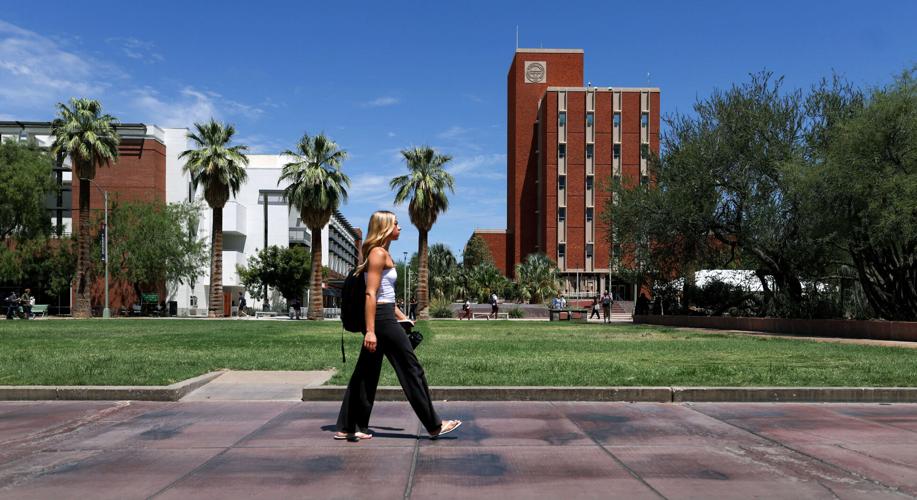
The University of Arizona campus.
“The largest focus in this area is around security of our campus,” Wright added. “We’re looking at some exciting opportunities to better integrate some of our security and safety between our video management systems, our access control and keyless entry systems, and our real-time operations center. And so, there’s a unique opportunity here to invest in some of our security and safety infrastructure at the main campus.”
Additionally, the UA submitted its capital improvement plan — numerous “high-priority projects” for 2029 through 2031 — which include building construction and renewal costs totaling $183.5 million. This plan was submitted to ABOR last week and is yet to be approved.
According to board documents, which did not specify dollar figures for each individual project, this work will include:
Deferred maintenance: This is for the highest-priority buildings and building systems across campus.
Lab modernization: This includes renovating multiple older research buildings to increase usage, efficiency and bandwidth.
Renovation of Arizona State Museum: This is to build infrastructure and improve accessibility to increase the longevity and functionality of historic buildings.
Campus infrastructure improvements: This is to support increased utility loads from new and planned facilities, and includes upgrades to aging infrastructure, including network and surface infrastructure such as outdoor space, pedestrian and bicycle needs, and landscaping, etc., with an emphasis on public safety.
Intercollegiate athletics upgrades to venues: Deferred maintenance and building upgrades to McKale Center at Alkeme Arena, Casino Del Sol Stadium, Hi Corbett Field and other intercollegiate athletic facilities.
Campus housing: This is to work on additional housing facilities on campus, such as first-year housing, Greek housing, graduate student housing, and other specialty housing offerings.
Reporter Prerana Sannappanavar covers higher education for the Arizona Daily Star and Tucson.com. Contact her at psannappa1@tucson.com or DM her on Twitter.

Prerana Sannappanavar
Higher Education Reporter


 U of A backs off selling Folklore Preserve property that was donated