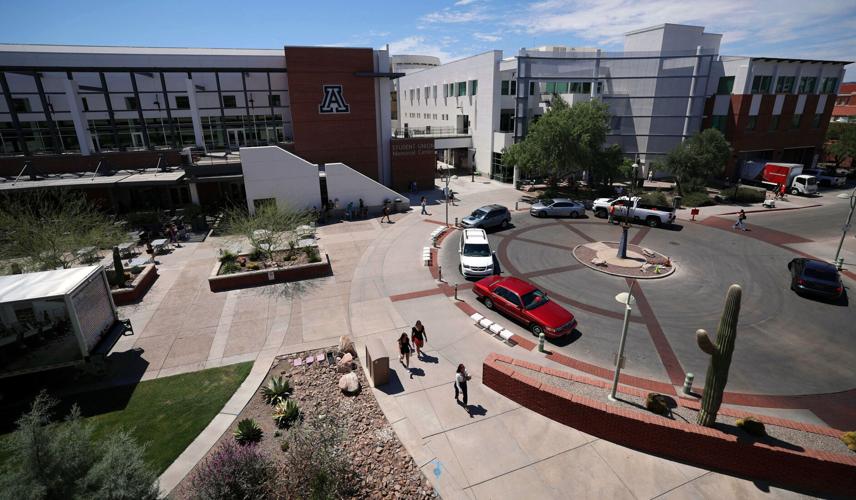
The University of Arizona’s preliminary request for state funding for fiscal year 2028 includes $7.5 million to hold tuition flat for in-state, undergraduate students for the fourth year in a row.
UA’s budget request also includes $25 million to renovate and modernize classrooms at the UA, and $17.5 million to expand its healthcare workforce training.
It will be submitted to Gov. Katie Hobbs along with the requests for Arizona State University and Northern Arizona University.
The three state universities’ total requests for state funding for fiscal year 2028, approved Thursday by the Arizona Board of Regents for forwarding to the governor, amount to $50 million each.

Bradley Kendrex, vice president for finance and administration for the Arizona Board of Regents.
“We have a package of requests from the University of Arizona that focuses on keeping undergraduate resident tuition flat in the future, that focuses on facility needs, and that expands healthcare partnerships and training capacity across the state,” said Bradley Kendrex, ABOR’s vice president for finance and administration, at the special board meeting Thursday.
People are also reading…
“All of these things again represent important opportunities for the state, and opportunities for the board, for the universities, and for the governor and Legislature to partner together,” Kendrex said.
Each year, Kendrex told the board, ABOR presents budget requests to the Governor’s Office on behalf of the three universities.
The governor and the Legislature will decide during negotiations next year how much to spend on the state’s fiscal ’28 budget, which will start on July 1, 2027.
In ABOR documents, UA said the $7.5 million to freeze tuition “gives students stability, keeping them on track to finish their degrees and build their careers in Arizona.”

The University of Arizona has submitted a preliminary budget request that would keep tuition flat for in-state, undergraduate students, expand healthcare workforce training and renovate classrooms.
The $25 million investment to modernize UA classrooms is part of UA’s “broader five-year capital plan, which identified $740 million in campus capital needs,” documents show.
The $17.5 million to expand opportunities for healthcare workforce training includes offering additional clinical partnerships with the medical school; increasing the capacity for nursing, veterinary medicine and pharmacy programs; and investing funds for clinical rotation preceptors to train doctors, nurses and other health professionals.
“One thing that is worth noting is that we don’t enter into this conversation without calling attention to the fact that we understand we’re operating in a constrained fiscal environment,” Kendrex said.
“State budget forecasts right now do not anticipate huge amounts of money available that are currently unrestricted,” he continued. “So, there are a lot of hard choices ahead that the Governor’s Office and the Legislature need to navigate during that time.
"That said, we recommend that the board bring forward the universities’ most pressing priorities, so that the Governor’s Office and the Legislature are best informed about the types of opportunities available, the types of needs that are required, and the things that we would recommend focusing on" in state investment.
ASU’s request includes funding for:
ASU Health ($40 million): This includes ASU’s new medical school, the John Shufeldt School of Medicine and Medical Engineering, that was launched this month with start-up investments from donors and one-time local and state funds.
Building an AI-enabled decision intelligence platform ($10 million): This would expand ASU’s “Decision Theater,” an interactive platform where researchers, policymakers and the business community can come together to find solutions to complex problems. The addition of AI to this would transform the theater into a “statewide modeling and visualization capability that would let Arizona leaders test scenarios and tradeoffs across health, water, energy, infrastructure, and economic growth before major decisions are made,” board documents say.
NAU’s request includes funding for:
Restoring NAU’s state appropriations ($7 million): This would restore the state’s investment in the university’s base dollars, supporting workforce-aligned programs, teaching and learning, and the success of students, 75% of whom are in-state students.
NAU’s healthcare workforce programs ($20 million): This would bring recurring investments in the university’s nursing, health professions, and behavioral health programs, and support faculty, program infrastructure, and clinical capacity. It would help enrollment, graduation and in-state retention of students to improve Arizona’s healthcare workforce needs.
NAU’s campus infrastructure ($18 million): This would help improve safety for students by putting funds towards fire and safety, roofing and HVAC (heating, ventilation, and air conditioning) systems in the residential and academic buildings.
NAU’s “100% Career Ready” initiative: This would put money towards a career readiness program that is aimed toward students who are predominantly Arizonans who will live and work in the state after graduating from college.
The board unanimously approved all three universities’ budget priorities.
Regent Gregg Brewster said it is always good in times of “economic hardship” to list the most pressing needs.
“Whether the budget can handle those $150 million worth of (priorities), I don’t know. That’s for later exercises,” he said.
Reporter Prerana Sannappanavar covers higher education for the Arizona Daily Star and Tucson.com. Contact her at psannappa1@tucson.com or DM her on Twitter.

Prerana Sannappanavar
Higher Education Reporter


 U of A acceptance rate rises to 90% as applications plunge