

The U.S. Fish and Wildlife Service has downlisted the razorback sucker from endangered to threatened, citing growth in fish populations that the agency says has reduced the risk to the species.
The freshwater fish, which is native to the Colorado River and the Grand Canyon, was first listed in 1991 after dams on the river and other waterways in the Colorado River Basin fractured its habitat and created conditions that hampered its ability to reproduce. Non-native fish in the river also contributed to losses to the species.
The sucker is the second Canyon fish downlisted from endangered to threatened. The Fish and Wildlife Service reclassified the humpback chub in October 2021.

Razorback suckers, being reared in the Willow Beach National Fish Hatchery, swim to the surface of the water to feed.
Conservation groups say the decision to downlist the sucker ignores the threats that remain.
“The razorback sucker’s outlook is no better today than when the fish was originally protected under the Endangered Species Act in 1991, so this move makes no sense,” said Taylor McKinnon, Southwest director at the Center for Biological Diversity. “It’s still in danger of extinction throughout its range, which should preclude this downlisting.”
People are also reading…
The Fish and Wildlife Service said a series of conservation measures, such as stocking fish from hatcheries, non-native fish control and habitat restoration have helped stabilize populations in rivers around the Colorado River basin. The species is now found in eight populations, the agency said. The largest is in the Green River on the upper Colorado, where numbers have grown from about 100 in the late 1990s to about 36,000 today.
The fish species still faces threats to its survival, the agency said, including changes in river flows and habitat, changes in water quality, drought and non-native species.
The razorback sucker is one of eight fish native to the Grand Canyon. Of those, three — the Colorado pikeminnow, roundtail chub and bonytail — are extinct. The construction of Glen Canyon Dam altered the flow of the Colorado River and changed the water temperature, forcing wildlife agencies to step in and help preserve species.
Scientists worked for years to help the humpback chub, which was near extinction at one point. The species' numbers in the main Colorado and the Little Colorado rivers have grown, but only because of human intervention, scientists say.
The razorback has a distinctive bony keel behind its head. It's the largest of its type in the Colorado River and can grow up to 3 feet long and weigh 10 pounds or more. Their mouths allow them to feed on insects and plants from a river's channel. Beyond Arizona, they are found in California, Colorado, Nevada, New Mexico and Utah, and were once found in Wyoming and the Mexican states of Baja and Sonora.
But conservation groups say the razorback sucker populations are not stable enough to warrant downlisting.
“The razorback sucker would cease to exist without the dumping of thousands of hatchery-raised fish into rivers each year,” McKinnon said. “Hatchery and habitat restoration programs are bass feeding programs that don’t tackle the underlying problem of non-native fish eating all the razorback’s larvae and juveniles.”
Robin Silver, the center's co-founder, said the threat extends beyond the Canyon.
"In the Verde and Salt rivers, between cattle grazing, destroying streamside vegetation, and the non-native sport fish introduced by Arizona Game and Fish Department, this magnificent creature, literally a living dinosaur, is becoming functionally extinct in Arizona," he said.
Photos: Grand Canyon celebrated 100 years in 2019

Cautiously, George Bernard Shaw, the Irish playwright, peers over the edge of the Grand Canyon at Lipan Point, on the south rim in Grand Canyon, Arizona on March 9, 1936. President Woodrow Wilson signed legislation to create the park in 1919. (AP Photo)

A hike through Matkatamiba enables hikers to get a close-up perspective of the powerful erosion that created the canyon in Grand Canyon National Park, Ariz. This limestone slot canyon can be tricky to hike because of its narrowness and slippery stream, but gives a rewarding view of hundreds of layers of limestone. (AP Photo/Brian Witte)

Indian Watchtower at Desert View, South Rim of the Grand Canyon of Arizona is shown in photo dated May 6, 1933. President Woodrow Wilson signed legislation to create the park in 1919. (AP Photo)

The size of only ten square miles, Supai or Havasu Canyon, shown here on July 23, 1942, is one of America's most remote Indian reservations. The area west of the South Rim of the Grand Canyon is home to the Havasupai, who cultivate the land growing corn and fruit crops; as visible in the center of the picture. (AP Photo)

With the North Rim in the background, tourists hike along the South Rim of the Grand Canyon Tuesday, Feb. 22, 2005. Grand Canyon National Park, which will celebrate its 100th anniversary as a national park in 2019, draws more than 6 million tourists a year. (AP Photo/Rick Hossman)

A mule train winds its way down the Bright Angel trail at Grand Canyon National Park, Ariz. The Grand Canyon lures millions of people each year with its colorful landscape, immense size, and awe-inspiring geology. (AP Photo/Jeff Robbins,File)

Perched on a cliff in Grand Canyon National Park in Arizona, the Lookout Studio is shown in this January, 2001 photo. One of many buildings designed by Mary Colter in the early 20th century, the Lookout Studio was completed in 1914. While Colter's buildings are found throughout the canyon, including Phantom Ranch on the banks of the Colorado, most lie like pearls along the South Rim, within easy walking or driving distance of each other. (AP Photo/John Torigoe, File)

This Aug. 29, 2002 file photo, shows the Colorado River at the Grand Canyon National Park, in Arizona. In 2019, the Grand Canyon will celebrate its 100th anniversary as a national park. (AP Photo/Brian Witte, File)

Rafters take a break from the rapids at Redwall Cavern in Marble Canyon near Grand Canyon National Park, Ariz., Aug. 29, 2002. The popular spot along the river is about 33 miles from Lee's Ferry. (AP Photo/Brian Witte)

Seen from the roof of the nearby Hopi House, the El Toval Lodge sits just feet from the edge of the South Rim of the Grand Canyon, April 13, 2005, in Ariz. The Grand Canyon celebrates its 100th anniversary as a national park this year. (AP Photo/Jake Bacon)

This Aug. 31, 2002 file photo shows a group of visitors riding a pontoon raft through rapids in Grand Canyon National Park, Ariz. (AP Photo/Brian Witte, File)

The Kaibab Trail, running right to left in the center, at the Grand Canyon National Park is shown on Jan. 20, 2001. The Grand Canyon lures millions of people each year with its colorful landscape, immense size, and awe-inspiring geology. (AP Photo/Matt York)

A crowd of tourists watch the rollout of the Skywalk on the Hualapai Indian Reservation in Grand Canyon West, Ariz., Wednesday, March 7, 2007. Organizers expect the Skywalk to become the main draw in a community of tribal attractions that includes a cowboy town, an Indian village, helicopter tours and Hummer rides through the outback. (AP Photo/Ross D. Franklin)

Tourists visit the Hualapai Indian Reservation along the western end of the Grand Canyon. Grand Canyon National Park draws more than 6 million tourists a year and will celebrate its 100th anniversary as a national park in 2019. (AP Photo/Jake Bacon, File)

Charlie Nichols, 12, from St Louis, Mo., looks out of a window of a Grand Canyon Railway car as he waits to leave the Williams, Ariz. depot, for a trip to the Grand Canyon, March 25, 2001. The Grand Canyon Railway ran the first ever train to the Grand Canyon's South Rim on Sept. 17, 1901, in an effort to capitalize on Americans' growing fascination with one of the world's greatest natural wonders. (AP Photo/Jake Bacon)

Visitors gather at an outlook on the South Rim of Grand Canyon National Park in northern Arizona in 2015. The Grand Canyon lures millions of people each year with its colorful landscape, immense size, and awe-inspiring geology. (AP Photo/Felicia Fonseca)

A wrangler helping guide tourists riding mules in the Grand Canyon pauses to speak with another wrangler leading a train of mules used to carry supplies in the Grand Canyon National Park, Ariz. Mules reign supreme here. This is especially true on the South Kaibab trail, where you'll see young mule packers leading a lumbering line of the creatures, all carrying full bags. Every day, supplies and souvenirs go down the South Rim. Trash comes up. And sometimes tourists get a ride. (AP Photo/Paul Davenport, File)

This photo shows a view from the South Rim of the Grand Canyon National Park in Arizona in 2012. The Grand Canyon will celebrate its 100th anniversary as a national park in 2019. (AP Photo/Rick Bowmer)

This 2010 photo shows hikers on the South Kaibab Trail in Grand Canyon National Park, Ariz. Grand Canyon National Park draws more than 6 million tourists a year, but most visit in summer and relatively few venture below the rim. But for the well-prepared who are relatively physically fit, hiking into the canyon is safe and offers an experience that's difficult to duplicate. (AP Photo/Carson Walker)

This 2009 file photo shows a view from the South Rim of the Grand Canyon in Ariz. The Grand Canyon, which will celebrate its 100th anniversary as a national park in 2019, lures millions of people each year with its colorful landscape, immense size, and awe-inspiring geology. (AP Photo/Ross D. Franklin)

A sole visitor looks into the South Rim of the Grand Canyon from Yaki Point, June 17, 1996. The Grand Canyon will celebrate its 100th anniversary as a national park in 2019. (AP Photo/Scott Troyanos)

In 2019, tourists look at and take photos of a snow-covered Grand Canyon, in Arizona. The Grand Canyon lures millions of people each year with its colorful landscape, immense size, and awe-inspiring geology. (AP Photo/Anna Johnson)

This 2019 photo shows Lookout Studio in Grand Canyon Village on the South Rim of Grand Canyon National Park in Arizona. The Grand Canyon will celebrate its 100th anniversary as a national park in 2019. (AP Photo/Anna Johnson)

A tree frames a spectacular view of Arizona's Grand Canyon as seen from the Widforss Trail on the north rim in November of 1989. The Grand Canyon will celebrate its 100th anniversary as a national park in 2019. (AP Photo/Brian Killigrew)

This 2019 photo shows Lookout Studio in Grand Canyon Village on the South Rim of Grand Canyon National Park in Arizona. The Grand Canyon will celebrate its 100th anniversary as a national park in 2019. (AP Photo/Anna Johnson)


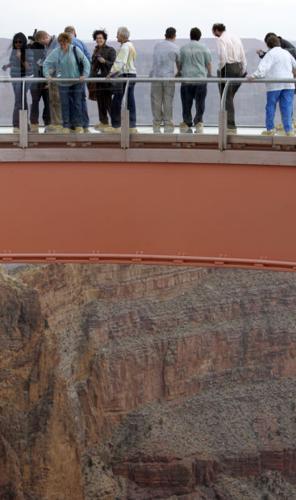
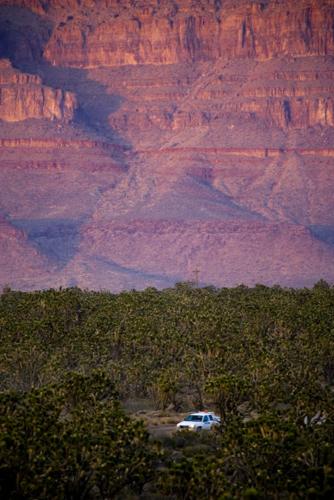
Amazing Skywalk at the Grand Canyon
Recently, a federal judge ruled in a favor of the company that invested to build and manage the Grand Canyon Skywalk in 2003 and against the northern Arizona tribe that took control of it. Opened in 2007, the Skywalk offers unusual and breathtaking views of the Canyon.
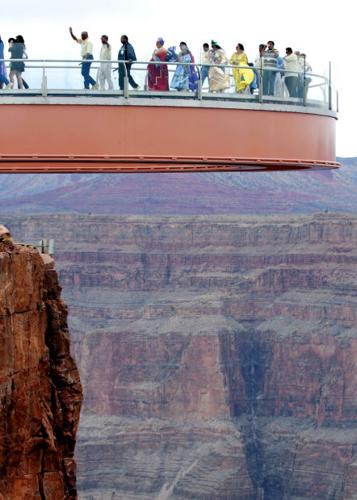
Tribe members were the first to walk the new Hualapai Tribe's Skywalk on March 20, 2007, near Kingman, Ariz. The Tribe has constructed a $30 million glass-bottomed walk way that reaches over the Grand Canyon's edge 70 feet. Photo by Dean Knuth/Arizona Daily Star


 River restorers target dry stretch of Santa Cruz through Sahuarita


