Tucson Water could lose as little as 6% to as much as nearly 85% of its total Colorado River-based drinking water supplies, depending on how big a cut the entire Central Arizona Project takes from the depleted river, Arizona State University researchers have found.
The wide range of projections for possible CAP cuts underscores the importance of an upcoming decision by the U.S. Bureau of Reclamation about how much it will cut river water supplies starting next year to Arizona and the other six Colorado River Basin states. The first clue will likely be unveiled this coming week, when the bureau is expected to release its preferred alternative.
The same range of potential cuts makes it clear that Tucson water users and managers face a huge amount of future unknowns.
People are also reading…
One big unknown is when or if Tucson must tap into some of the 47 years' worth of groundwater it owns in the Avra Valley north and west of the city. A second unknown is whether that will be enough to keep the city juiced with adequate water, or if the city will have to spend more money to find additional outside water supplies.
ASU's Kyl Center for Water Policy determined the potential impact of CAP cuts on Tucson Water as part of a broader examination it conducted of the potential impacts of cuts on every city, private water utility, tribe and business in the state that takes CAP water.
It based calculations of each potential cut on the legal priority each water user has for CAP water for which it has a signed contract, said Sarah Porter, the Kyl Center's director.
Tucson owns the largest share of CAP water of any water utility — 144,191 acre-feet a year. But that total lags far behind Arizona's largest CAP contractor, the Gila River Indian Community, whose supply totals 311,000 acre-feet annually.

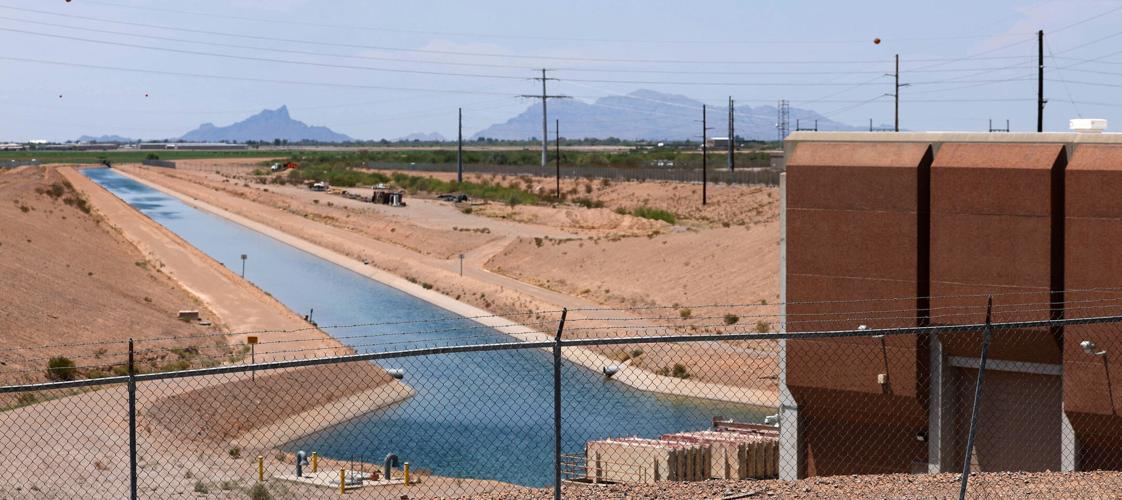
The Central Arizona Project canal, seen from West Twin Peaks Road in Tucson, delivers drinking water to the Tucson area from the Colorado River, which is now in increasingly short supply due to drought and climate change.
If the city's CAP cuts are small enough, Tucson Water can absorb them without reducing how much Colorado River water it serves its customers. That's because currently, the utility has the legal right to take nearly 45% more CAP water than Tucson-area residents and businesses use each year. Tucson Water has, since the early 21st century, been recharging and storing the extra water underground to be saved to meet future needs.
But if CAP cuts leave Tucson with less total water than its customers use, the utility will eventually face some difficult and potentially costly choices:
- Should residents and businesses be encouraged or required to conserve more water when they've already compiled a water conservation track record that's better than most, if not all, other Western cities?
- Or should the city spend hundreds of millions of dollars to obtain expensive, alternative water supplies by means such as capturing large amounts of stormwater, desalinating salt water or treating wastewater to drinking quality?
- At the same time, how far should the city dip into its vast, but still limited, groundwater supplies that it's packed away, unused, in the Avra Valley northwest of Tucson since the 1970s?
Tucson Water officials confident of avoiding crisis
Such tough decisions may not have to be faced immediately, regardless of the level of CAP cuts. Tucson will have access to at least 10 years' supply of project water it and the state stored underground even if the feds slash the CAP's entire supply. If the federal cut is less, that supply will last longer.
But when and if that stored supply runs out, the city might have to turn to some of the groundwater supplies it owns in the Avra Valley, invest in costly new supplies, or both.
In total, the city's groundwater supplies, including the stored CAP supplies, amount to about 4.7 million acre-feet. That's 47 years' worth of groundwater at the city's current rate of use.
For now, Tucson Water officials say they're confident of avoiding a water crisis here, regardless of how much our CAP supplies are cut.
If more conservation is needed, Tucson Water Director John Kmiec said he believes Tucson residents will respond voluntarily, as they've done off and on over the past four decades whenever city officials called on them to do it.
Since 2000, for instance, residents' per-person water use has dropped by about one-third, to less than 80 gallons daily, while Tucson Water's service area population has risen about 18%.
If more supplies are needed, Tucson Water will be prepared to invest in them, as shown by the utility's long-range, One Water 2100 plan that the City Council adopted in 2023, utility officials said. The plan encourages the city to look at stormwater capture and treating wastewater to drink — through what public officials call "advanced water purification" — as potential future supplies if needed.
"Tucson Water customers have done a tremendous job in working with the utility in using water wisely. We've been seeing great conservation programming at residents and businesses throughout the community, some of it with messaging Tucson Water has put out there," Kmiec said. "As the community continues to grow, as new houses come on, you'll see conservation happening. As long as people do that, I think Tucson is going to be just fine."
Some want quicker action from city
But two Tucson City Council members, Paul Cunningham and Kevin Dahl, along with several University of Arizona researchers, say they are either less certain that the utility's current strategies will be enough or want us to do more and sooner.

City Council member Kevin Dahl says the best option is conservation. "We've done a lot. We could do more. It’s the cheapest way. All new sources of water cost more."
In interviews, the officials and researchers told the Star they'd like to see quicker action from the city and Tucson Water on capturing more stormwater, on water conservation in general and on innovative but still relatively untried policies such as "net zero" requirements for new developers. A "net zero" policy would require they ensure their projects' water use is offset by taking on additional conservation elsewhere.
And, some said they'd like to see utility officials engage more often with the public about their views of the region's water problems and their plans about what to do about them.
"I think our utility is performing in a manner superior to any other utility in the Southwest. But we have to keep pushing that envelope and continue the excellence," Councilman Cunningham said. "What we're doing now is good enough now. It may not be good enough in 50 years. We need to think strategically that way."
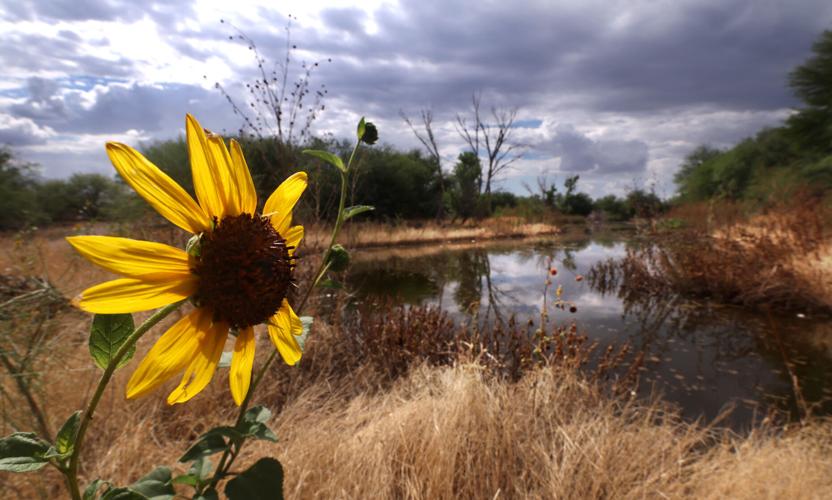
Cunningham would like to see more large-scale stormwater capture projects built like the Kino Environmental Restoration Project, lying on Tucson's south side. It's a 125-acre oasis of ponds and wetlands, run by the Pima County Regional Flood Control District, that captures stormwater to maintain wildlife habitat and to water ballfields at the neighboring Kino Sports Park.

A wild sunflower grows along the wetland shore of one of the ponds in the Kino Environmental Restoration Project just north of the Kino Sports Complex. Water from the ponds nourisheas the complex's sports fields, and Tucson City Councllman Paul Cunningham says more projects like this one are needed to capture additional rain runoff to give Tucson more water.
The best option is conservation, said Dahl, adding, "We've done a lot. We could do more. It’s the cheapest way. All new sources of water cost more."
Dahl also endorses the "net zero" concept. He said he objects to current water users being asked to save water or pay higher water bills so there can be enough supplies to support new development.
"New growth should come in at its own dime," he said.

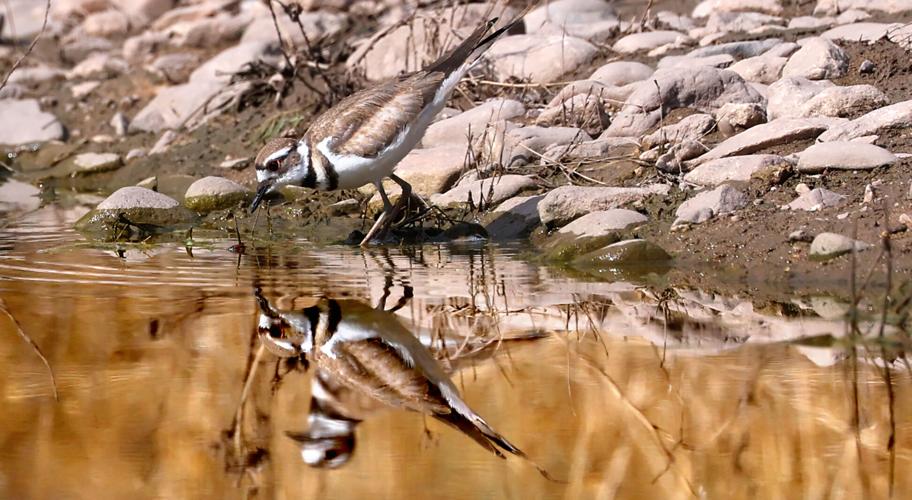
A pair of killdeer investigate the shallows along one of the ponds in the Kino Environmental Restoration Project. The project captures stormwater to maintain wildlife habitat and to water ballfields. As Tucson grapples with an uncertain water future, particularly if Central Arizona Project supplies are slashed, some environmental advocates say more basins should be built to capture stormwater.
Residents and businesses should step up their conservation now, said Sharon Megdal, director of the University of Arizona's Water Resources Research Center. The more water we save now, the less will have to be pulled from the aquifer later, said Megdal, a former CAP governing board member of 12 years.
"Yes, tighten your belts," Megdal said. "If we take actions to reduce our demand, we are helping ourselves for the long run. I do think there are very few water users that can’t conserve some. Maybe some are doing everything they can, but I still look around and see lawns, watering that’s done that’s maybe still ornamental."
In a statement to the Star, Tucson Mayor Regina Romero proposed no new water initiatives, but paid tribute to the "strong conservation ethic in Tucson that is shared with our entire community. I’ve often said we are using the same amount of water now as we did in the 1980’s.
"That is the result of smart policies of the mayor and council that include introducing a green stormwater Infrastructure program and fee to support it, reducing non-essential turf, proactively keeping PFAS out of our water supply, purchasing water to use for our economic development activities, creating nature-based recharging programs like the Santa Cruz River Heritage Project and investing in advanced water purification.
"I have been working diligently with our Congressional partners and federal agencies to continue to make sure our water supply is safe and secure. So, to me, all of our actions count - from turning off the water while we are brushing our teeth to making sure that we are bringing in the millions of dollars necessary to build the advanced water purification systems to secure our water supply into the future just as cities across our country like San Diego, El Paso and Los Angeles are doing," the mayor said.
Federal decision is key
The starkness in the gap between the best- and worst-case scenarios for the CAP stands out in the difference in the range of potential cuts that the Bureau of Reclamation is studying to introduce on the river starting next year.
When the bureau released a draft environmental impact statement on river water use cuts last winter, the proposal that seemed most likely to be approved at the time would have cut statewide CAP deliveries by 77% next year, CAP officials said at the time. Such a cut would take Tucson's annual CAP supply below 40,000 acre-feet a year, possibly as low as 37,000, the Kyl Center analysis shows.
Another proposed CAP cut at the time would take Tucson Water's supply to barely 25,000 acre-feet a year, the Kyl analysis shows. The worst-case bureau proposal at the time would have slashed CAP total deliveries 98%, leaving virtually nothing for Tucson Water.
Since then, however, the Lower Basin states of Arizona, California and Nevada have jointly sent the bureau a proposal to cut CAP deliveries to cities starting next year by only 14%. Reclamation officials haven't said if they'll accept that proposal, but Arizona Department of Water Resources officials said they've received encouraging signs from the bureau.
A 14% cut would lower Tucson's annual supply to 124,000 acre-feet a year, and even a 20% cut would lower it only to 116,000 acre-feet, Tucson Water officials have said.
Whatever CAP cuts happen next year, they likely will get bigger in future years if the Colorado River's declining flows continue deteriorating, many officials and other experts have said.
The city's CAP supply would only be cut below its current use if it was shaved by about 30%, Kmiec said. Cuts of 40% to 50% would require the city to dig into the 600,000 acre-feet of CAP supplies it has stored underground since 2000.
But even with a 40% cut, that would only require the city to take 14,000 acre-feet a year out of that reserve, Kmiec said. On top of that, the state-run Arizona Water Banking Authority has stored a considerable amount of CAP underground in this area. Kmiec estimates Tucson would have access to more than another 400,000 acre-feet of that.
"There is a variety of scenarios we’ll be looking at. The point is Tucson has been in an excellent position, due to activities we've taken over the last several decades in managing our water supplies," Kmiec said.
Tucson Water officials have made it clear, however, that they will use their Avra Valley supplies if necessary to cushion the blows from CAP cuts. The valley's groundwater supplies underlie 22,000 acres of former farmland that Tucson bought in the 1970s to set aside as a long-term, future supply.
For many decades now, Tucson Water officials and most Arizona researchers and other outside water experts have said cities should do all they can to avoid returning to the massive groundwater pumping that dominated Arizona's water use back in the 1960s and '70s. In particular, they cited the increased costs of pumping as wells went deeper underground.
They also cited the risks from excessive pumping of subsidence, in which the ground sinks and ultimately collapses. The subsidence can also create earth fissures, which have regularly occurred in heavily pumped farming areas in Pinal County and the Willcox Basin in Cochise County.
During the 1990s in Tucson, when the CAP was shut down here for eight years after officials botched the first deliveries of the water here, many researchers warned that if we couldn't get back on CAP water — whose deliveries ultimately resumed in 2001 — the Tucson area could also face major subsidence.
Chris Avery, an assistant city attorney for Tucson Water, said that today, however, he believes the risks of subsidence from future Avra Valley pumping is minimal. That's in part because the city wouldn't be pumping on the scale that farmers in the Eloy and Coolidge areas of Pinal County pumped back in the 1950s and '60s. If subsidence did occur now, the damages from it wouldn't be as severe as they've been elsewhere because the largely undeveloped Avra Valley lacks the major highways and other infrastructure that exist in Pinal and in areas around Phoenix where subsidence occurred.
"If we see it, we'll adjust our pumping accordingly," Avery said.
Avery also bristled at suggestions that the city's ownership of only 47 years' worth of groundwater represents a major threat or limit to its overall water supply portfolio.
"A lot of people who say 47 years isn’t all that long, those same people do not seem capable of thinking the city would adapt. We have 47 years of supply if we do nothing," Avery said. "Do people come up with these questions just because they want to make things seem worse than they are, or promote their own agenda?"

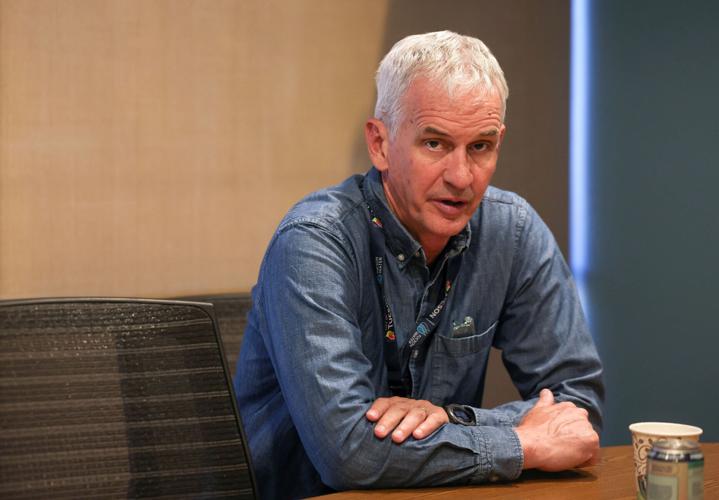
Tucson Water Director John Kmiec says, "Tucson has been in an excellent position, due to activities we've taken over the last several decades in managing our water supplies."
As for past warnings about what could happen to Tucson if CAP water disappears, Kmiec said things have changed since the 1990s that put the utility's water supply issues in a different perspective. First, the city's decision to store its CAP supplies underground when the project resumed operations allowed it to save its excess supplies for the future, he said.
Second, "our community has adapted to a Sonoran Desert lifestyle" that puts less pressure on water supplies, he said.
"We don’t have front yards like we had in the '50s and '60s," he said. "We don’t have large farmers in the Tucson basin now. Our community's water demand has fallen. Our water supplies that are necessary (aren't increasing) in parallel with growth. People continue to adapt."
The two water officials said the city has already started to evaluate the feasibility of getting alternative water supplies by obtaining an $86 million federal grant to build a small plant on Tucson's northwest side to treat wastewater for drinking. The city has started designing the plant and expects to have it online by 2031 or 2032, serving 3% to 5% of the city's drinking water supply, they said.

Chris Avery, Tucson Water attorney, says Tucson isn't going to have a water crisis despite the prospect of massive cuts in its Colorado River supply from the Central Arizona Project.
"The plant sets a ceiling on what we need to pay for (alternative) supplies," Avery said. "We will know what it costs to build a plant and how much to operate it, and what kind of problems there are or costs" if it scales that idea up to build a larger plant, he said.
That information will help the city evaluate whether investing in a new desalination plant, which is likely to be more expensive than wastewater treatment, makes sense for Tucson, he said.
Advocates: Prepare now to conserve more water
Kathy Jacobs, a just-retired University of Arizona climate scientist, ran the Arizona Department of Water Resources' Tucson office in the 1990s and early 2000s when the CAP was shut down and then revived. She is the first to praise Tucson Water's management of its supplies as far-sighted and innovative, but says the city needs to prepare more now for conserving additional water should that become necessary.
"There is no such thing as a foolproof solution. I agree that Tucson has been very successful at managing their CAP and groundwater but it is better to be prepared for the worst case and be pleasantly surprised," said Jacobs. "We need to be prepared for the worse case scenario but not overdo it at the wrong time —the timing is really important."
Today, any mandatory water conservation measures probably aren't warranted, she said. But officials could use the current time to get the public engaged in designing different kinds of water-saving programs to turn to during different levels of cutbacks, she said.
A recent, comprehensive report the state's three major universities prepared on capturing stormwater for recharging — of which she was lead author — also contains ideas worth pursuing to find water to replace CAP cutbacks, said Jacobs.
Megdal said Tucson Water should change the messaging it currently uses to encourage conservation and see how that affects people's behavior. She also said it's now time for Tucson Water to carry out its normal, five-year update to its drought management plan, and suggests the city use that update to discuss with the public when and how more stringent conservation regulations should be carried out.
The city of Tucson and Tucson Water also need to go out into the community and say how they plan to deal with prospective future shortages, said Megdal and Andrea Gerlak, director of the UA's Udall Center for Public Policy.
"It’s a perfect opportunity for them to make that case to the community," Gerlak said of Tucson Water officials. "Let’s have that conversation. Let's do a listening session and public engagement."
Gerlak acknowledges having some uneasiness about the prospect of the city returning to large-scale pumping, if that becomes necessary.
"If you have to go into your savings account to get water, it's a big switch from what we've done the last two decades, psychologically," she said. "Until now, it's been 'look at us, we're saving water'. Now, we'll be saying we're all sharing in the shortage, and we will start to pull water from our savings.
"When I have to pull money from our (family's) savings, it never feels good."
Contact Tony Davis at 520-349-0350 or tdavis@tucson.com. Follow Davis on Twitter@tonydavis987.

Tony Davis
Reporter


 As water lifeline evaporates, Arizona faces a cultural change over water use