

I call baby quail "buttons with fast feet." Just about this time each year we see them, many of them racing after one or two moms on the lookout for something good to eat. Baby quail are truly adorable and appear too small to be active at all.
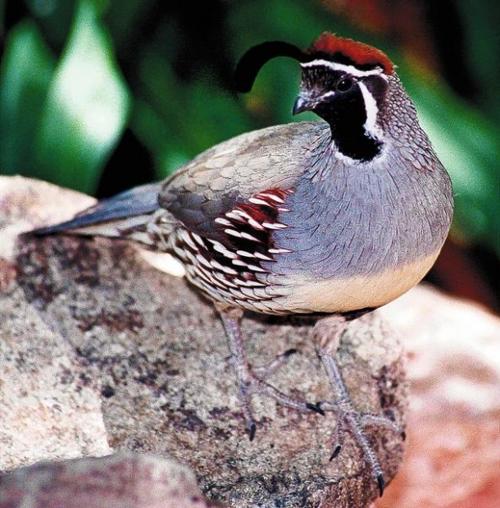
I was very used to quail in California; however, the Gambel's quail of Arizona are a different matter, as far as beauty goes. That may explain the origins of their taxonomic name Callipepla gambelii. In Greek, the word "calli" means "beautiful"; the word "peplos" means "robe."
That most certainly describes the exquisite plumage of an adult male Gambel's quail.
The male Gambel's is quite spectacular with its dark and heavy topknot and several black markings, incorporating other colors as well as a really pretty olive. The females are more drab, of course. It's the curse of many lady birds.
People are also reading…
As one would imagine, Gambel's quail like deserts with enough shrubs for night roosts. Their favorite foods are seeds, cactus fruit, shrubs and berries. They will also eat insects, and I can attest to that. The young, especially, are fond of bugs. All are ground feeders.
Gambel's quail range into other states and Mexico, but they are mainly associated with Arizona; they have actually been successfully introduced to Hawaii. Introducing non-native species is a practice that gives me the willies. It is so often very destructive to the native animals.
As for the range of individual quail, they stick pretty close to home. Wanderlust is not their thing. They are fast runners, but flight is reserved for danger, and is in short bursts.
It is interesting that, when I was researching Gambel's quail, many statements were made about the fact that they are most often found near a water source. These same references stated quail get all of the water they need from their food and rarely drink.
This really surprised me, as I have a bird waterer out in front, and I see quail drink quite often.
Quail tend to form fairly large groups called "coveys" or "bevies." Their life span isn't very long. Most are said to live about a year and a half, though there have been some recorded to have lived up to four years.
Nesting is most often on the ground, under a large rock, but these birds will nest in shrubs and trees if there is a convenient spot. Eggs hatch in about 23 days, at which time the tiny young are able to fend for themselves, though they stick close to Mom and Pop and use their guidance on what is safe to eat, and also for protection, of course. These game birds are sexually mature at a year old, which is fortunate given their short life span.
Quail are considered monogamous, but there is a caveat. Often a male will lose a mate, and though he takes care of the little ones, he's not above seeking a new mate to share the chores. He does this by offering a female (who probably has a brood of her own) delicious bits of food. This practice is called "tidbitting" and is often successful in luring the female away from her own kids and spouse. These kinds of shenanigans are evidently prevalent among all sorts of species.
You may have noticed I referred to our quail as game birds. They are that, and there is a season for legally killing them. This makes me cringe. I guess I have a strange set of taboos when it comes to food. I will eat chicken quite happily, and their eggs. But place a couple of once gorgeous little quail which have been roasted in front of me, and I'll run from the table. Put a poached quail egg on my salad, and I'll think you are sick.
Quail are relaxing to watch and a beautiful part of the desert landscape. So enjoy the tiny buttons with fast feet, following their elders. May a few cross your path — it has to be good luck.
Desert corner
By Lee Reynolds


