

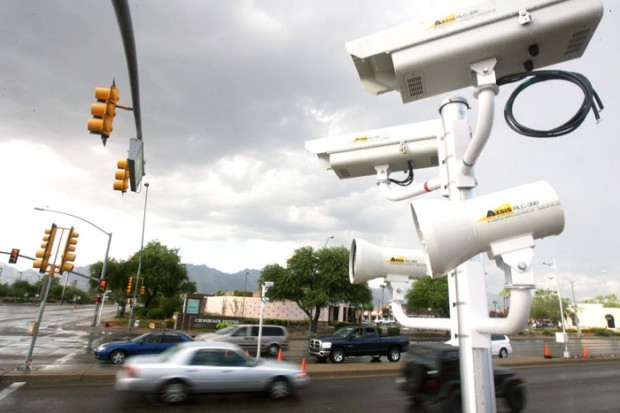
PHOENIX - Arizona drivers may get a bit of leeway in trying to make the light without getting nabbed by a camera for blowing through the red cycle.
The Senate Appropriations Committee voted 8-4 Tuesday to revise the state law on exactly what constitutes an "intersection." HB 2557 redefines it in the state's traffic code to include a much broader area.
That change is significant.
It means the pavement sensors that trigger red-light cameras to record violations have to be moved, so driving practices that now result in citations would no longer be illegal.
Tuesday's vote came despite opposition from the city of Phoenix, which provided statistics saying its red-light cameras, as currently operating, have reduced deaths and injuries at intersections.
But Senate Majority Leader Andy Biggs said the testimony of a Phoenix police commander, while interesting, is meaningless. The Gilbert Republican said the only evidence that would convince him the change will make a safety difference would have to come from traffic safety engineers.
People are also reading…
The move is a victory for Sen. Frank Antenori, R-Tucson, who has waged a campaign against all forms of photo enforcement for years.
Under Arizona law, an intersection is defined as an area within what would be imaginary lines extended from each curb. That creates a box, with communities that use red-light cameras putting their sensors just inside that box.
But Antenori told colleagues only Alaska uses that same definition. His legislation would bring Arizona into conformance with 38 other states.
As approved, HB 2557 says the intersection starts at any painted "stop" line or at the first crosswalk line a vehicle would encounter going into an intersection, whichever comes first.
From a practical standpoint, that means if a driver already is in the crosswalk when the light turns red, there would be no violation.
Under current law, the driver might be in the crosswalk when the light changes, but then would trigger the red-light camera after entering the box that now defines the intersection.
Antenori said that's only fair.
"Many motorists do not know where the intersection begins and ends," he said. "And many are already under the impression that the stop line is the intersection line."
The result, Antenori said, is they get a ticket - unfairly, he believes.
Antenori said he believes cities like the current system precisely because of that, saying it's designed to generate as much money as possible.
Phoenix lobbyist John Wayne Gonzales disputed that.
"It does not pay for itself," he said. "It is not a profit maker."
Phoenix Police Cmdr. Joe Klima said this is a safety issue.
"By extending the intersection to the crosswalk line or the stop line, that could be anywhere from 24 to as far as 38 feet outside the intersection as we know it today," he told lawmakers.
Klima said in 2010 there were 1,587 people injured and seven killed in Phoenix by red-light runners. And he said most of those are caused by "aggressive" drivers trying to speed through the light at the last minute.
Sen. Rick Murphy, R-Glendale, said while that may be the case, his concern was how often the cameras catch "technical violators."
Klima acknowledged some of those who are ticketed do fit that category.
He said that often includes people waiting in a left-turn lane who have entered the crosswalk but are waiting before going any farther to be sure that opposing traffic has stopped. They get cited when making that turn after the light turns red because they had not yet entered what the state now defines as the intersection.
But Klima said the change will only make matters worse.
"Now you have four vehicles that could actually be in the (redefined) intersection to make a left turn when it cycles to red and now they can make that left turn," he said. And that, Klima said, creates its own new hazard.
Sen. Ron Gould, R-Lake Havasu City, said his concern is bringing the law in line with motorist expectations that they are required to stop at the crosswalk or stop line.
"That's the line that they're shooting for," he said.
Klima conceded the point. But he said those who have been through driver education classes or have attended defensive driving school are told the intersection is the curb line and not some earlier point.
If Antenori's measure becomes law, it will require cities to not only move sensors embedded in the pavement but also adjust the cameras.
Tucson spokesman Mike Graham said he had no idea of the cost. But he said the contract with American Traffic Systems requires the city and the company to negotiate how the expenses would be divided.


