

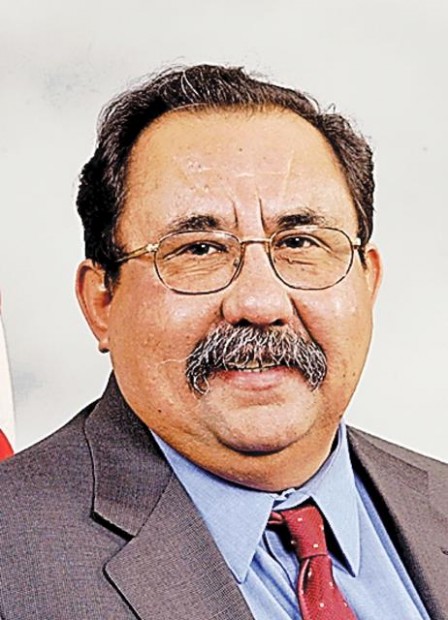
Other than complaining about a bad cold, U.S. Rep. Raúl Grijalva was relatively upbeat Thursday, even though he lost his bid for interior secretary.
He blamed his inability to get the job partly on not having anyone on the presidential transition team to run interference for him, and partly — "possibly," he said — on his assertive pro-environmental stances.
President-Elect Barack Obama gave the nod to Colorado Sen. Ken Salazar, a more politically centrist Democrat than Grijalva.
While clearly disappointed that he's not going to be Arizona's third interior secretary since the 1960s, Grijalva also said, "Now you move on. I have a good job, I have a good committee."
Former Arizona Rep. Stewart Udall was interior secretary from 1961 to 1968, and former Arizona Gov. Bruce Babbitt had the job from 1993 to 2000.
People are also reading…
Grijalva, of Tucson, chairs the Public Lands Subcommittee of the House Natural Resources Committee, a position he's used to battle with the Bush administration's efforts to loosen many environmental regulations and promote oil and other energy exploration on public lands.
Here is a Q&A with Grijalva, who spoke Thursday by phone from his Washington, D.C., apartment as he prepares to enter his fourth term in Congress:
How close did you come?
"I believe we were one or two through this whole process. The problem was, I didn't have anybody on the inside promoting me on the transition team. It makes it difficult, but we did very well. I'm very gratified with the support that we had. In the end, it was kind of a surprise. It was our understanding that Salazar was not interested in it, and then he was."
How disappointed are you?
"The disappointment is that we thought we were equal to the task, and we still think it, but we didn't get it. We came extremely close. Now you move on. I have a good job. I have a good committee."
What's next?
"The problem is going to be that the (Interior) agency is so messed up in a variety of ways; Bush left a really horrible legacy in there. We will continue to press the fact that there has to be some structural, ethical reforms and work with the secretary to get that done. We will push where we need to. We are not going to leave it behind."
Where did your bid go wrong?
"It was a Catch-22 for the transition team. They had to get someone from the West, preferably a Latino with environmental creds, you know, with some record on these issues. I thought up to that point, we had really good support nationwide from Indian country. We were always there in the hunt. When I look back, I'm going to figure out what the deficits were that kept me from getting picked. We are a little more assertive about some of the issues than others. That possibly played a role."
You've been an elected official most of your career. Do you think your lack of management experience hurt you, since Salazar had a lot? He was attorney general and head of the Department of Natural Resources in Colorado.
"I thought that was a non-issue. The agency has 70,000 people and you can appoint a management team, while I would define the positions, set direction and set priorities for where I want to go."
Were there any groups opposed to you, like energy, mining or ranching?
"Yes."
Was it overt, or did you learn about it all through the grapevine and under the table?
"You got it."
Did anyone from the transition team tell you why you didn't get the job? When did you learn?
"No. I learned Saturday, when people on the team called us and let us know they thought Salazar was going to be the pick."
There aren't many liberals in this Cabinet, and many liberals, not just environmentalists, saw your candidacy as a shot to get one of their voices in there. How do you feel about the administration's decision not to pick more progressives?
"I'm disappointed, obviously. I think there is room for progressive opinion. I hope room is made in the future; I trust it will be."
Do you think Obama simply didn't want to have many liberals in key positions?
"I think it's, we're seen as convenient allies, not as necessary allies. It's an awkward position. We're taken for granted. We're not like blue dog Democrats (moderates who periodically stray from mainstream liberal positions), who threaten to vote against children and health care to get what they want. Maybe we need to do that."
It seems that Republican presidents like Ronald Reagan and George W. Bush have no problem appointing hard-core conservatives to key jobs — like former Bush Attorney General John Ashcroft or former Bush Interior Secretary Gale Norton. But Democrats like Bill Clinton and Obama have problems appointing liberals to similar positions.
"That's an accurate observation."
What do you think of Salazar?
"He's a good man. He's obviously more moderate than I am on a lot of issues. We have disagreements; he believes that loaded guns in national parks are OK. But he can be a good caretaker. Being from the West, I think he will understand the issues in the West."
Caretaker? That's not very flattering. Do you mean you don't think he has the vision to give Interior the overhaul you think it needs?
"No, I mean that he can take care of the job. I didn't mean it like he sits around on his hands."
Maybe Obama's vision for change means moving away from the partisanship of the Bush era rather than replacing an overtly conservative agenda with an overtly liberal one.
"I think the issue of bringing people together, bipartisanship, he said that during the campaign, I think that will be the effort to get things done. We're going to realize that there are going to be tough calls that need to be made on the economy and the war that won't lend themselves to that kind of bipartisanship."
What are your top priorities for next year as public lands chairman?
"We will look at the work force in the National Park Service and in public lands in general. The understaffing, the low morale, the politicized science, the land mismanaged to the point where we were having trouble with retention of employees. People are leaving. That is the backbone of the Park Service, the Forest Service, the BLM.
"One thing we are pushing is that we sent a letter to the transition team, the president-elect, we want a big chunk of the stimulus package for public lands. We have a big backlog of maintenance — roads, trails, etc. It would be like the Civilian Conservation Corps in the New Deal. At other times, it's hard to come up with money for these projects other than from a stimulus package."
Why didn't you take the Ways and Means assignment from Speaker Nancy Pelosi? They write the tax laws — that's a lot of power.
"My committee. You come to Congress for the things that you care about — resources, education and labor. Ways and Means is prestigious and powerful. It ain't my cup of tea."
If Salazar leaves in two or four years for whatever reason, will you try for Interior again?
"I think this might be my last hurrah. I have a legislative career I want to keep working on. The legacy I want here, I want to concentrate on it. I don't think it's going to come around again. If it does, I'm not sure I'm going to want to go through the same process. The only difficulty is that it consumes you. We did nothing else for three weeks but respond to questions on and on and on."


