

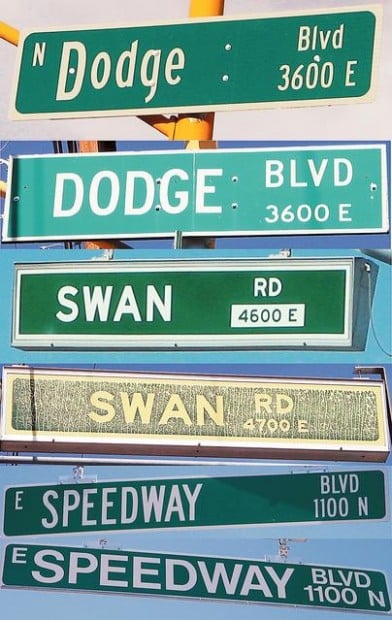
Tucson has a myriad of street-sign designs, and in this case, variety is not the spice of life.
Most of the city's 1,300 street signs are legible, but they're inconsistent.
There are the old illuminated signs, which feature street names glowing from afar at night. Some of those are nice and legible, with bright, white letters against dark green backgrounds. But some are cracked and faded, or in some cases broken and missing chunks of plastic, making it difficult to see what streets they're marking.
A few old wooden signs also dot the streets here and there, plus newer aluminum signs. But wait! Even with the new metal signs, there are multiple variations with different typefaces and letter sizes.
There is long, wide lettering, such as on the signs at East Speedway and North Columbus Boulevard. In 2007, the city said it was testing that style with 12-inch-tall letters instead of 8-inch letters. The words fill the width of the sign completely. Those signs have popped up at other intersections, too, so I guess the test must have been a success.
People are also reading…
There also is tall, narrow lettering, which can be seen at East Speedway and North Cherry Avenue or at Grant Road and North Stone Avenue. The signs are legible, but the letters are narrower, leaving a squished-looking word on a sign that seems to have leftover space.
At some intersections, it's mix-and-match, with different styles, depending on which direction you're heading. An example is at North Dodge Boulevard and East Fifth Street.
In addition to the changing styles, city sign makers can't make up their minds about telling drivers whether they're on the north, south, east or west segment of a street. Some do; some don't.
The last example I'll give is the mixed-capitalization sign, now appearing on Euclid Avenue at East Broadway, and at Country Club Road at East Broadway. These have street names that start with a 12-inch-tall capital letter, and the rest of the word in 9-inch lowercase letters.
This is supposed to be the standard the city Transportation Department is following now, not that you'll find too many examples out on the streets. But any new signs put in by the city will begin with capital letters followed by lowercase.
Street-sign design is regulated by the Manual on Uniform Traffic Control Devices. The manual sets the national standard for how street signs, lane markings and other visual cues for drivers should look. That way, when you cross into New Mexico, you aren't buzzing right by a blue square stop sign because you were looking for a red octagon.
City officials said standardizing the signs isn't a concern. They noted that people can easily switch between reading words in all capital letters and capital and lowercase lettering.
Well, of course. But someone new to town or looking for an unfamiliar street has less time to anticipate a turn or lane change if his recognition of the name on the sign at a distance is inhibited by having to factor the constantly changing sign styles.
Blame the hodgepodge on national sign standards changing over time, said Michael Graham, Tucson Transportation Department spokesman, and Diahn Swartz, the department's traffic engineering project manager.
When signs need to be replaced, they're updated to the most current standards. Those standards change through the years, and we get lots of different signs along a street corridor.
It's just a little silly, and looks tacky, to have so many kinds of signs. It's like wearing one loafer and one sandal and saying, "At least they're both shoes."
Sure, at least all the signs are in English and are green and white. But it looks disorganized, and it makes the city look haphazard, even though they all met regulations at the time they were installed.
Road Q
Question: "Can you tell me why the speed limit was lowered to 40 mph on Flowing Wells Road between the Rillito River and Roger Road? For at least the last 24 years it has been 45 mph. What traffic condition supported this change? Also, who makes these changes, and how are they decided?" Patt Hale asked.
Answer: The Pima County Department of Transportation noticed several rear-end crashes on Flowing Wells at Roger, said Priscilla Cornelio, the department director. After a safety study, county officials installed rear-facing red lights on the signal arms so that drivers can see the signal even if big trucks are in front of them. The speed limit was lowered so drivers have a better chance to stop in time to avoid a rear-end crash, Cornelio said. The county is continuing to watch for crashes to see how the changes affect traffic.


