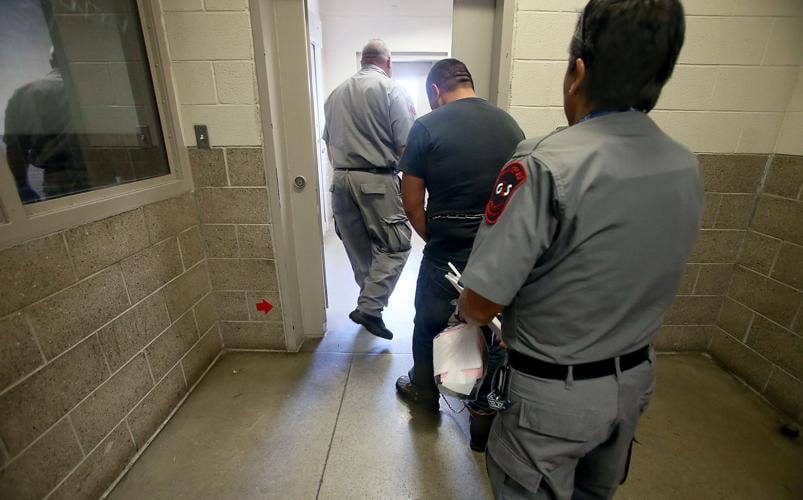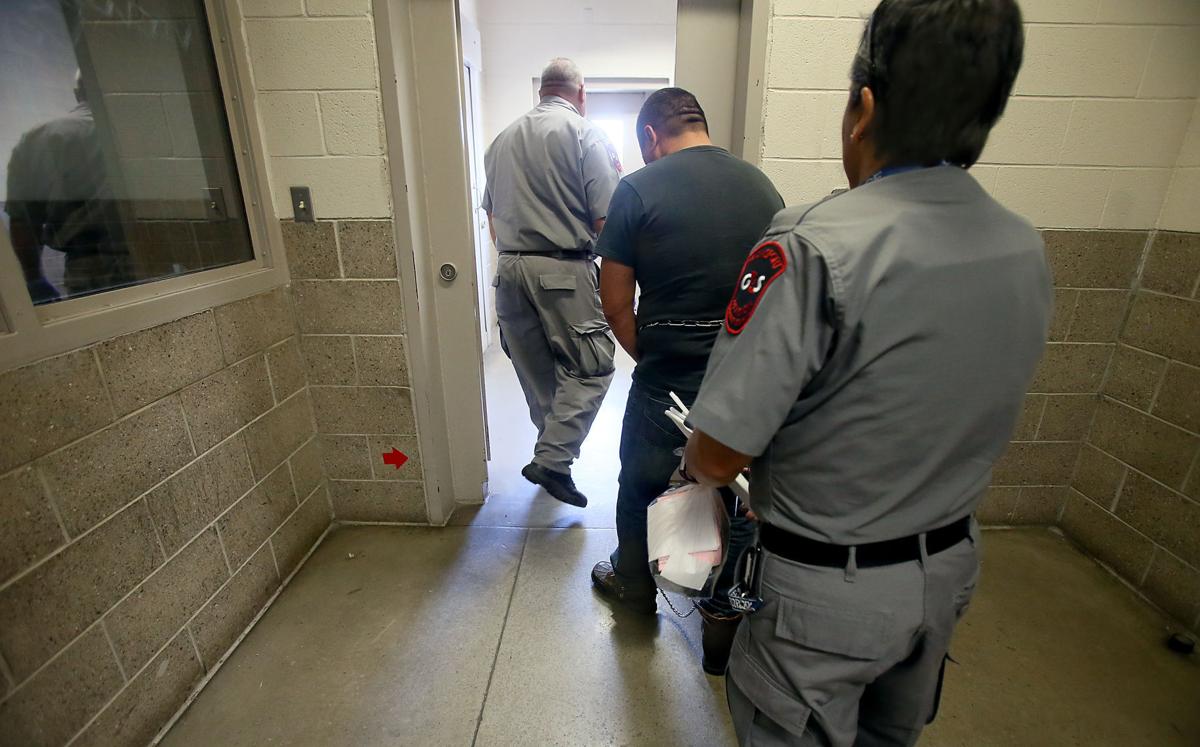
Pima County officials are working in collaboration to reduce the jail’s population as about 150 unvaccinated corrections officers could be fired by the end of the year, according to the sheriff.
After the Board of Supervisors mandated vaccines for county employees who work with vulnerable populations — such as those confined in a detention facility — unvaccinated jail employees are receiving notices of the county’s intent to terminate them if they don’t get vaccinated by Dec. 31.
The jail currently has 420 corrections staff members, and around 36% are set to lose their jobs if they don’t get the vaccine.
In response to potentially terminating corrections officers in an already short-staffed facility, county leadership is engaging in a two-pronged approach to lower the population that jail staff is responsible for overseeing: keeping people out of the jail while reconsidering the incarceration of those already in it.
People are also reading…
As of Dec. 16, the jail had 1,639 inmates, according to the sheriff’s department. The “loose target,” Pima County Attorney Laura Conover said, is to get that number down to 1,300. In the first move toward the goal, Conover’s office announced Dec. 14 it would no longer charge people for simple drug possession.
“It was an opportunity to remember that the jail is a place to separate out people who are an ongoing threat of harm to the community. It’s not a hospital; it’s not a treatment facility,” Conover said.

Jan Lesher, acting county administrator, wrote to the board in a Dec. 13 memo that Sheriff Chris Nanos “made clear” his department “is able to adapt as needed to meet the jail’s staffing needs” and said public safety won’t be placed at risk.
But Nanos said reducing the jail population may not alleviate those staffing needs. The jail is currently short-staffed by about 76 positions, according to data from the sheriff’s department.
“I agree we should be doing something, but to be honest with you, they can reduce that population by 200 or 300; it doesn’t reduce my need for staffing,” Nanos said.
Reducing the jail population

We are sharing Arizona Daily Star reporters' and photographers' favorite work from 2021.
After an inmate died after testing positive for COVID-19 in the jail in September, Nanos pointed to unvaccinated corrections officers as possible sources of transmission since they are among the few people who can enter the cells of quarantined inmates.
And while COVID-19-mitigation policies are in place at the jail, the sheriff’s department has reported 126 COVID-19 cases among inmates and 22 among staff from Nov. 1 to Dec. 11.
“The consequences have been laid out. The line in the sand has been drawn and the clock is ticking. I implore you to do the right thing,” Nanos wrote in a Dec. 13 letter to corrections staff. “Do what is right for your families, your loved ones and the preservation of your lifestyle. More importantly, do what is right for yourself and get vaccinated.”
To prepare for the departure of jail staff who don’t meet the Dec. 31 deadline, a group of county officials, including representatives from the sheriff’s department, the county attorney’s office, public defense services and the Pima County Superior Court, met on Dec. 8 to consider methods to scale down the jail population.
The first part of the plan is to divert people from ending up in jail in the first place, which has materialized with the county attorney’s announcement she will temporarily stop charging people for simple drug possession, paraphernalia or related personal use cases. The policy will be revisited in 60 days.
Conover directed law enforcement officials in a memo: “In the meantime, your agencies should deflect people to drug treatment.”
At the Dec. 8 meeting, Lesher said the group considered data from the sheriff’s department showing more than 500 inmates awaiting trial are classified as nonviolent or non-dangerous.
“Often, these detainees would have been released by now if they could afford the required bond,” Lesher wrote in a memo to the county supervisors, later adding, “The working group will continue to consider individual detainees on a case-by-case basis to determine if release may be appropriate and whether post-release supervision of some type is appropriate.”
Danelle Liwski, an associate presiding judge at the county’s Superior Court, said “there’s just a bigger push to review cases at this point” and that she expects to see more motions filed to modify conditions of release.
“If there’s any change of circumstance, then a motion to modify can be suggested,” Liwski said. “For example, somebody who might have come into custody and had no place to live at the time, but now has a stable home environment with a friend or family member, that would be a change in circumstance.”
Joel Feinman, the public defender for the county, said his role representing those accused of crimes naturally lends itself to the county’s plan to reduce the jail’s population, but that most of the power lies with the county attorney’s office.
“Our role is to help other agencies to brainstorm but also to vociferously advocate for criminal justice reform and advocate for our clients’ release and for them not going to jail in the first place,” he said. “At the end of the day, all we can do is advocate. We can’t implement policy, that’s the county attorney’s job.”
Conover said her office intends to aid in the release of incarcerated individuals by conducting thorough reviews.
“I think it’ll help to sort of have a more collaborative, intense effort to do a review of who is in there, to identify people who are in there on nonviolent, low-level offenses and can and should be released,” Conover said.
The county attorney also said she’s “fully supportive” of expanding the sheriff’s department’s ankle monitoring program to transfer inmates in custody to monitored release, a program Nanos said is deeply underutilized. According to the sheriff, housing people in the jail costs $126 a day, whereas monitoring someone with an ankle bracelet costs $15 a day.
But Liwski says the program’s availability depends on the charges one is facing.
“I can order (ankle monitoring), the problem is I can’t order an ankle monitor on anybody who is serving a sentence as a felon,” she said. According to the county attorney’s office’s initial review, 481 inmates are being held in the jail on nonviolent charges, all of which are considered felonies.
Band-aids over bullet holes
The jail operates under direct supervision, meaning a corrections officer is actively watching each of the jail’s 29 housing units at all times.
Mike Dominguez, president of the Sheriff’s Labor Association of Pima County and a correction sergeant at the jail, said further reducing jail staff could put this key safety practice at risk.
“I think it’s a very dangerous and unsafe situation. If I was the loved one of an incarcerated individual, I’m very concerned right now,” he said. “If my loved one’s in jail, how I can fully expect them to get the proper care and supervision and security that they are entitled to and that they deserve?”
While the sheriff’s department is actively recruiting corrections staff, the months-long training process has a high drop-out rate.
“The issue there is, it’s a tough job. Not many people grow up saying, ‘Hey, I want to be a corrections officer,’” Nanos said.
And while the spread of COVID-19 in the jail, and the resulting effort to ensure all its staff is vaccinated, have catalyzed reform efforts to keep people out of jail, these efforts may be temporary solutions to long-term problems.
“Will they result in a temporary decrease in the jail population? Probably. Will a 60-day suspension of drug prosecutions and a once-over effort to get people out of the jail who don’t belong there make any sort of long-term difference in the crisis facing our criminal justice system? No,” Feinman said.
Feinman said he’d support a permanent policy of the county attorney no longer prosecuting drug possession but said larger issues around incarceration have to be solved at the state and federal level.
“All of our efforts will amount to putting Band-aids on gaping bullet holes. Society is asking lawyers and judges and police officers to solve problems that they cannot solve,” he said. “The problem of crime, the problem of drugs, the problem of mental health is not a criminal problem, especially when it comes to mental health and drug addiction. Those are public health problems.”
Nanos also supports the county’s efforts to get people out of the jail, but he questions the motivation behind it.
“(The county’s) ability to reduce the jail population should not be based on my staffing needs or COVID, or anything related to the virus,” he said. “It should be based on their belief in judicial reform.”