


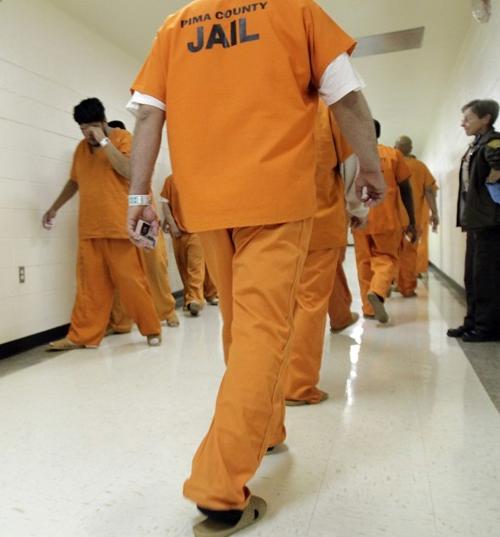
A Pima County resident will pay more in taxes next year, one way or another.
County officials say it's inevitable: either vote to approve the temporary state sales-tax increase May 18 - and raise your taxes - or turn down the measure and your property tax will go up to pay for things the state can't afford, including keeping prisoners locked away.
If the sales-tax initiative fails, the county will be responsible for twice as many prisoners as it houses today. About 1,800 inmates are in the jail on an average day. Another 1,821 state inmates could be transferred to county custody if the state doesn't get the sales-tax money to keep the prisons running.
Education is slated to receive two-thirds of the revenue raised in the sales tax, with public safety, health and human services splitting the rest, if voters approve the one-cent increase in sales tax. The higher sales tax would last three years.
People are also reading…
With the jail capacity capped at 2,240 inmates, Pima County would need to figure out what to do with another 1,381 extra people. The cheapest estimate is pegged at $50 million.
"What starts to become more expensive is when you exceed capacity. Right now I have the COs (corrections officers) to staff all the pods at the minimum staffing levels. If we increase that and triple bunk, we're obviously going to have to add more officers, more staff, more equipment. When you add more inmates into housing you need to boost A/C capacity. Food costs go up, all of those types of things," said Capt. India Davis, county corrections captain.
Where will the money come from? "From the taxpayers of Pima County," said County Administrator Chuck Huckelberry. That is, as long as the county can legally raise property taxes by 17 percent to cover the increase, which may not be possible.
The Pima County Sheriff's Department has come up with five options to cope with twice as many inmates.
"If I had to pick one, I would pick a legal response and try to prevent the Legislature from doing what they say they're going to do," said Pima County Sheriff Clarence Dupnik.
• Option 1: Triple-bunk the jail, add beds to the day-room areas and the old medical unit. House women inmates at the county juvenile detention center, double-bunk juveniles and convert classrooms at the facility to "dorms." Contract with Maricopa County jail to house the 274 inmates who still wouldn't fit in Pima County facilities. Cost: $50.1 million
• Option 2: Build a 1,600-bed temporary housing structure near the jail, delay long-term planned solar panel installation on the associated land. Cost: $77.7 million
• Option 3: Permanently expand the jail with a 1,536-bed addition. Cost: $187.7 million
• Option 4: Build some temporary housing (as in option 2) at Kino Sports Complex, and house other inmates in buildings throughout the community, including closed schools and vacant hotels. Cost: operating, transportation and renovation costs unknown
• Option 5: Put some inmates on "home detention" without electronic monitoring, but with occasional probation-style checks. Put other inmates on electronic monitoring program, including the kind which detects alcohol in those with alcohol-related convictions. Pima County doesn't know how many inmates may qualify for these, and if state law can be changed to allow it. Cost: unknown
Options 1 and 2 would be temporary because the county has to meet federal mandates to prevent overcrowding.
If the county can't raise property taxes enough to cover the inmate cost, it will have to make cuts to all departments, including the sheriff, Huckelberry said.
"We're talking about cutting services to the point where we are no longer a credible, effective organization," Dupnik said.
Even if the county finds room for twice the number of inmates, no plan is a sure thing, Davis said. Without knowing the what inmates were sentenced for ahead of time, it is difficult to plan for how many must be housed individually, and which inmates can be in rooms with other people.
"Will they get along? Will they have medical issues? Will they be elderly? We don't know that. Which portion of them are women? Juveniles?" she said.
Contact reporter Andrea Kelly at akelly@azstarnet.com or 807-7790.
The Tax Foundation takes state and local taxes, including property taxes, from Census data and counts out-of-state tax payments in the state of residence instead of the state of collection and divides total tax payments by total income to calculate the "tax burden."


