

Alysha Rivas is only 19, but she takes pills to help her sleep.
Nighttime is no longer restful for her. She dreams of men following her, kidnapping her, shooting her.
"I hate to be alone. I get freaked out when someone knocks on the door unexpectedly," she said.
Her persistent anxiety and fear started when two armed young men burst into her family's home on June 26, 2006. The attackers went into her room, pointed a gun at her and demanded drugs and money as she shielded her 5-year-old sister.
"I can't forget about it," Rivas said. "I can't move on."
She and her family are unwilling members of a growing group in the Tucson area: home-invasion survivors.
Police are unsure whether home invasions are increasing in the Tucson area. But they suspect the crimes are spreading beyond the criminal circles where they began as a way of stealing drug loads or money from traffickers. The numbers are still very small, but more and more it seems, innocent residents are being attacked, leaving them with a deep sense of insecurity and anxiety after their sanctuaries — their homes — are so violently violated.
People are also reading…
A wave of home invasions led the Tucson Police Department to form a home-invasion unit last year. While most of the cases the police have investigated involved drug trafficking, about one-fourth could not be explained that way, police Sgt. Fabian Pacheco said.
And even in the homes of criminals, there may be innocent victims — children or spouses who didn't willingly participate in the drug trade.
James Springs was a 71-year-old marijuana dealer when his East Side home was invaded on Jan. 11, 2008. His son, who has cerebral palsy, walked into the robbery on his two canes and was shot by the invaders.
Then there are the people outside the criminal realm, such as the Rivas family, whose members have found themselves targeted, sometimes by mistake, sometimes intentionally.
Alysha Rivas was 16 when her home, near South Cardinal Avenue and West Los Reales Road, was attacked. That night she was awake in the early-morning hours, watching TV while her sister slept, when two men kicked in the door of her room, the first bedroom they came to.
"I immediately began crying," Alysha said.
Her father, Joe Rivas, heard the ruckus and emerged from his room to see the intruders. Rivas was ordered to the ground.
"I don't know what I was thinking — maybe I just wanted to protect my daughters — but I wasn't doing what they wanted me to," Rivas said.
He was pistol-whipped multiple times, and the gun discharged once during the beating. The bullet struck a closet at the end of the hallway.
The intruders tried to tie Rivas up, but they were unable to because he struggled.
" 'We're not here to kill no one,' " Joe Rivas recalled one of the men saying. " 'Just give us the money and the drugs.' "
He told them that there were no drugs, and the men instead left with jewelry and a camera.
The Rivas home was one of five the intruders hit in a matter of three hours that night. Two hours later, the men would strike another home where an innocent man struggled with the intruders — just like Rivas did — and was shot to death.
150 invasions in 2008
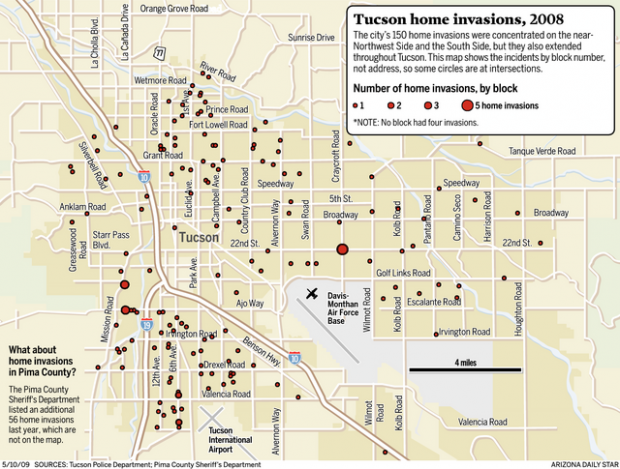
Tucson police received reports of 150 home invasions last year, the first year the department has kept track of the cases as a separate crime, within the broader category of residential robberies. Whether Tucson has more home invasions than other cities is unknown because few, if any, other cities track them separately.
But the little information available suggests Tucsonans are more likely to become home-invasion victims than are residents of other Southwestern cities. Last year, police in San Diego, with its population of about 1.3 million, received reports of 149 residential robberies — a rate of 11.5 cases per 100,000 residents.
In Tucson, with its population of not much more than 500,000, the rate was almost four times higher — 38.7 cases for every 100,000 residents.
Not every residential robbery is a home invasion, but in Tucson most residential robberies are. In home invasions, the perpetrators typically work in groups, go into houses armed, wear masks and dark clothing, use threats and force to subdue residents, and steal property.
That's different from the more common crime of burglary, in which criminals enter a home, intending to steal property and leave undetected.
Both the Tucson Police Department and the Pima County Sheriff's Department say law-abiding residents have little to worry about from home invaders.
Tucson police say 75 percent of home invasions target victims who have been involved in crime, and the Sheriff's Department pegs that figure at 95 percent.
But both agencies acknowledge that a tactic born in the drug trade seems to be spreading into the homes of more law-abiding residents.
One reason is mistaken addresses. Home invasion "crews," as the attackers are known, get their information by word of mouth, police said. They may hear that a marijuana load has been delivered to a certain house, but they may not get the location quite right.
That phenomenon seemed to hit the Midvale Park area, on Tucson's Southwest Side, about three years ago, said Christina Cruz, president of the Midvale Park Neighborhood Association.
"Criminals have a chain of information," she said. "In a place like Midvale Park, with all these cookie-cutter houses, it's easy to hit a house that's close to but not the correct house."
Former Pima County prosecutor Michael Kelly estimated that half the home-invasion cases that came to his office targeted the wrong house. In part, that may be because some home invasions targeting drug traffickers are never reported, said Kelly, who left his job as a prosecutor in March after more than three years in the gang unit.
While The New York Times reported in March that Tucson's home invasions are a symptom of broader cross-border violence, few of the perpetrators are from Mexico, said Pacheco and sheriff's Lt. Michael O'Connor. Most of them are young local men, often involved in gangs or drug trafficking.
"Kind of gives me a chill"
One case Kelly prosecuted was against the men who burst into Philip Mendoza's far Southwest Side house on the night of Jan. 2, 2007. Kelly never was sure why they hit the home, on West Valencia Road near South Camino de Oeste, but he thinks they thought there was marijuana there.
Mendoza, then 22, had just gone to sleep when he heard stomping and yelling in the house. As he stirred, the action came to his bedroom door.
"They hit my door twice. I could see my door flexing," Mendoza recalled, sitting in the living room of his home last week. "Even talking about it now, it still just kind of gives me a chill."
That night, Mendoza grabbed a shotgun in the room and aimed it at the door. When it burst open, he took a quick peek at the person there — just in case it was a family member — then fired. The shot injured the man, who ran out of the room.
Mendoza took two steps toward the door, and another man appeared. Mendoza fired again.
"That was the fatal shot," Mendoza said, eyes downcast.
Three other family members were in the house when the men burst in: Mendoza's mother, her boyfriend, and Mendoza's 9-year-old nephew. The attackers had forced them onto the floor at gunpoint but fled after Mendoza fired, leaving an accomplice dead or dying on a hallway floor.
"I was freaking out, dude," Mendoza recalled. "My adrenaline was pumping. Everything was overwhelming.
"It was a horrible night."
He and the others in the house that night have had trouble dealing with it since. They moved out of their house for three months, thinking they might be in danger there, and considered leaving the state, Mendoza said. They finally decided to return after friends said they shouldn't let those men drive them out of their home.
But the effects of the attack remain.
"Even now, I hear noises that wake me up, and my heart starts pumping," said Mendoza, a welder. "You're never quite the same after that."
Mendoza's mother, Guillermina, said in Spanish that she thinks of that night often — "every time I go down the hallway," she said. As tears began to pool in her eyes, she said she remembers the dead invader, Anthony R. Amavisca, lying in the hall.
"I spent four or five months praying for him — 'so that you rest in peace and leave me in peace in my house,' " Guillermina Mendoza said.
Scene from a horror movie
A rash of home invasions in Midvale Park started about three years ago, forcing residents to act. One of the hottest spots was a single block of West Maplewood Drive, where two home invasions happened over a period of a few days.
Maria Arredondo, 32, had heard her neighbors' house being invaded a couple of days earlier. On the early morning of Jan. 2, 2007, it was her turn.
She was asleep when she heard a sliding-glass door breaking. Her husband confronted the intruders, who told him: " 'Shut up. We're going to kill you if you don't give us the money or the drugs,' " Arredondo recalled.
"They shot at him three times. I never got out of the room," Arredondo said. "I rolled under the bed and called the police with my cell phone."
Then a scene from a horror movie unfolded. Lying quietly under the bed, Arredondo watched as armed men came into the room.
"I thought they were going to kill me, but they didn't know I was there," she said.
When the assailants left, her husband — who had not been hit — chased after them. He hadn't seen or heard his wife and thought they had kidnapped her.
Afterward, Arredondo joined other Midvale Park residents at neighborhood meetings to address the problem. The neighbors mobilized.
Cruz, the president of the neighborhood association, was one of them. The wave of invasions "scared the hell out of me," she said.
The Police Department held a meeting about the violence, a session that didn't entirely satisfy residents, Cruz said.
"After this meeting, people got pissed and felt very empowered," she said.
Organized efforts to combat crime in the area resulted, but perhaps the most effective tool has been the increased watchfulness of neighbors, Cruz said.
"There are pockets of Midvale Park where you can't walk down the street without being reported," she said.
Maplewood Drive is one of those areas, Arredondo said.
"Since that happened, all the neighbors are watching each other," she said.
That has helped ease the insecurity Arredondo and her husband felt, she said. But it hasn't been so easy for their two children, who were ages 7 and 13 at the time of the attack and remain afraid.
"We feel more secure, but since then, they don't feel safe," she said.
Part of the reason for the sense of insecurity among home-invasion victims is that the crimes shatter the sense of safety in their homes, said Sergio Martinez, a forensic psychologist in Tucson. It leaves symptoms like those of post-traumatic stress disorder, such as anxiety and sleeplessness.
Joe Rivas still lives in the home where he was pistol-whipped during the 2006 home invasion, but now it has wrought iron bars and motion-sensor lights.
"It just makes you that much more leery," Rivas said. "You lose the comfort you had in your own home and trust in people."
HOME INVASIONS
Has there been a home invasion in your neighborhood? Search through our database to find out.


