

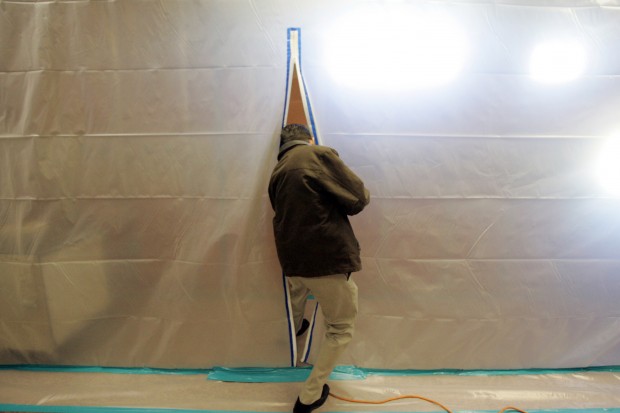
When teacher Suzanne Anderson discovered mold behind a poster in her classroom this fall, it set off alarm bells.
Angela Cupis, the teacher who used the Summit View Elementary School classroom last school year, had spent a nightmarish 2009-2010 assigned there. She was in and out of urgent care, was hospitalized several times and at one point was in isolation while doctors tried to figure out what was wrong.
"Once I was back at school and off my medication, it would take about two weeks before I would start getting sick again," she said.
At the end of the year she was laid off in districtwide budget cuts.
But what may seem to be a clear-cut connection between mold and Cupis' illness is not so certain. School principal Valerie Lopez-Miranda said no mold was detected in the classroom until September, when Anderson happened to pull up the edge of a laminated poster. This summer, before heavy rains in August and September, the walls were bare and clean, Lopez-Miranda said.
People are also reading…
Also, many experts are cautious about saying mold causes severe illness. Among the small percentage of people who react to indoor mold, by far the most common reactions are mild respiratory effects - runny nose, itchy eyes, asthma or maybe sinusitis.
Fear of "toxic mold" is widespread, but it has not been proved that indoor mold can infect people with these "mycotoxins," said Dr. Robert McLellan, past president of the American College of Occupational and Environmental Medicine.
At Summit View, 1900 E. Summit St., two classes, including Anderson's, have been moved from the wing where the mold appeared. The school will move a total of eight classes, two at a time, to repair mold damage in Anderson's class and water damage in the other seven, Lopez-Miranda said.
"As far as we know, there were no illnesses due to mold," Lopez-Miranda said.
Symptomatic Students
That doesn't mean no strange medical conditions occurred in that classroom.
"My daughter suffered from a lot of migraines, upset stomach, fevers, chills and would vomit," said Summit View parent Jerilyn Ugalde, whose daughter, Annaliese, was in the class last year where mold was found this year. "She easily missed more than 20 days last school year and her pediatrician could never figure out what was wrong."
Her teacher last year, Cupis, said she still recalls the room's musty odor. She had severe headaches, her temperature spiked as high as105 degrees, and she suffered chills, respiratory infections, pneumonia, urinary tract infections and kidney stones, she said.
She fell behind at work, and said principal Lopez-Miranda was documenting her performance before Cupis took a medical leave. Lopez-Miranda said she couldn't discuss Cupis because of confidentiality laws.
Doctors physicians mentioned the possibility of mold as the culprit, Cupis said. "They asked me if it could be environmental, but I told them no," she said. At the time, "I didn't know about the mold."
This year, the new teacher in the room, Anderson, had her own symptoms.
"I am allergic to mold, and I suffered from itchy, red eyes and congested sinuses. I felt like I had a cold that would not go away," she said. About half of her students also had runny noses and watery eyes, she said.
Lopez-Miranda said absenteeism has not been significantly worse in the water-damaged classrooms than in other classes.
"A lousy feeling"
What Anderson described are typical symptoms of exposure to indoor mold, experts said.
Mold can cause "a lousy feeling," said Dr. John Sullivan, a medical toxicologist with the Arizona Poison Center at the University of Arizona Health Sciences Center. Symptoms can include headaches, itchy and burning eyes, fatigue and asthma attacks.
About 5 percent of the population is susceptible to these allergic symptoms, but a small number - especially those with suppressed immune systems - may get a pneumonialike condition, a systemic fungal infection, and even exposure to mycotoxins - perhaps the most feared result of mold growth.
People working with moldy hay in a barn may be exposed to these toxic molds, McLellan said, but it has not been shown that indoor molds can transmit mycotoxins to people. And in some cases people attribute their symptoms to mold when the actual cause is something else, he said.
Communication, cleanup
Two keys to responding to mold are remediation and communication, experts said. The Sunnyside school district jumped on the remediation effort after Anderson reported mold.
The district hired Belfor Property Restoration to tear down the inner wall where water damage occurred and remediate the damage.
"The building needs to be made well," Sullivan said. "When the building is better, then the patients will get better over time."
Health Effects Group, Inc., of which Sullivan is president, is sampling the air. As of Nov. 22 there have been no reports of airborne mold spores, district officials said.
In September, families were notified of the classroom switches, but only the families of Anderson's students learned of the mold growth.
After the Star inquired about the mold last month, the district notified all parents in a Nov. 24 letter. Ugalde, whose daughter was sick in the affected classroom last year, said all parents should have been notified when the mold was found.
The district held a meeting about the situation Wednesday, but only one parent showed up. Lopez-Miranda took that as a sign parents believe the school is taking care of the problem.
Cupis hopes so.
"Since I have left Summit View, I am healthy. I feel great," said Cupis, who now teaches at a charter school and works a retail job to support her five kids. "But I do worry about the students and teachers I left behind."
Contact reporter Carmen Duarte at 573-4104 or cduarte@azstarnet.com


