

Pima County Supervisor Ally Miller has made a legal misstep that could cost her $5,000 — although she denies she did anything wrong.
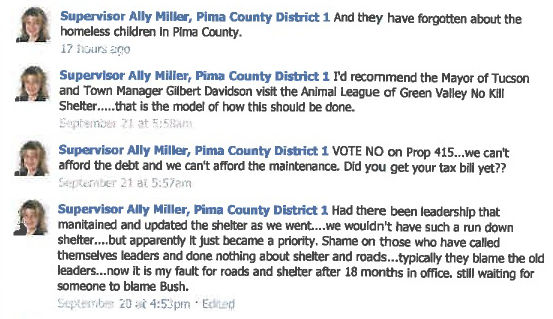
On Sept. 21, in a post that has since been removed, the first-term supervisor wrote on her Facebook page — which includes a link to her county-sponsored web page — “VOTE NO on Prop. 415 … we can’t afford the debt and we can’t afford the maintenance. Did you get your tax bill yet?”
Arizona Revised Statute 16-192 says it’s illegal for any public authority to use public resources to influence an election. Those resources include web pages, personnel “and any other thing of value of the public entity.”
The penalty, if a violation is confirmed, is $5,000.
The statute says to “influence an election means supporting or opposing a candidate for nomination or election to public office or the recall of a public officer or supporting or opposing a ballot measure. …”
People are also reading…
Voters will vote on Prop. 415 in the November election. The proposition would set aside $22 million for renovation and construction of the aging, county-run Pima Animal Care Center at 4000 N. Silverbell Road. For a taxpayer who owns a home valued at $150,000, the bond would cost about $2.89 a year.
Miller’s Facebook page links to the website www.allymiller
district1.com, which includes a “contact” link that directs to a Pima County page.
Miller said if there are links from her Facebook page to the county website, “It was a mistake.”
Later, though, she said, “But I would certainly post ‘Vote no on Proposition 415 again because that is my opinion. There was no county funding to do that post.”
She said she doesn’t know why the post is no longer on her Facebook page, but it originally included a spreadsheet. “So I don’t know why it’s disappeared.”
Miller said she has used it to explain why she opposes the proposition — partly because the pricetag has changed three times.
“Expressing my opinion as a supervisor is perfectly legal. I have expressed my opinion as a supervisor,” Miller said. “What funds did I use? I posted that in my own time.”
County Administrator Chuck Huckelberry had a different take.
“I think it’s obvious we go to great lengths to be neutral, and the staff cannot take a position on a proposition one way or another. All we can do is factually provide information,” he said. “This clearly is something that ought to be reviewed by the county attorney.”
He continued, “When your Facebook page is linked to a publicly financed web page, it clearly is very questionable activity.”
The county Attorney’s Office said it hasn’t received a complaint from anyone about the post.
If it does, it will either investigate the matter, or, if there were a conflict of interest, refer the matter to another agency such as the Attorney General’s Office, said Amelia Cramer, chief deputy county attorney.
Supervisor Ramón Valadez, who was in the Legislature when the statute was revised, said, “The intent of the Legislature when we adopted those changes was to prevent the usage of public resources for the purpose of campaigning. There’s just no way to put it any clearer … if you’re going to do it, do it on your personal website, do it with your own resources.”
Valadez was appointed to the Board of Supervisors in 2003 to serve out the term of Dan Eckstrom and is in the midst of serving his third full term.
Five-term supervisor Ray Carroll said, “This is not some rookie mistake.”
“I think it was an abuse of taxpayer money with insidious intent. And I hope she can explain to the proper authorities how she will reimburse the taxpayers and cease and desist from future flagrant violations.”
The statute says, “Any person or public entity that knowingly violates this section or that knowingly aids another person or public entity in violating this section is liable for a civil penalty of not more than five thousand dollars for each violation.”
The court may also order the violator to pay the cost of the public resources that were used unlawfully. If the attorney general takes action, the money goes to that entity’s office. That’s the case, too, if the county attorney takes action. If a resident of the jurisdiction — in this case, Pima County — takes legal action and civil penalties are assessed, they go to the resident.
Contact reporter Tiffany Kjos at tkjos@tucson.com. On Twitter @tiffanykjos