

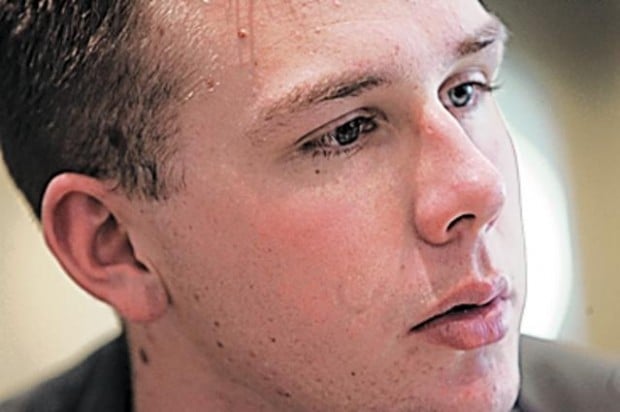
Four months after finishing boot camp, Pvt. Kyle Lawson is no longer a gay soldier.
The 19-year-old Tucson native returned to civilian life Thursday, honorably discharged from the Army a few weeks after going public about being assaulted by a fellow soldier. He was discharged at his own request on the basis of his homosexuality.
"It feels weird," Lawson said, while waiting in line at the American Airlines counter at Tucson International Airport, about to board a flight home to his mother's house in Missouri.
"It's bittersweet. On one hand, it will be better for me because I can be who I am. But I'm going to miss it a lot. I really loved it."
The clerk behind the counter, noticing Lawson's Army-issued green duffel bag, cheerfully asked him for his military ID.
He looked back at her blankly, then winced. "I don't have it," he mumbled.
People are also reading…
It was a small sign of how much has changed for Lawson.
He has become a virtual celebrity in the gay and lesbian world since the Arizona Daily Star ran a story last month about an Oct. 29 attack that left him with a broken nose and a nagging fear that he was not safe in the military after his sexual orientation became known.
News of Lawson's plight has traveled around the globe via the Internet. A Google search of his name and the word "army" drew close to 29,000 hits as of late Thursday, a number that's been growing by several thousand a day.
The Advocate, the nation's largest gay news publication, soon will feature Lawson on its cover. U.S. Rep. Barney Frank, an openly gay Massachusetts Democrat, has written to the chief of staff of the Army, demanding to know why Lawson's attacker was not prosecuted.
And the mother of a murdered Army private, bludgeoned to death in his sleep at Fort Campbell, Ky., by fellow soldiers who suspected he was gay, has issued a statement calling on the Pentagon to do more to protect gay troops from harm.
"Words cannot express how upset we are to learn that no appropriate punishment has been ordered" in Lawson's case, said Patricia Kutteles, mother of Pfc. Barry Winchell, who was slain in 1999. An Army inquiry after his death found anti-gay harassment had occurred in his unit before the killing. The death prompted a Pentagon push in 2000 to prevent gay-bashing.
Officials at Fort Huachuca in Sierra Vista, where Lawson was about to start training as an Army interrogator, maintained the case was handled appropriately in the circumstances.
The soldier who punched Lawson at an off-post party was charged by civilian police with felony aggravated assault in the attack, which the investigating civilian officer described as unprovoked.
The Army requested jurisdiction over the criminal case, then declined to prosecute the alleged attacker on the charge, which draws an average 3 1/2 years in prison upon conviction in Arizona.
Fort Huachuca officials have issued two different statements to news media about their handling of the Lawson matter.
In the first one, dated Dec. 15, in response to questions from the Star, officials said commanders disciplined Lawson's attacker appropriately "based on their review of all the circumstances." That statement did not say what the punishment was, or what the circumstances were, details Army officials said were protected by privacy laws.
The second statement, dated Dec. 20, was issued two days after the Star story appeared as controversy grew and media outlets around the country were pressing Fort Huachuca for answers. Fort officials said Thursday that the second response was a "clarifying statement."
The second Army statement said Lawson's attacker admitted punching Lawson, and said he did so because he felt Lawson was sexually harassing him. "Numerous witness statements" made to Sierra Vista police supported the attacker's account of what occurred, the second Army statement said.
Police reports obtained by the Star do not support that statement. Two other soldiers whose statements were included in the police reports gave conflicting accounts of what happened.
One said he had overheard Lawson making sexual remarks but did not see the attack take place. The other soldier who saw the punch thrown said she didn't know why Lawson was attacked. She also told Sierra Vista police that the soldier who attacked Lawson was "dangerous," police reports said.
Lawson's attacker and other soldiers had ample advance notice that civilian police were headed to Fort Huachuca to interview them, police reports show. Police contacted the fort at 8 a.m. on the day of the interview. They were told to come to the fort at 12:30 p.m. and when they got there, all the soldiers they planned to question already had prepared written statements.
According to Lawson's discharge paperwork, he had a spotless behavior record when he left the Army. The papers contain space for the officer overseeing the discharge to document wrongdoing such as illegal or problematic behavior. Each of those spaces in Lawson's paperwork contains the word "none."
Steve Ralls, of the Servicemembers Legal Defense Network, a national advocacy group that assists gay and lesbian service members, called Fort Hua-chuca's handling of Lawson's case "outrageous" and riddled with inexplicable conflicts. For example, he asked why, if the Army bought the attacker's claim that Lawson was a sexual harasser, did Lawson still have a clean behavior record?
Service members like Lawson usually leave the military quietly when harassed or assaulted, Ralls said. The global interest in his case reflects how rare it is to see such a story in the news.
Lawson "has done a very brave thing and the gay and lesbian soldiers who continue to serve will owe him a debt of gratitude for speaking up," Ralls said.
Nearly 10,000 gays and lesbians — at least 63 from Southern Arizona bases — have been discharged under the military's "Don't Ask Don't Tell" policy.


