

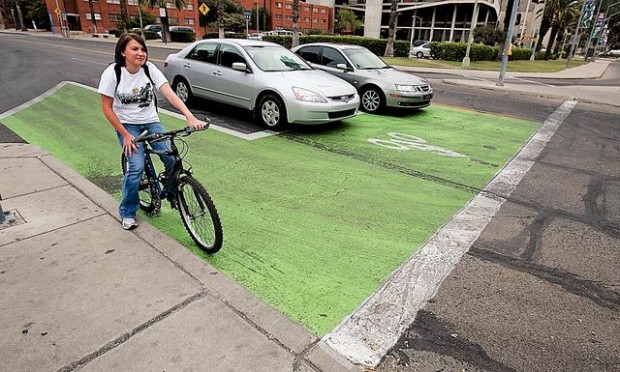
A new feature for bicyclists was added to a busy bike route last month.
At East Sixth Street and North Highland Avenue drivers and bicyclists will find new green markings on the pavement. The bike lane is marked with the green, thermoplastic material, and it also stretches 12 feet in front of where cars stop (moving the vehicle stop line back 12 feet from the crosswalk).
This is Tucson's first "bike box."
The concept is to show, with the green color, where the bicyclists should stop as they wait for the traffic signal to change. Drivers are supposed to stop behind the green box, on the regular asphalt. The extra space for bicyclists is to help prevent competition for position when the road narrows on the south side of the intersection.
"The intersection narrows at the southwest corner. The curb goes in about six feet, so there's a bottleneck or pinch point, and bikes and cars have to jockey for that space, while in motion," said Tom Thivener, bicycle and pedestrian coordinator for Tucson.
People are also reading…
Though this is the first bike box in Tucson, it may not be the last. Other U.S. cities, including Portland, Ore., and several European cities use the thermoplastic coating to distinguish bike space from car space. The city will keep an eye on how the configuration works at this intersection before deciding where else to install it, Thivener said.
I have to admit, when I first saw photos of the bike box, I wondered why the cyclists should be out in front of the cars, as opposed to along the right side of the traffic lane. It just seemed counter to what we learn about where we should ride.
But once I heard the explanation on reducing the bottleneck and preventing cars and bikes from jockeying for position at the south side of the intersection, it made sense to me.
Getting bicyclists out in front of the vehicles also makes them more visible.
I think it's something that could really help make life better for cyclists, without causing delay for motorists, once everyone gets used to it.
The key thing is public education on the city's end. If this system doesn't work, it will be because people don't know how to use it.
The University of Arizona Police Department handed out information about the new traffic configuration Feb. 23, after a weekend installation. There's also a pamphlet box alongside the road, so people can grab information about it as they wait for the signal to change.
I hope those who slipped through the cracks and didn't know why the intersection was reconfigured can quickly adapt. Confusion won't help cyclists on one of the busiest bike routes in town, but education will.
RoadQ
Question: "Why did ADOT remove the oleanders from the side of the (I-)10 freeway between the Sixth Ave westbound exit and the Sixth Ave overpass? Those oleanders were a nice aesthetic touch to the roadway, and it doesn't make too much sense to have them removed," wrote Gabriel J. Harvey.
Answer: The oleanders along the road were trimmed but not removed, said Linda Ritter, spokeswoman for the Arizona Department of Transportation. They will grow back, but they were cut because the plants grow against the guardrail, trapping trash and debris there, she said.


