

BENSON — For Gordon Abbott and his sons, Ryan, 9, and Sean, 12, Kartchner Caverns State Park provided an eye-opening experience during a trip from Honolulu.
"I want them to take home some really special memories, and I know they will," Abbott said after a tour of the caves.
To scientists, the caves are fertile ground for research on subjects such as microscopic food chains.
"We have an amazing diversity of bacteria in this cave," said Bob Casavant, park research and science manager at Arizona State Parks. "It's all kinds of different bacteria and fungi and then the bugs and the bats."
To Brian Dinwiddie, the caverns mean more customers at his Horseshoe Cafe down the road in Benson.
"This used to be a place for locals to eat on weekends," he said. "Now it's where a lot of people eat before or after visiting the caves."
People are also reading…
And for the state parks system, Kartchner Caverns is a source of income that helps offset budget cuts.
"The funds we bring at Kartchner are crucial," said Ellen Bilbrey, public information officer for Arizona State Parks. "That supports the rest of the state park system as well."
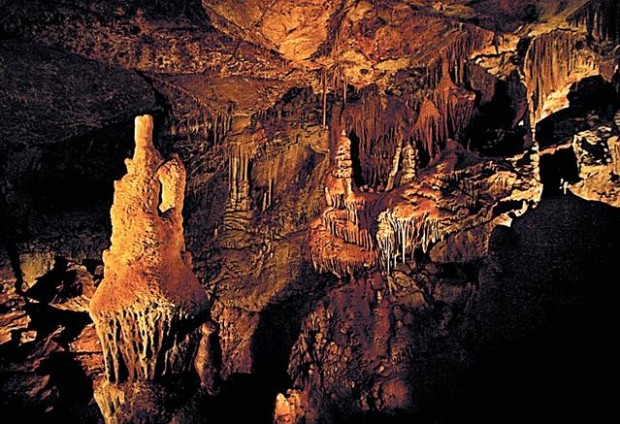
November will mark 10 years since Kartchner Caverns State Park opened to the public. In that time, 2 million people have wondered at the Throne Room, the Big Room and other features of what's called a living cave, one whose stalactites, stalagmites and other calcite formations are still growing.
The story of the caverns' discovery remains almost as big a part of the experience as going underground.
Tour guides tell it this way: Gary Tenen and Randy Tufts found the caves on property owned by the Kartchner family in 1974. They spent the next few years exploring in secret and a few more years meeting with the landowners to discuss the best way to preserve what they'd found.
"They took so much care to keep it a secret because they saw how the caves discovered before have a lot of damage," Bilbrey said.
In 1988, the state bought the property to turn it into a park, but it took more than 10 years of careful construction to get the caves ready for the public.
A path had to be blasted using the same technology used to implode large buildings. Volunteers used buckets to pour concrete walkways inside the caves. Workers installed airlocks at entrances and exits to maintain the cave's naturally high humidity.
Visitors say all of those preparations create a unique experience.
"It's just phenomenal, almost spiritual," Ruth Blazek said of the Throne Room, home to a redwood-sized column of limestone that discoverers named Kubla Khan.
Blazek, on vacation with her husband, Jerry, from their home in Salt Lake City, was also impressed that cave tours accommodate wheelchairs.
"The way they've been able to preserve it and still have access for everyone is great," she said.
About 150,000 people visit the caverns each year, with adults paying $18.95 or $22.95, depending on the tour. The park limits the number of people in the cave and recommends reservations.
Visitors often use one of Benson's 1,828 RV spaces or 350 hotel rooms, said Bob Nilsen, Benson's tourism supervisor.
"We're like the gateway to the park. A lot of visitors stay here while they explore the area," he said. "It's meant more sales- and bed-tax revenue for the town."
It works much the same way at other state parks, Bilbrey said.
"State parks are economic engines for rural areas," she said. "All national and state parks are that way."
A report from Northern Arizona University's Arizona Hospitality Research & Resource Center found that per-person spending by people who visit state parks is about $70 a day.
Scientists benefit from the caverns as well, studying everything from cave science to climate change to fossils to microbes.
NASA, looking toward establishing colonies beyond Earth, visited to see how the caverns' environment is preserved, Bilbrey said.
"There's so much opportunity when you have a pristine environment to study science," she said.
Perhaps more valuable than science and economic impact, Bilbrey said, is that as a state park Kartchner Caverns is preserved for future generations.
"We're protecting a valuable natural and cultural resource," she said.
The Abbott boys from Honolulu hope so.
"When we grow up and have kids, we're going to be able to bring them here and see it, too," Sean said.


