

If you open your mail and find a city speeding or red-light ticket issued by a camera instead of a traffic cop, you don't have to pay it.
State law says civil citations, which include most traffic violations, must be served in person.
But that technicality won't get you off the hook entirely. It will just buy you a little time. And unless you go to court and beat the rap, it will cost you an extra $25 for the process server the city will send to your house to deliver your ticket in person.
That $25 charge on top of the standard fine, for making the city serve you in person, the way it's supposed to, has many Tucson attorneys, and at least one state lawmaker, crying foul.
But city officials say Tucson is following the same procedure used by half a dozen governments in Maricopa County, some of which have been using red-light cameras and photo radar for years.
People are also reading…
Still, members of Tucson's citizens transportation advisory committee are concerned enough that they plan to put the issue on their next agenda. City Councilwoman Karin Uhlich said she, too, questions whether it's fair to charge people extra if they insist on their right to be served in person, and may seek a council review of the policy.
The focal point for all this angst is two new programs implemented in recent months to target unsafe drivers.
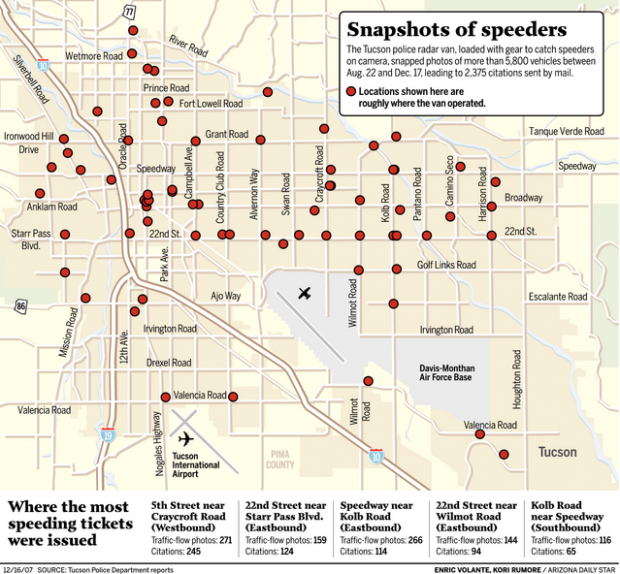
One is a photo radar van that is periodically moved to catch speeders. The other is a digital camera designed to catch red-light runners at Tanque Verde and Kolb roads. Three more red-light cameras are expected to come online by February.
People caught speeding or running red lights on camera are mailed tickets and given 30 days to respond by paying them, contesting them or going to traffic school.
If a driver doesn't respond, the city has 60 days to serve the citation in person.
Tucson attorney Michael Boreale, who is also a member of the citizens transportation committee, contends the Arizona Rules of Civil Procedure require the tickets, which are considered a civil matter, to be served by process servers, just as lawsuits must be.
The city is counting on the ignorance of the general public to boost its revenues, Boreale said. The average citizen is going to assume once they get a ticket in the mail, they have to pay it, and not quibble about whether it was delivered in person or by mail.
"Everyone deserves to live in a safe society, but more fundamentally, everyone deserves to be treated with fairness," Boreale said. "If the city is willing to put safety or revenue above that fairness, it is not serving us well."
Justin Castillo, another local attorney, said he thinks city officials approved the new traffic devices more for the revenues they generate and less for safety reasons.
"It's safety tax," Castillo said. "It's a tax on the people, and our rights are not for sale. No one is advocating for unsafe streets and no one is advocating for speeding, but we've got a due-process system that was put in place for a reason. We can't have a state that doesn't honor its own rules."
State Sen. Ron Gould, R-Lake Havasu City, agreed cities are likely to try to keep quiet about the fact that violators can ignore the citations they receive by mail.
Gould is a photo radar opponent who will soon introduce a bill in the Senate that would create a November referendum on use of the cameras.
He said he doesn't think drivers should have to pay the process server for exercising their right to demand proper service.
"To me that seems kind of counterintuitive," Gould said. "It's ridiculous that they have to pay the process server on top of a ticket."
Presiding Tucson City Court Judge Tony Riojas said Tucson is in full compliance with the law, and the Arizona Supreme Court approved the language on the ticket explaining the process.
"All the citation does is let them know they have been accused of violating the law and they have the opportunity to contest it," Riojas said. "This process is being used statewide. We're not any different. No one's abusing their rights."
Paying the mail citation lets them save $25, he said.
Phoenix, Mesa, Paradise Valley, Tempe, Scottsdale and the Arizona Department of Public Safety all have photo radar cameras.
Uhlich said she believes the city is following the letter of the law, but she's open to changes.
Photo radar and red-light cameras add to public safety, Uhlich said, but the idea you have to pay more to exercise your rights to be served in person is one issue that is worth addressing by the council.
"It's a question that might be worth re-examining," Uhlich said, while noting that most who get the ticket in the mail will simply pay it.
Riojas disputed the suggestion that the tickets are nothing but revenue-generators. By the time the city pays the vendor who owns the cameras and city and state processing fees and surcharges, the tickets are "revenue-neutral," he said.
Photo-radar vans and red-light cameras simply save lives, Riojas said.
Tucson gives three classes of photo-radar tickets: $191 for 11 to 15 mph over the speed limit, $208 for 16 to 20 mph and $234 for 21 to 25 mph over the limit.
Deputy City Manager Mike Letcher said by far the most common fine is $191.
That ticket includes a $88.37 base fine and $102.63 in city and state processing fees and surcharges. Letcher said the city gives its vendor a $33.50 cut of the base fine if it can find and successfully serve the driver intime.
Deputy Court Administrator Chris Hale said the fine for red-light cameras is $280, split among a $136.74 base fine, $114.86 state surcharge and about $29 in case processing and other surcharges.
Last year, the city collected $23.7 million for fines, fees and licenses, Riojas said. It ended up with $12.7 million after giving the state its share.
Brian Cabianca, a partner in the Phoenix law office of Squire, Sanders & Dempsey, said cities resorted to process servers only after a few people got "creative" and figured out that if they didn't respond to the ticket, it wasn't valid.
"For a year that generally worked. Everyone would just ignore them," Cabianca said. "For a while they weren't following through and sending process servers to get people to pay them."
Richard Gaxiola, a partner with the Phoenix-area personal-injury law firm Alex and Gaxiola, said making drivers pay for the service fee is wrong.
"Making them pay the fee for the service process clearly is improper for someone who is exercising their rights," Gaxiola said. "Should they be penalized? In my view it's certainly not correct."
However, he said most drivers don't know their rights, and therefore the government is getting away with improper service, Gaxiola said.
"There would be a lot more photo-radar tickets thrown out if people knew the rules," Gaxiola said. "To level the playing field, people need to understand their rights."
Lt. Mike Pryor, the traffic section commander for the Tucson Police Department, said he is sure a small percentage of people will throw away their tickets.
"People will throw them in the trash: There's no two ways about it, but if the letter found you, the process server probably will be able to, too," Pryor said. "But I think most people are responsible, and they know if they did right or wrong."
Roughly 3,600 tickets were mailed out between Aug. 24 and Dec. 4, Pryor said. The vast majority were for speeding.
By February, red-light cameras will be installed at Valencia Road and Nogales Highway, Wilmot Road and 22nd Street and River and Oracle roads, Pryor said.
Snapshots of Speeders
The Tucson police radar van, loaded with gear to catch speeders on camera, has snapped photos of more than 5,800 vehicles between Aug. 22 and Dec. 12, 2007, leading to 2,375 citations. Click here for a an interactive map, which shows the approximate area some of the speeders were caught.


