

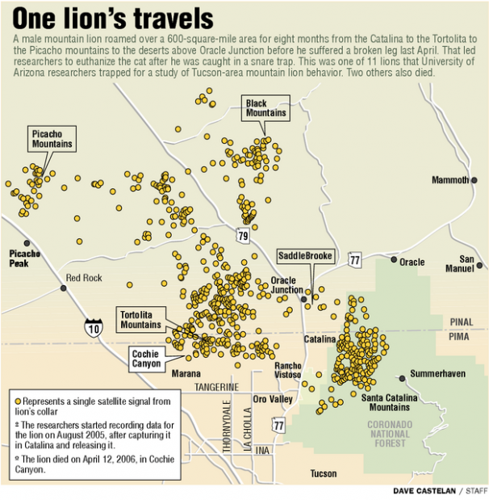
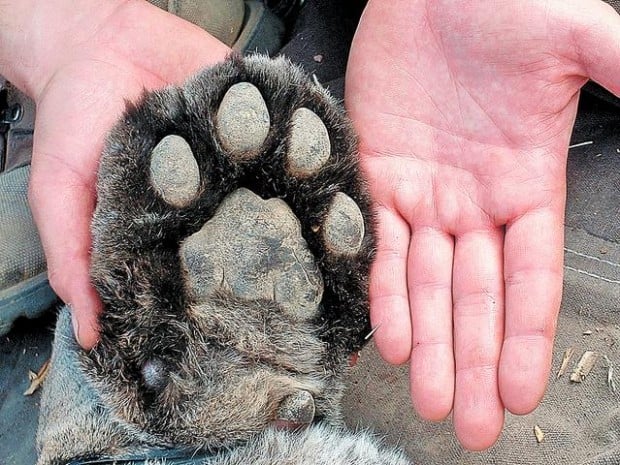
For eight months the 4-year-old male mountain lion roamed back and forth from the Tortolitas to the Catalinas. Sometimes it journeyed 15 miles in a day; sometimes it hung out in one mountain range for a week.
One September evening shortly after sunset, the lion padded through SaddleBrooke Country Club just north of Tucson. Two other times, it came to within 600 yards of a golf course in Oro Valley's Rancho Vistoso development.
But mostly, the big cat stayed as far from people as it could and ventured near them only under cover of darkness.
Over the past year, University of Arizona researchers have tracked the daily moves of that lion and 10 others across the mountains ringing Tucson — although three of the radio-collared lions have since died.
All the lions generally avoided populated areas, researchers say — but they did roam through or near several swaths where development is planned and up to tens of thousands of new homes could be built.
People are also reading…
The research raises questions about mountain lions' future here as metro Tucson's population heads to 1 million and more. The cats — which can thrill and frighten in the same instant when glimpsed in the wild — are already thought to be in jeopardy in the Tucson Mountains on the West Side.
The study also suggests that continued growth in areas where lions live could spark future conflicts of the kind that prompted a controversial lion hunt two years ago in popular Sabino Canyon on the Northeast Side.
In parts of the West, including northern Colorado and Southern California, lions have attacked humans and sparked fear. Just this May, a mountain lion walked into a Boulder home, ate a pet cat and the cat's food before being captured.
But SaddleBrooke resident Jim Cloer, for one, was happy to see a lion walking through that community's golf course early one morning last summer.
"He was going down into this wooded area, off to the right side, between holes 26 and 22," said Cloer, a retired schoolteacher with a master's degree in biology who works as a volunteer ranger at the course. "It was trying to get down out of sight. It was nice to see."
The UA's and Arizona Game and Fish Department's nearly $500,000 study is the first of its kind for Arizona. It's trying to pinpoint where lions travel not just in the Tucson area but around Central Arizona's Prescott and Payson.
The 11 radio-collared in the Tucson area included two near Oracle, one in Catalina, two each in the Tortolita and Santa Rita mountains, two from Agua Caliente Wash on the far Northeast Side, one originally caught in an Oro Valley back yard and one from the Silverbell Mountains northwest of the city.
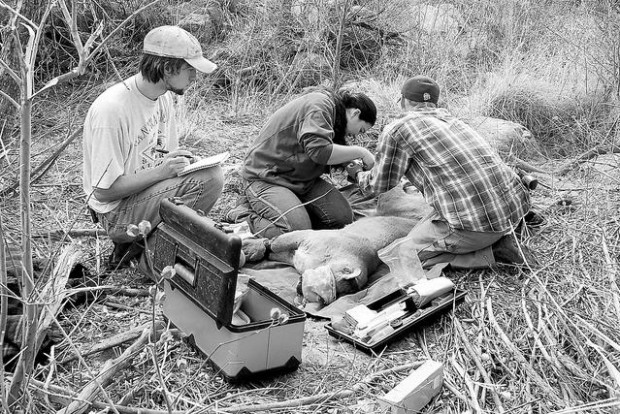
Of the three lions that died during the study, the first was killed by another lion. The second was euthanized after it got caught with a broken leg in a snare trap set by the researchers. The third was killed by a rancher in the Santa Ritas after it ate three cows.
The three deaths are not unusual in a project of this scope, the researchers said.
UA plans to keep gathering satellite-transmitted data from the eight remaining cats until October 2007 and publish its analysis by early 2009.
So far, the researchers released detailed data only for the 4-year-old male on the far Northwest Side, because its safety is no longer an issue. The lion died in April in the study's snare trap in the Tortolitas, after being tracked for eight months.
The scientists would not release specific locations for the other lions. After the Star printed a map last fall showing that same male cat's moves, hunters called one area rancher looking for it, said Paul Krausman, a UA wildlife sciences professor who is leading the research effort.
The researchers will release all lion data once they've stopped tracking them, he said. They will inform authorities immediately, before then, if they track lions in urban areas that could pose hazards to people.
More homes in their habitat
But less detailed maps released by the researchers indicate lions traveled in or near the following areas slated for possible development:
● The 19,000-acre Willow Springs Ranch northwest of Oracle, which ultimately could have more than 30,000 homes although so far only 4,600 acres have been rezoned for about 6,500 suburban homes.
● About 45 square miles of state land, north of Oro Valley and west of Oracle Road, stretching into southern Pinal County. Early planning is under way that could lead to development of some of this land.
● An area of unincorporated Pima County just north of the Santa Rita Mountains, about 25 miles southeast of Tucson, where the 1,320-home Sycamore Canyon development is now under construction on 1,600 acres west of Harrison Road.
● The far Northeast Side north of Tanque Verde Road, which has been slowly filling with low-density housing.
● The Biosphere 2 site just southwest of Oracle, planned for a 1,600-acre housing development.
● The Rosemont mine, where a Canadian company is planning an open-pit copper-mining operation in and around the Santa Rita Mountains, about 30 miles southeast of Tucson.
Lion covered 600 square miles
The far Northwest Side lion that has since died approached two of those areas — Willow Springs and the Biosphere — as it traversed mountains as high as 7,450 feet and deserts as low as 1,950 feet.
It covered about 600 square miles, spending much of its time on Samaniego Ridge high in the Catalinas. It wintered primarily in the lower Tortolita, Picacho and Black mountains, and spent Christmas in the Tortolitas.
The lions journey so far partly because deer, javelina and other foods are limited in the desert, Krausman said. And males often roam far in search of a mate.
"He's gotta find those girls, and he's gotta find the food," said Kerry Nicholson, a UA research assistant on the study. "Those are his two main priorities, and typically he puts girls over food."
While a golf course often is just a travel lane for the cats, the lions can also find skunks, rabbits and rodents there to chow down on, Krausman said.
When this lion reached the SaddleBrooke golf course, it was surrounded by a dense seat of tract homes and stood between them and the green of a fairway.
Four hours later, the animal had buzzed five miles to the west, having crossed North Oracle Road probably between Catalina and Oracle Junction.
By the next morning, it had traveled 15 miles west to the Cottonwood Canyon area near Tortolita Mountain Park.
Guesstimate: 50 to 100 lions
Today, no one knows how many mountain lions live in the Tucson area, or if their population is rising or declining. Krausman "guesstimated" 50 to 100 lions, at most.
The population seems fairly healthy in the Rincon, Catalina and Santa Rita mountains, but less so in the Tucson Mountains, said Don Swann, a National Park Service biologist, and Lisa Haynes, a UA lion researcher.
Researchers don't know if the lions can get in and out of the Tucson Mountains, or if the population is isolated and possibly inbred because the range is surrounded by housing, roads, railroad tracks and the Central Arizona Project canal.
Krausman warned that as growth spreads, mountain lions will not persist unless open-space corridors are preserved within their habitat.
"We need to maintain connectivity between mountain ranges — something that's broad enough to allow animals to move back and forth," he said.
As lions get used to the presence of people, they also can get more aggressive toward them, Krausman noted.
Lynn Kahler, who lives in the Tanque Verde Valley on the far Northeast Side, said she has had three dogs attacked by coyotes, but she believes strongly that lions and other predators deserve to survive.
"It's their right to be here. They were there first," Kahler said, adding that officials "should try to come up with a plan to protect the mountain lion and his environment, and the human population."
A conflict broke out in Sabino Canyon in 2004 after the presence of four lions prompted Game and Fish to announce plans to shoot them. A protest erupted, and the state switched to catching and removing the animals, although officials shot and killed two lions in the Catalinas that year after they confronted hikers.
Nationally, the number of human-lion encounters has increased from about two each year in the 1970s to between six and 10, said Paul Beier, a conservation biology professor at Northern Arizona University.
Still, fatal mountain lion attacks are rare — 17 nationwide since 1890.
One question UA researchers will try to answer is, when lions come into a city, where do they go — washes, schoolyards, open space or neighborhoods?
Lion's itinerary
In early February, the 4-year-old male lion was back in the Tortolitas, and spending a lot of time near a large water tank close to a ranch corral.
From Feb. 16 to 20, the cat hung out in low desert in and near a tree-lined wash north of Oracle Junction. After night fell on the 20th, it pushed south toward the Tortolitas, where it spent a week.
Then, after climbing into Owl Head Buttes, four rocky cliffs about 3,000 feet high, it loped around small mountains just west of "wildcat" subdivisions near highway Arizona 79.
The lion then headed south into the foothills north of Rancho Vistoso. By 9 p.m. on March 6, it had ventured farther south, to 600 yards north of the Golf Club at Vistoso.
But it turned around and headed north from the development, and by the next morning it was deeper into the foothills.
By 10:30 p.m. on March 7, it stood within 300 yards of two foothills homes along a path that passes the Gallery Golf Course in the Dove Mountain development in Marana. But the satellite data never recorded it on the golf course.
The lion spent much of March in the Tortolitas, and never left those mountains again.


 U of A’s fall enrollment down more than 20%, sources say


