

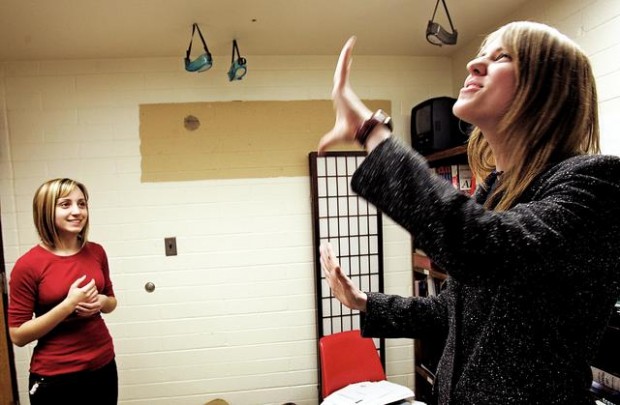
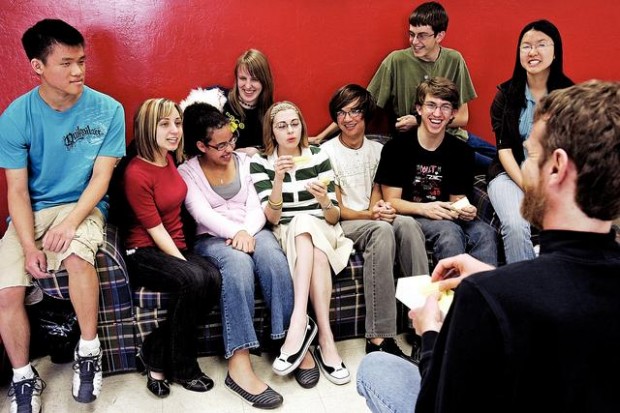
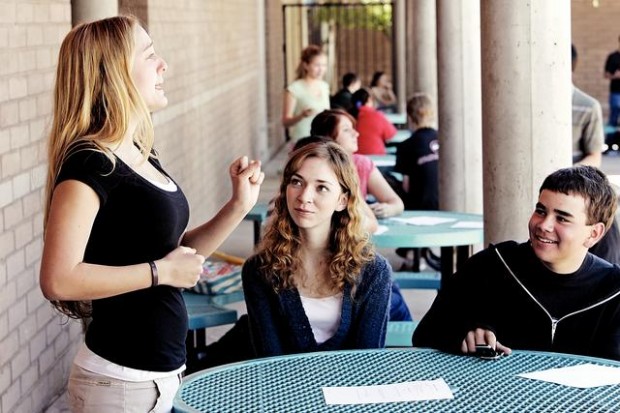
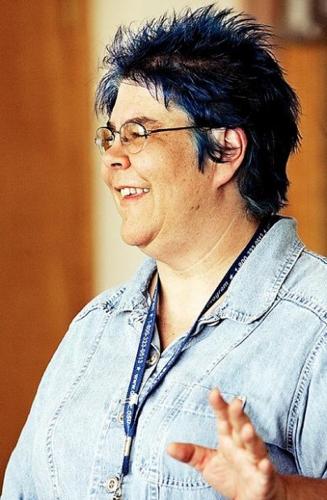
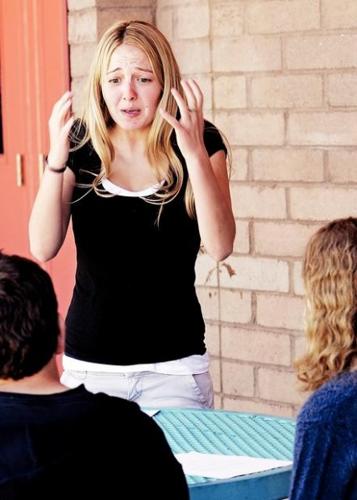
Immaculate Heart High School teacher Karen Ahrens used a bottle of hair dye to motivate her students.
Ahrens promised her Academic Decathlon team members she'd color her hair blue — and we're talking electric blue, not a subtle blue rinse — if they qualified for the state competition, which starts Friday and concludes Saturday in Phoenix.
Five area schools, including Immaculate Heart, qualified for the contest, which is a team competition that tests students in 10 categories. Amphitheater, Canyon del Oro, Marana and Mountain View high schools also qualified for the state competition.
The state winner advances to the national finals in April and May.
Canyon del Oro was the Region III overall winner and is the second-best team in the state. Region III comprises schools in Southern Arizona.
People are also reading…
Ahrens should have known better when it came to the Ironwood Ridge team.
Ironwood Ridge has qualified for state competition three out of the last four years and was named 1A champ in 2005 and 2007.
The school finished eighth at the Region III contest and is currently the top-ranked small school in the state. As a result, Ahrens' hair is electric blue.
"Last year it was luscious raspberry. You could see me from space," she said. "My husband is OK with it. You get used to people looking at you really weird in Wal-Mart."
Ahrens, who also teaches biology, chemistry and astrobiology at the school, said Academic Decathlon is unlike any other high school experience.
"This is an eclectic class. This isn't a regular classroom experience," she said.
Students agree decathlon is a unique opportunity.
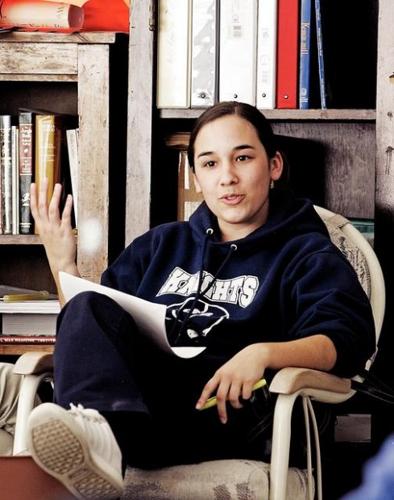
"Over the past few years we've absorbed things in Academic Decathlon that can't possibly be taught in the classroom," Immaculate Heart senior Patricia McCoy said.
To be competitive, schools offer Academic Decathlon as a course, but students begin preparing for the intellectual contest well before regional and state competition.
Immaculate Heart students met once a week during the summer.
Each year, a different theme is selected — this year it is the Civil War — and students must verse themselves in that period's art, economics, essay, interview, language and literature, mathematics, music, science, social science and speech.
"The knowledge is equivalent to a freshman-level college course," Canyon del Oro coach Chris Yetman said.
Students participate in the team competition for an assortment of reasons, but all will eventually exit high school with an advantage.
"Academic Decathlon is very difficult," Yetman said. "In order to succeed, you have to read. You can't get by on sheer brains alone, and a lot of my graduates tell me if there is one thing they took out of the class, it's that they really learn how to study and focus on succeeding. I think that's really the biggest benefit of all."
Immaculate Heart senior Therese Aroz joined because the Academic Decathlon class at her school has a perk none of the other courses afford: "We're the only class that's allowed to have food."
More seriously, Aroz said, the decathlon has made her a better student.
"It really helps your study skills," she said. "It helps you learn to focus more. You take tests so many times that taking regular tests seems like nothing."
Did you know ...
• Academic Decathlon consists of a nine-member team, or three "A" students, three "B" students and three "C" students, competing in 10 events.
• Students are tested in seven areas — economics, art, language and literature, math, music, social science and the Super Quiz.
• Students also are required to give prepared and impromptu speeches, an oral interview and write an essay.
By the numbers
9
team members
10
events
7
subject area tests
3
communication style events
30
minutes competitors are allowed to complete each subject test


