

Tom Ford didn't flinch as he watched smoke billow from his Northwest Side home Tuesday morning.
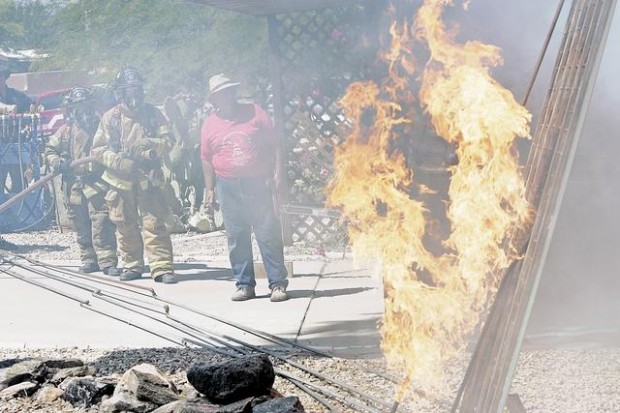
His house, which is vacant, wasn't on fire, but blinding smoke did fill it as part of a Northwest Fire/Rescue District drill.
Ford, a licensed pyrotechnician, loaned his home, which is on the market for about $169,000, to Northwest Fire so the district could stage a fire drill and demonstrate the importance of practicing fire drills at home.
"The lesson for today is that when there is smoke and fire, do you really know what to do?" Northwest Fire Capt. Adam Goldberg said.
Goldberg said firefighters can't teach a family not to be scared and panicked should a fire break out in their home, but what they can do is provide them with information and encourage them to practice fire drills so they have a better understanding of what they need to do in an emergency.
People are also reading…
Families need to prepare an escape plan highlighting all of the home's exits, such as windows and doors, and practice that plan, Goldberg said.
Ford pumped smoke into his home, 2928 W. Lena Way, and produced real flames — outside one of the house's windows — to simulate a real house fire.
His company, Double F Productions, produces special effects for movies and television and offers training scenarios for fire and police departments.
Ford did not charge the fire district for his services.
"I specialize in explosions and pyrotechnics. This is nothing," Ford said.
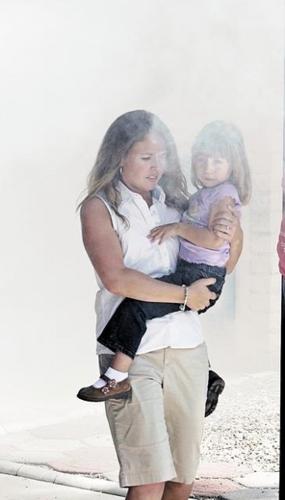
Goldberg's 3-year-old daughter, Jayden, and his neighbor, Alexandra Yarborough, demonstrated how to exit a home during a fire.
"As kids practice (fire drills) at school and knowing what to do if the smoke detectors and fire alarm go off, do they ever get those lessons at home?" Goldberg asked. "Do parents actually practice escape drills and getting out of the house safely if there is a fire?"
Families have to practice escape routes over and over, especially if there are young children in the home, Goldberg said.
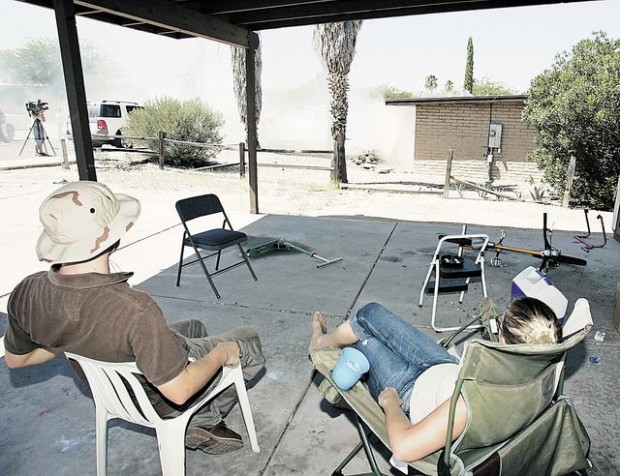
Ford's neighbor, Amanda Baker, and her friend Taylor Lindsey watched the drill from Baker's front yard.
Both have children who have practiced fire drills at home.
"The kids practice them at school and they have to make a fire plan and meeting point for the home," Baker said.
How to make your own escape plan
• Draw a floor plan and if possible, locate two exits for each room — usually the door and a window.
• Pick a meeting point in front of the home where family members will gather after they've gotten out.
• Call the Fire Department from a neighbor's phone or use a nearby phone.
• Practice home fire drills often and make them realistic by blocking escape routes that in a real fire could be blocked by smoke or fire.
• Teach everyone in the home to unlock all windows and doors.
• If windows are equipped with security bars, make sure each has a quick-release bar and teach everyone in the house how to use them.
Escape tips
• Close doors behind you once you escape to slow the spread of fire and smoke.
• Crawl and keep your head 1 to 2 feet above the floor if you have to escape through smoke.
• Touch doorknobs and spaces around doors with the the back of your hand; if they're warm, try another route. If it's cool, open the door slowly but shut it if smoke pours into the room.
Source: National Fire Protection Association


