

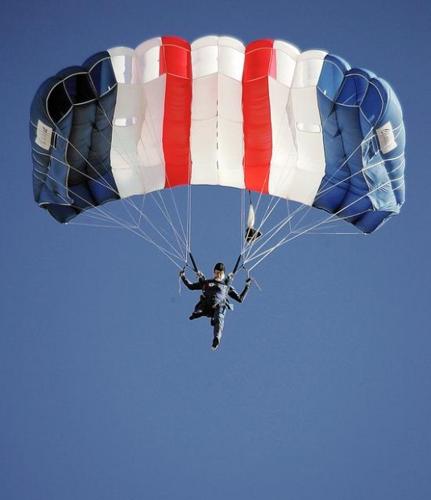
Yee haw! Whom do you trust when you step out of the door of a perfectly good airplane, 2 miles up, for the first time?
Sky divers — from beginners celebrating a birthday to top-level foreign national teams training for international competition — come to the Marana Skydiving Center at Marana Regional Airport, 11700 West Avra Valley Road.
The Czech Military Sport Parachute Team just wrapped up training there and the U.S. national team started its sessions last week.
It's the most visible part of the sky-diving center's operation, one of the municipal airport's businesses.
Inside the big steel building, the atmosphere is cool and confident. The walls are covered with pictures and cartoons of sky divers — big grins, thumbs up — falling through the air.
Professionalism is the key
People are also reading…
There's nothing slick about this place. It could be the 1970s, except for the modern square "ram air" parachutes instead of those old round umbrella-style chutes we know from World War II movie invasion scenes.
Owners Tony Frost and Greg Behrens and the half-dozen sky-diving instructors, pilots and certified parachute fabrication and repair specialists who work at the Skydiving Center mingle with the often slightly giddy newcomers training for their first jump, along with the veterans of thousands of jumps and professionals.
Laid-back is the theme. It's no wonder. Collectively, the staffers have been jumping out of airplanes for more than a century.
Certification is ample
Frost and Behrens are not only sky-diving veterans, but they have the Federal Aviation Administration certifications to train people who pack and repair parachutes.
Parachutes have to be inspected regularly, and rips and faults in the harnesses, lines, canopies and bags repaired.
There's a lot of stress on that thin ripstop nylon and those thin lines when they slow a sky diver falling at "terminal velocity," roughly 120 mph, "down to 10 to 15 miles per hour vertical speed in anywhere from a half second to three or four seconds," says Behrens.
And that's just the beginning of what they do here.
Pros pack the chutes used by new sky divers on their first or first few jumps, Behrens says. Then they learn to do it themselves.
Painstaking repacking
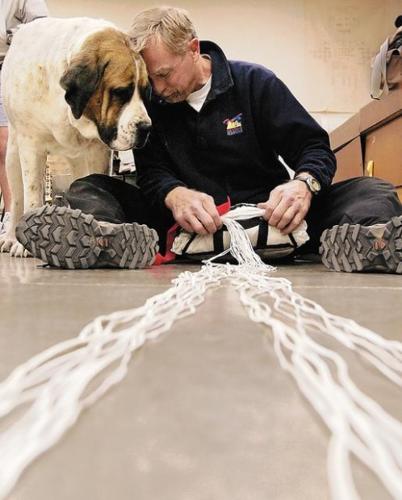
The euphoria that follows a jump and good landing fades as you watch an experienced sky diver repack a chute. It's easy to understand why. It's not the kind of thing to be done casually.
It looks something like trying to pack a four-bedroom tent into a sandwich bag.
The chute is stretched out on the floor, its lines untangled and straightened, and the canopy is folded, flag-style, then compressed under the weight of the packer and stuffed into the sturdy nylon bag it came in — and will hopefully come out of — next time.
"You can be sloppy — it's just so it fits in the bag. As long as it's straight," says Behrens.
But reserve — also known as backup or emergency parachutes — are always packed by certified riggers, Frost says. No explanation needed on that one.
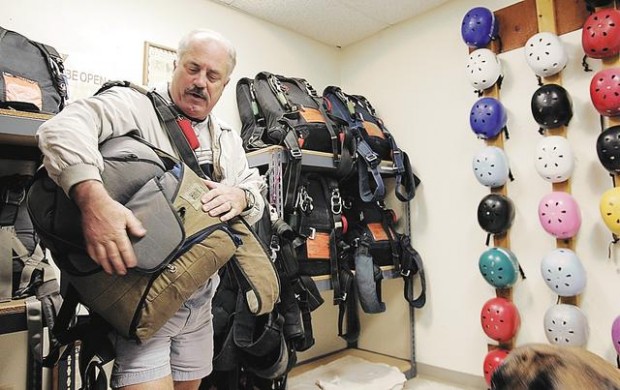
Besides the long, narrow front room, where sky divers gather before jumps — and afterward to repack their chutes and hang out — there is a classroom for those training for their first jumps, and a room where sport jumpers get to watch the videos of their jumps and some workshops.
And there's the hangar part of the building, where the center's old bare metal Cessna 182 jump planes get serviced.
Some exotic parachutes
But it's in the workshops where some of the center's most interesting work happens.
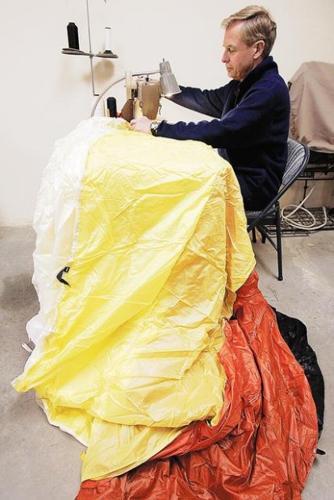
Frost holds some special licenses that allow him to manufacture special parachutes. Some of it he can't talk about. But among the interesting chutes they've built are those for recovering unmanned aerial vehicles, UAVs, the aircraft seeing action in Afghanistan and Iraq.
They've also built chutes for extraction systems used during test flights of new planes, chutes for munitions delivery systems and rocket recovery, drogue chutes to decelerate airplanes and dragsters, and even sea anchors — parachute-like devices that keep a ship from drifting in deep water.
Parachute testing a specialty
They not only build special parachutes, but they test parachutes for large-scale manufacturers.
They can also make special harnesses that Frost says will withstand the kinds of forces experienced upon ejection from jet aircraft.
"We're pretty much willing to take on anything that's interesting," says Frost.
"Rather than be a (large) manufacturer, we prefer to be a design and prototype" company.
None of this comes easy, says Frost. Like the rest of the aviation industry, accountability is crucial. Nobody wants to get blamed for not doing everything imaginable to avoid deaths.
Not surprisingly, then, the FAA doesn't let just anybody build or repair parachutes.
Frost says one of the hottest areas in the business is unmanned parachutes that steer loads of munitions to the exact location of ground troops by using Global Positioning Systems and radio. Frost says they did some testing on those systems.
The idea is to get the equipment or weapons directly to the troops who need them, without making them come to the load, and without endangering the crews that drop the package.


